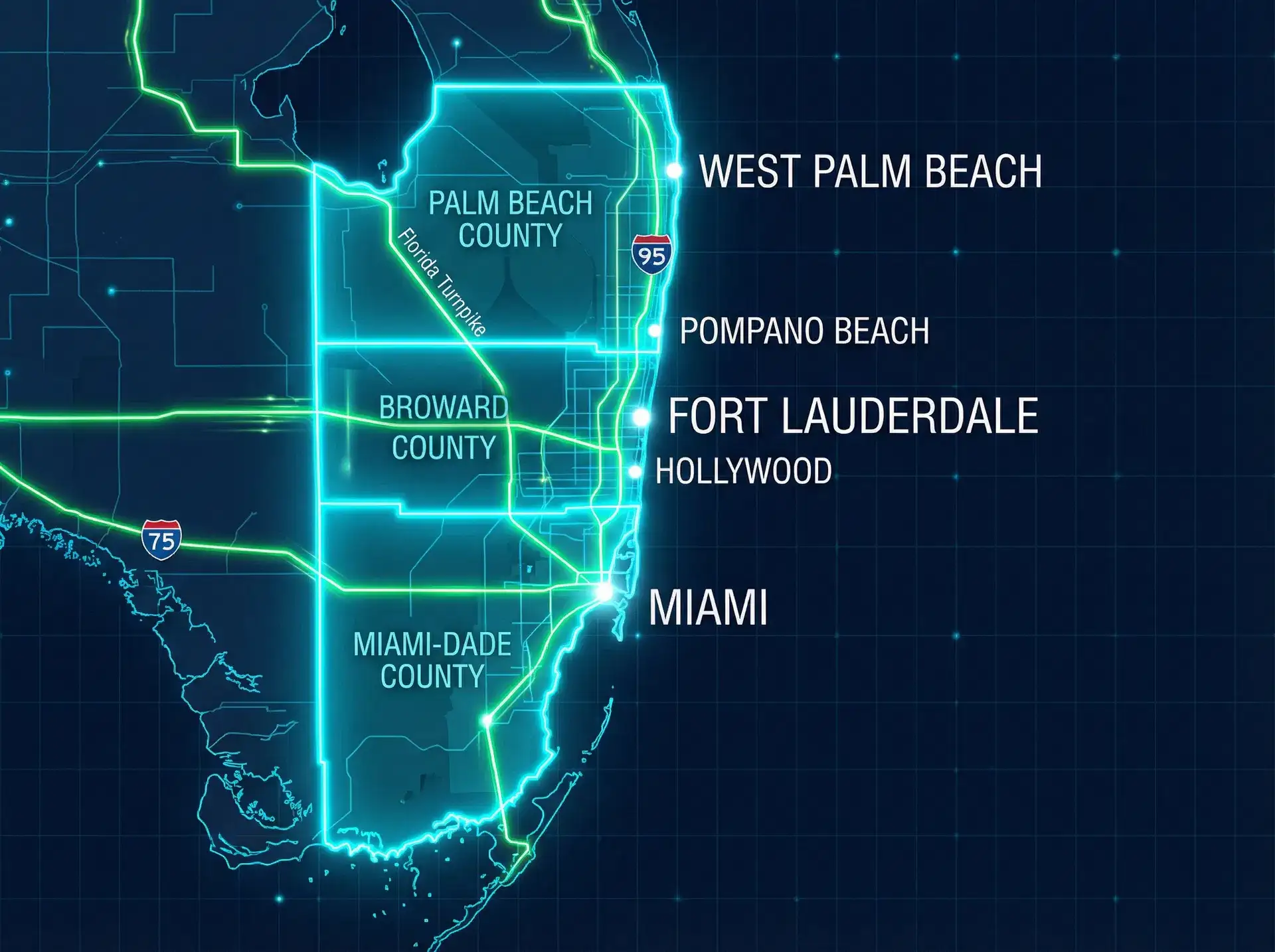
Public charging in Broward clusters along the coast and the central malls, then thins dramatically toward the Everglades line. If you live or work in the county's western half, the gaps shape your whole EV life. This is the honest map, in prose.
Lay Broward's public charging over a map and the pattern is blunt: stations crowd the coastal cities and the central retail spine, then fade block by block as you drive west, until the Everglades levee ends the conversation entirely. Rapid Charge EV dispatches into that western fade every day, which gives us an unusually honest view of where the county's charging actually runs out. Here is the map in prose.
Where the gaps actually are
The line that matters is University Drive. East of it, Fort Lauderdale, Hollywood, Pompano Beach, Oakland Park, Wilton Manors, Dania Beach, public charging is findable if not always available. West of it, the thinning starts immediately and compounds with every mile.
The far southwest: Weston, Southwest Ranches, western Pembroke Pines, and western Miramar. Large homes, long distances, and public charging that effectively ends at the I-75 retail nodes. The Ranches in particular, acreage and equestrian properties, are as close to a true desert as urbanized Broward gets.
The Sawgrass fringe: the arc of communities against the toll road, Parkland's western edge, north Coral Springs, Tamarac's reaches, where the expressway is minutes away but a dependable charger is not.
The US-27 line: the county's western boundary road, serving the Everglades recreation traffic and the long way to Alligator Alley, with functionally zero charging end to end.
The in-between pockets east of the line: North Lauderdale, Lauderdale Lakes, and stretches of Lauderhill and Margate, dense, residential, and skipped by the retail-anchored buildout that served their richer neighbors.
Why these gaps exist
Charging stations are retail tenants, and they follow retail logic: traffic counts, dwell time, and host properties willing to give up parking spaces. Broward's western half is residential by design, planned communities, golf developments, acreage, so the host sites are scarce and the buildout went where the malls are. Add the apartment-and-HOA layer (renters and association residents who cannot install at home even when they want to) and the western gap becomes a daily-life problem rather than a map curiosity.
None of this is conspiracy; it is siting economics. But the result is a county where your zip code decides whether EV ownership is trivial or a logistics hobby.
How western Broward drivers actually manage
The coping patterns are consistent. Home charging carries the households that can install it, though the older panels in parts of the west make that a project. Errand-pairing carries the rest partway: charging at the central retail nodes while shopping, the Sawgrass Mills area, the University Drive corridors, and accepting the queue. The commute-charge pattern tops up near coastal workplaces and rides the margin home. And an increasing share simply orders the charge in: delivered charging at the driveway, scheduled weekly, which removes the geography from the problem entirely.
If you are managing a gap-zone EV right now and the juggling has gotten old, that last pattern is one phone call to set up: (954) 278-4454, and the dispatcher will map a cadence to your actual week.
Where mobile charging fits the map
Delivered charging inverts the desert logic: the less public infrastructure your area has, the more the service matters. That is why our densest scheduled routes run through exactly the zones this post names, Weston, the Ranches, Parkland, western Pembroke Pines, and why emergency dispatch out west, though honestly quoted with the extra miles, is often still faster than the drive to a working public plug. The full county operating picture is in our Broward mobile charging guide.
Zone by zone: the western Broward playbook
Weston and the far southwest: this zone's saving grace is its garages. Nearly every home can host charging or receive it, so the play is simple, solve the driveway and the desert disappears. The trap is the commute assumption: I-595's evening crawl plus summer A/C regularly turns a comfortable 50% departure into an anxious arrival, so the household battery floor matters more than the map does.
Southwest Ranches and the Davie horse country: acreage, trailers, well water, and zero public anything. Treat the property as the station, wall box where the panel allows, delivered charging where it does not, and apply the same logic to guests, because visitors arrive at 30% expecting suburbia and find paddocks.
The Sawgrass fringe, Parkland's west, Coral Springs' edges, north Tamarac: closer to retail than the Ranches but funneled by the toll road. The play is knowing your two reliable central nodes cold, and never boarding the expressway loop at night under 40%. The fringe's distances are short until the plazas lock; then they are real.
The in-between pockets, North Lauderdale, Lauderdale Lakes, Margate's interior: denser, more renters, fewer driveways, and the same thin public map. Workplace charging is the lever where it exists; where it does not, a scheduled delivery to an apartment lot or a standing arrangement with Rapid Charge EV at (954) 278-4454 turns the pocket's gap into someone else's logistics. The zone least served by the buildout is, not coincidentally, the zone our routes pass through most.
Will Broward's map fill in?
Directionally, the eastern and central gaps should narrow: new mixed-use construction along the coastal corridor increasingly includes charging, and the retail nodes keep adding stalls. The west is a different forecast. The land use that created the gaps, residential planning, acreage zoning, communities that host nothing commercial, is not changing, which means the western desert is structural rather than temporary. Households there should plan on solving their own charging for the foreseeable future, not waiting out the buildout.
The honest planning posture for the county: treat public charging as an eastern amenity and home-base charging, installed or delivered, as the western requirement. The drivers who internalize that split stop experiencing Broward's map as a problem at all; it becomes one known fact among the commute's many, planned around like the I-595 merge.
One last observation from the dispatch side: the gap zones produce two kinds of customers, the ones who learned the map from this kind of post and the ones who learned it on a shoulder. Both end up with the same setup eventually, a solved home base, a saved number, and a healthy western floor. The only difference is what the lesson cost, and western Broward charges generous tuition to optimists after dark. If this post is your version of the lesson, consider the tuition waived; the setup itself takes one evening and a phone call, and the county's geography never bothers you again.
Planning advice for gap-zone residents
Treat 30% as your western floor. The buffer that feels paranoid in Fort Lauderdale is rational in Southwest Ranches.
Know your two reliable nodes, the central retail clusters you actually pass, and their peak-hour patterns.
Solve home base first: wall box if your panel allows, scheduled delivery if it does not. The commute math in our range anxiety guide assumes a solved home base.
Never board the Sawgrass or US-27 under 40% at night. The infrastructure argument in our urban mobility post explains why help is not coming soon.
If you live or work in Broward's charging gaps and want the geography taken out of your EV life, call Rapid Charge EV at (954) 278-4454 or email support@myrapidchargeev.com. We dispatch across Broward, Miami-Dade, and Palm Beach 24/7.
Frequently Asked Questions
Why is western Broward so much thinner on charging than the coast?
Station economics follow commercial density. Operators site chargers at retail anchors with dwell time, and Broward's big retail gravity sits central and east. The western residential expanses, low-rise, residential, spread out, offer fewer host sites, so the buildout skipped them.
I'm in Southwest Ranches. What's my realistic charging plan?
Home charging if your panel supports it, delivered charging if it does not or until the install lands. The Ranches' acreage lots and horse properties are textbook scheduled-service territory: the public network is not coming to rescue you out there, and the driveway solves it.
Is the Sawgrass corridor really a desert? There's so much retail at Sawgrass Mills.
The mall node itself has options; the desert is the loop around it. The Sawgrass Expressway's long arc from Deerfield Beach to Sunrise has thin ramp-adjacent charging, and the communities tucked against it, Parkland's west side, Coral Springs' fringe, Tamarac's north, sit minutes from the toll road but miles from a reliable plug.
Does mobile charging actually cover these gap zones?
Fully. The west is core dispatch territory precisely because it is underserved publicly: Weston, Southwest Ranches, Parkland, western Pembroke Pines and Miramar all get routine deliveries, scheduled and emergency alike.
Chargers cluster at the Town Center and the urban core while entire Jacksonville quadrants run nearly empty. Here is the honest desert map, and the playbook for driving through it anyway. Call (954) 278-4454.
Miami-Dade has Supercharger queues downtown and forty empty miles to the south. The county's charging deserts are real, specific, and survivable with the right plan. Call (954) 278-4454.
The nation's oldest city was not planned around charging pedestals. Here is who dispatches mobile EV charging from the historic district's garages to Anastasia Island and the I-95 exits. Call (954) 278-4454.