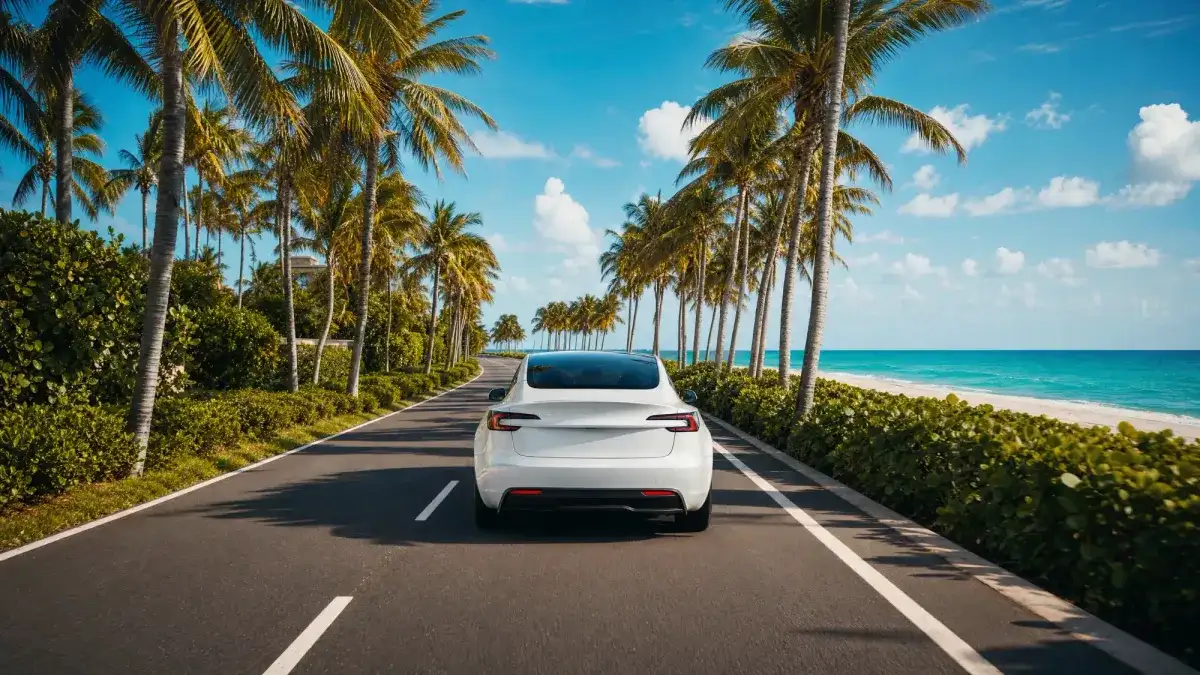
Palm Beach County's charging map is a string of bright coastal nodes with long dim stretches between them, and a western half where the map goes dark entirely. Add the seasonal population swing and the gaps get teeth. The honest explanation.
Palm Beach County charges beautifully in about five places and barely anywhere else. The nodes, Boca's retail clusters, Delray's downtown, the Gardens' mall corridor, downtown West Palm, glow on every station map; the spaces between them, and everything west of the Turnpike, sit dim or dark. Rapid Charge EV's routes cross those dim stretches daily, and this is the honest accounting of where the county's charging actually runs out.
The gaps, named
The western communities: Wellington beyond its mall fringe, Royal Palm Beach, Loxahatchee, and the acreage. Estate lots, equestrian land, gated developments, and essentially no public charging anywhere among them. The county's deepest and most populated desert.
The in-between corridor: Lake Worth Beach, Greenacres, Palm Springs, and Riviera Beach, the working coastal cities the buildout skipped while serving their famous neighbors on either side.
North past PGA: the thinning run up to Jupiter and beyond, where exits grow dark and the next reliable node stops being assumed.
The island: Palm Beach proper, where public charging barely exists by design and everything real happens behind hedges, in estate garages and club lots.
The A1A stretches: the barrier miles between the coastal downtowns, lovely, dark, and chargerless at night.
Why the county's map looks like this
The buildout followed retail gravity and affluence-adjacent traffic, which in this county means the same five nodes every time, repeatedly. The west never qualified: low density by design, private communities that do not host public anything, and land use, equestrian, agricultural, estate, that offers no station sites at all. The in-between cities lost a quieter version of the same lottery: dense enough to need charging, not anchored enough to attract it.
Then the season multiplies the arithmetic. The same fixed nodes that serve August's population absorb February's doubled demand, so even the bright spots dim in season, queues at the Gardens, waits in Boca, and the gap-zone residents who commuted to those nodes to charge find the commute newly pointless.
How gap-zone residents actually manage
The west solves it at the property or not at all: estate and acreage households install where panels and garages allow, and increasingly order the charge in, standing delivered service that treats the absent infrastructure as someone else's problem. The in-between corridor mixes workplace charging, node trips paired with errands, and a rising scheduled-delivery share among its renters and HOA residents. Island households run on home infrastructure and staff-managed logistics, as they do for everything. And the seasonal arrivals, the gap zones' most exposed class, either learn the county's map in their first stranded week or read the snowbird guide and skip the lesson.
Skipping the lesson is one call: (954) 278-4454 sets a standing arrangement matched to your address and season before the gap ever bites.
Where mobile charging fits this map
Delivered charging is how the county's dark half runs EVs at all. Our densest Palm Beach scheduled routes are the western ones, Wellington, Royal Palm Beach, the acreage, precisely because no alternative exists; the island arrangements run property-level for the same reason; and the in-between corridor anchors a growing share of weekly driveway stops. Emergency dispatch covers the same map with honest western ETAs, which is the standing argument for scheduling ahead of needing. The full county operating picture lives in our Palm Beach mobile charging guide.
Zone by zone: the Palm Beach gap playbook
The western communities, Wellington to the acreage: property-first, full stop. Install where the garage and panel allow; schedule delivery where they do not or where the household fleet outgrows one wall box. The winter multiplier is the planning trap, the same roads carry triple the EVs from December through March, so the floor that felt cautious in October is correct in February.
The in-between corridor, Lake Worth Beach, Greenacres, Palm Springs, Riviera Beach: the zone of renters, older plazas, and skipped buildout. Workplace charging is the first lever; the second is converting the node trips you already make (the Wellington mall run, the downtown West Palm errand) into charging stops; the third, increasingly the default for apartment and HOA residents, is the standing weekly delivery that makes the corridor's thinness irrelevant, one arrangement with Rapid Charge EV at (954) 278-4454 and the map stops mattering.
North past PGA toward Jupiter: corridor living with corridor rules, full battery for the dark stretch, known fallbacks at the Gardens nodes, and no nighttime improvisation north of Donald Ross. The zone rewards the planner and punishes the optimist with a long quiet shoulder wait that always costs more than the five-minute top-up would have.
The island and the A1A stretches: home infrastructure plus delivered service is simply how the island runs, and the barrier miles between downtowns stay dark by design. The estate household's version of the playbook is staff-mediated and gate-protocols deep; the visitor's version is shorter: arrive charged, leave charged, and never trust the strip at midnight.
Will Palm Beach's gaps close?
Selectively. The coastal nodes will keep thickening, new retail and mixed-use along the spine reliably adds stalls, and the in-between corridor should eventually benefit from spillover as Lake Worth Beach and Riviera Beach redevelop. The west will not follow: gated and equestrian land use hosts no public infrastructure by definition, and the island's privacy-first architecture is a choice, not a lag. Season will keep stressing whatever exists, because the population swing is the county's identity, not a phase, and no buildout sized for the average month survives contact with the peak ones.
The planning posture that survives all of it: nodes for errands, home base for life, and a healthy skepticism about February. Households that solve their own charging, installed where the property allows, delivered where it does not, experience the county's famous gaps as scenery. The ones that lean on the public map in season experience them as Tuesdays gone wrong.
From the dispatch side, the county's gap calls have a calendar as much as a map: the same western addresses, the same in-between cities, the same northern dark, but concentrated almost entirely between Thanksgiving and Easter. That seasonality is the planner's gift, because it means the gaps announce themselves months in advance. The household that sets its arrangements in October, charging, gate protocols, the saved number, spends the season reading about strandings instead of starring in them, and the October setup costs an hour against a season of never thinking about any of this again.
Planning advice for the gaps
West of the Turnpike, treat 35% as your floor and your property as your station: install or schedule, but solve it at home.
In-between corridor: claim workplace charging where it exists and put the rest on a delivery cadence rather than node-hopping.
Season-proof by October: whatever worked in August will queue by January. The commute-level math lives in our range anxiety guide.
Island and A1A: home-base charging plus a saved dispatch number; the infrastructure realities in our urban mobility post explain why the public map will be slow to change.
If your Palm Beach address sits in the gaps, west, in-between, island, or north, and you want it solved for good, call Rapid Charge EV at (954) 278-4454 or email support@myrapidchargeev.com. We dispatch across Broward, Miami-Dade, and Palm Beach 24/7.
Frequently Asked Questions
Which Palm Beach communities sit in the worst gaps?
West: Wellington's residential expanse, Royal Palm Beach, Loxahatchee, and the acreage, where public charging is functionally absent. The in-between corridor: Lake Worth Beach, Greenacres, Palm Springs, and Riviera Beach, dense, lived-in, and skipped by a buildout that jumped from Boca's nodes to West Palm's. North: the thinning past PGA Boulevard toward Jupiter's edges.
Why do the gaps get worse in season?
The infrastructure is fixed; the population is not. October through April roughly doubles the EV count drawing on the same coastal nodes, so stations that work in August queue in February. The gap zones feel it hardest because their residents were already commuting to the nodes to charge.
Is the island itself a charging desert?
Functionally, for public access, yes: Palm Beach proper offers little public charging, and what exists skews private, club, estate, or staff-managed. Island EV life runs on home infrastructure and delivered charging, not on public plugs.
Does mobile charging really reach the western communities?
Fully, and they anchor our Palm Beach scheduled routes precisely because the public map fails them. Wellington, Royal Palm Beach, and the acreage get standing weekly service; emergency dispatch reaches too, with the western surface miles quoted honestly.
Palm Beach County runs on seasons, gates, and distance. Its mobile charging playbook is unlike the southern counties: standing seasonal service, estate logistics, and a 45-mile coastal spine. Call (954) 278-4454.
Broward's public charging follows the money east. West of University Drive the map empties fast, and whole communities run EVs on planning alone. The honest gap map. Call (954) 278-4454.
Sunrise hosts two of the biggest EV-traffic magnets in the county, and both saturate their chargers on schedule. Here is who dispatches mobile charging to the mall rows, the arena lots, and everywhere between. Call (954) 278-4454.