Out of Charge: What to Do When Your EV Battery Hits Zero
This guide is for the moment, not the planning. If you're reading this on the shoulder of I-95 or in a parking lot watching the dashboard count down, the steps below are the right ones in the right order.
Your EV is at zero, or seconds away. Maybe you're parked. Maybe you just rolled to a stop on the side of I-95. Either way, the steps below are the right ones in the right order. Read fast. Rapid Charge EV will get you moving.
First 90 seconds, safety
Before anything else: get the vehicle out of any active travel lane. Most modern EVs will give you several warnings before truly stopping, a yellow turtle icon, a sharply reduced power mode, then an audible chime. If you're still rolling, coast to the right shoulder, an exit, or a parking lot. Don't stop in a travel lane if you have any momentum to use.
Once stopped: hazard lights on immediately. If you have a roadside triangle or flares in the trunk, place them, 50 to 100 feet behind the vehicle on a divided highway. If you're on the MacArthur Causeway, the Julia Tuttle, the Rickenbacker, or any of the South Florida bridges, this is critical, shoulder space is minimal and traffic doesn't see disabled vehicles fast enough.
Drop a pin in your map app and screenshot it. You'll need to give your location to dispatch and you may not have great cell signal in 30 seconds. Get the location captured now.
Get out of the vehicle if you're in any unsafe roadway position. Move uphill of the vehicle on a shoulder, away from traffic, behind the guardrail if there is one. Do not stand between your vehicle and oncoming traffic for any reason. Do not stand in a travel lane. Do not stand on the median of an interstate.
Whether you can save the last few miles
If you're still rolling and trying to make it to a known charger, this section. If you're already stopped, skip to the next.
What actually works to extend range in the final miles:
Turn off air conditioning, this is the single biggest draw. Crack the windows instead. On a hot Miami afternoon you'll lose comfort, not range.
Reduce speed to 45-55 mph on a highway if you can safely do so. Aerodynamic drag is the second biggest energy sink. If 55 is unsafe given traffic, exit to a slower road and reroute.
Turn off heated/cooled seats, defroster, and any auxiliary load you can reach. Headlights if it's daytime.
Use the navigation system's range-aware routing if your vehicle has one. Tesla in particular will reroute to the nearest Supercharger automatically when you're below threshold.
Stop accelerating sharply. Coast where possible. Regenerative braking returns some energy on deceleration.
What does not work, common EV mythology:
Switching into 'eco mode' alone won't save you if you keep driving at 75 mph. The mode reduces power output but you have to drive accordingly.
Drafting behind a truck. Marginal at best, and at the speeds and distances required it's dangerous. Don't.
Putting the car in neutral and coasting downhill. Regenerative braking is more efficient than free-wheeling. Don't try to outsmart the powertrain.
And the most important thing: if you're below 5% and more than 10 miles from a station, stop trying to make it. Pull over while you have control of where you stop. The cost of stopping early in a safe location is far lower than the cost of stopping in a travel lane on a bridge.
Who to call and what to tell them
Three options once you're stopped: mobile charging, tow, or a friend with a long cable (which almost never actually works, see the FAQ on EV-to-EV charging).
If you just need energy and the vehicle is otherwise functional, have a charge brought to you. In South Florida that's Rapid Charge EV at (954) 278-4454. Tell us four things, in this order:
Your location, cross-streets or a dropped pin if you're on a highway.
Your vehicle, year, make, and model.
Your state of charge, the dashboard number, or 'fully shut down' if it's past displaying.
Where you're trying to get to, home, the nearest Supercharger, a hotel.
If the vehicle has a fault beyond charge state, a battery management warning that doesn't go away, a 12-volt-system warning, a charge port that won't unlock, a 'service required' that predates the charge issue, call for a tow. Mobile charging can confirm the fault but can't repair it. We coordinate with shops if the situation is mixed.
If you're in a position where the vehicle is at safety risk, a narrow bridge shoulder, a flooded area, the median of an interstate, your first call is 911 for a safety escort or a tow to a safe lot. Mobile charging can come to the safe lot once you're there.
What not to do
A short list of things that seem like they should work but don't:
Don't try to push the car. EV battery packs are heavy and most EVs can't be moved without putting the drive system into a specific neutral-tow mode that may not be accessible from a fully dead vehicle. You'll hurt yourself or the vehicle.
Don't try to 'jump' it from another EV or an ICE car. EVs don't accept conventional jump-starts for the main battery. (You can sometimes jump the 12-volt accessory battery, but that's a different problem from being out of charge.)
Don't run any kind of portable generator or inverter directly into the charge port. This is dangerous, can damage the vehicle's charging system, and won't deliver meaningful range even if it doesn't fail outright.
Don't leave the vehicle and walk to a station. In Florida heat, on an interstate, this is unsafe in ways that aren't obvious until they go wrong. Stay with the vehicle until help arrives.
Don't try to outsmart the dashboard reserve. If the car says zero, stop. The hidden buffer is for getting safely off the road, not for squeezing more miles.
How long you'll wait
Realistic response times in South Florida depend on your location and the time of day. The honest framing: faster than a tow in most cases, slower than driving to a Supercharger if you could have made it (which you couldn't, or you wouldn't be calling). A typical on-demand response runs under 90 minutes from call to driving away, but specific times vary. We give you the actual ETA on the call.
If you're on a bridge or causeway where shoulder space is dangerous, the priority shifts to getting you off the bridge first. Our MacArthur Causeway emergency guide covers that specific scenario in detail.
What happens when help arrives
The truck arrives. The technician confirms your vehicle and connector. Plugs in. The dashboard usually wakes back up within a few seconds, most EVs come back online from a fully shut-down state when external power is connected, though some models require a 12-volt reset first.
Charging proceeds at commercial Level 2 or Level 3 DC rates, 25 to 120 kW, depending on the call type and what your vehicle accepts. In 30 to 60 minutes you'll typically have 15 to 50 miles of usable range, enough to get to a fixed charging station, drive home, or reach wherever you were going.
The technician stays on-site the entire time, monitors the session, and confirms the vehicle is accepting charge normally. Once the target charge is reached, the equipment disconnects, payment is handled, and you're cleared to drive.
How not to be here next time
The single most effective prevention is treating 20% as your real reserve, not 0%. Below 20%, an EV's behavior gets less predictable, colder weather, hotter weather, heavy traffic, sustained highway speed all eat into the bottom of the range faster than the dashboard math predicts.
Second most effective: actually know where the chargers are along your routine routes. Brickell, Aventura, Doral, Boca, Palm Beach Gardens, the major Tesla Supercharger nodes. The CCS networks at retail anchors. The condo and workplace chargers you might have access to. Our South Florida range anxiety guide walks through the 12 most common commute scenarios in the metro and the charging strategy each one calls for. Read it once and your odds of being on a shoulder hit zero stay low.
If you're going somewhere your routine doesn't cover, F1 weekend, a cruise pickup at PortMiami, a Keys drive, an event at Hard Rock Stadium, build the charging into the plan before you leave. Most stranding events are the predictable consequence of a trip that wasn't planned around battery state.
Bottom line
If you're reading this from home, not stranded: take the prevention section seriously, especially the 20% reserve rule. The drivers who never need to make this call are the ones who treat their EV's bottom 20% as the real fuel light, not the dashboard zero.
If you're at zero right now, call Rapid Charge EV at (954) 278-4454 or email support@myrapidchargeev.com. We dispatch across Broward, Miami-Dade, and Palm Beach 24/7.
Frequently Asked Questions
My EV says zero miles of range, is it actually dead?
Usually not yet. Most EVs reserve a hidden buffer below zero (3-15 miles depending on the model) for exactly this scenario. The dashboard reaches zero before the battery is truly empty. That said, you should treat zero as 'pull over now,' not 'see how much further I can get', you do not want to find out where the actual limit is.
Can I push my EV to a charging station?
No. EV battery packs are heavy (a Model 3 is around 4,000 lbs, a Rivian or Lightning closer to 6,000) and most modern EVs cannot be safely pushed in either direction without putting the drive system into a neutral-tow mode that's not always accessible from a dead vehicle. Don't attempt it. Call for charging or a flatbed tow.
Can I get a 'jump' from another EV?
No. EV-to-EV charging, sometimes called bidirectional charging or V2V, exists on a few specific models with specific equipment, but it is not standard and not something a stranger with another EV can do for you on the roadside. A handful of V2L-equipped EVs can technically trickle-charge another vehicle with the right portable equipment, but the rate is far too slow to be a practical roadside fix. Don't waste time trying.
What does a mobile charging visit actually deliver in this scenario?
Enough usable range to reach a fixed charging station or get home, typically 15 to 50 miles, delivered over 15 to 45 minutes on-site. Mobile chargers don't fast-charge like Superchargers; they're sized for bridge events. You'll be moving again in under an hour after the truck arrives.
Your battery is at 15% and dropping. You have maybe 15 minutes of decision time before things get tight. Here is what to check, in order, while you still can. Call (954) 278-4454.
Most Tesla drivers have never called for roadside charging, so the unknown adds to the stress. Here is the whole sequence, from the first question a dispatcher asks to the moment you pull back into traffic. Call (954) 278-4454.
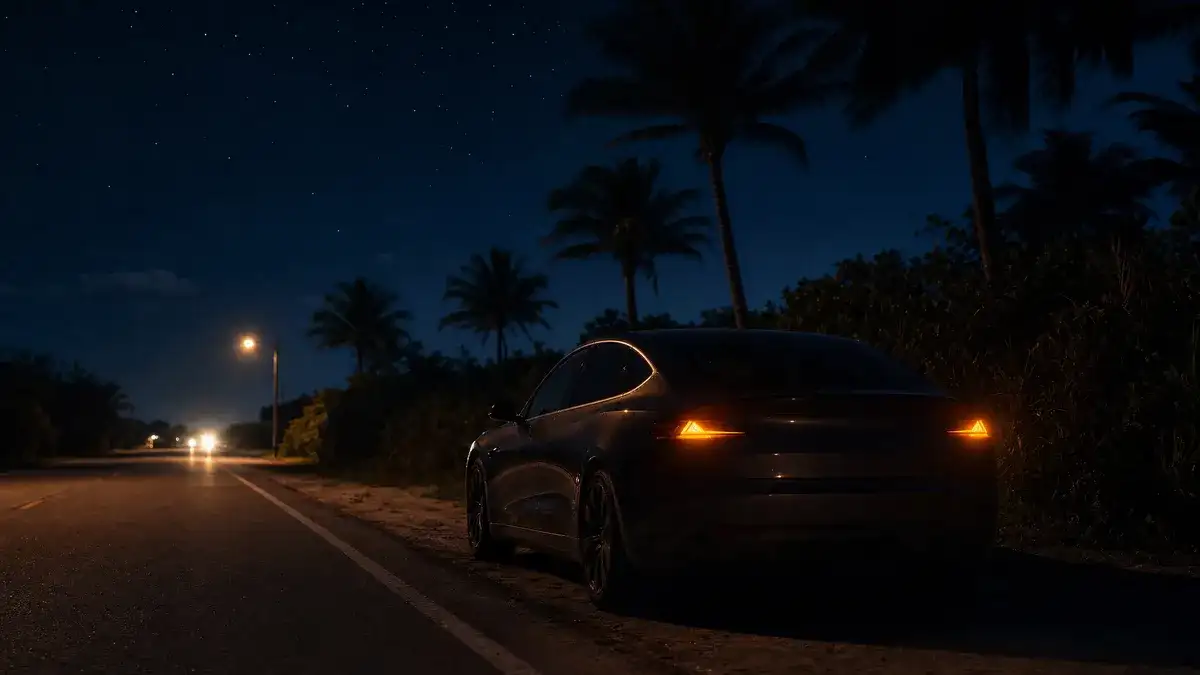
Getting stuck with a dead EV battery is never fun. When it happens at night, in a heavy Florida rainstorm, or on a lonely road near the Everglades, it can feel scary and dangerous very quickly. Call (954) 278-4454.