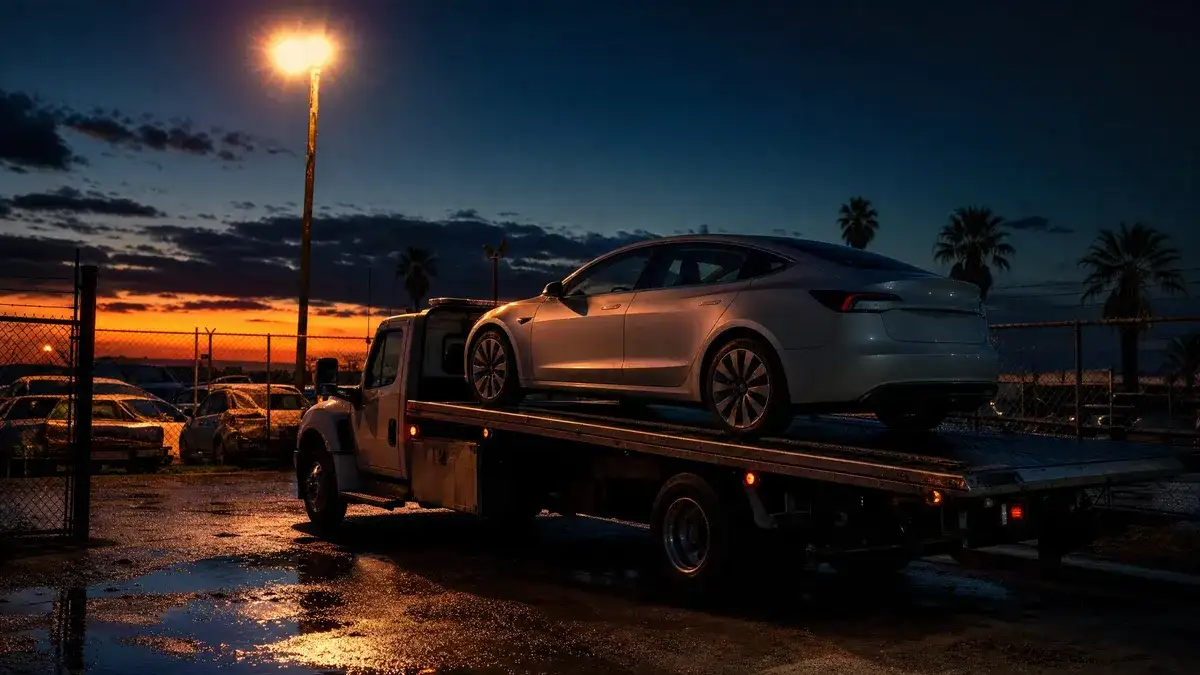
This is an edge-case scenario that most EV owners never think about until it happens to them. EV got towed. It is at a yard. It is dead, or close to it. What now? Practical guide based on what works in South Florida.
Your EV got towed. Maybe a parking ticket escalated, maybe there was an accident, maybe registration expired and Miami-Dade or Broward enforcement caught it, maybe a repossession. The vehicle has been at the yard for days or weeks. Vampire drain has done its work. Now you need to retrieve the car and the battery is dead. This guide, drawn from Rapid Charge EV's yard-release dispatches across all three counties, walks through the options.
How EVs end up dead at tow yards
Three patterns we see.
First, the slow-drain case. The vehicle was towed in a normal state of charge, maybe 40 to 60 percent. Then it sat at the yard for days or weeks. Modern EVs have vampire drain, energy consumed by the vehicle's onboard systems even when parked, that ranges from negligible to a few percent per day depending on the model and the settings. Two weeks at the yard with default settings can take a vehicle from 50 percent to single digits or zero.
Second, the already-low case. The vehicle was towed when it was already at low charge, sometimes because the low charge contributed to the situation (running out on a highway, blocking traffic, getting towed off the scene). It arrives at the yard with little reserve and depletes further as it sits.
Third, the battery-related case. The original problem was the vehicle would not start or move, leading to the tow, and the cause was a depleted main battery or in some cases a depleted 12-volt accessory battery that prevented the main battery from being engaged. The vehicle was effectively dead when it arrived at the yard.
The complications of charging an EV at a tow yard
Tow yards are not designed around EV charging. Several real-world friction points.
Access restrictions: most yards are locked, gated, and limited-access. They are not designed for vendors or service providers to come in and use space and equipment.
No outlets: yards typically do not have accessible electrical outlets where customers or service trucks can plug in. Even Level 1 charging often is not possible.
Yard space and positioning: vehicles are parked tightly. Getting a charging truck or any other service vehicle close enough to the customer's car often requires the yard to reposition the vehicle, which costs time and sometimes money.
Liability concerns: some yards have policies that limit what outside services can do on their property. The yard's insurance considerations are real and they affect what is allowed.
Fee structures: some yards charge daily storage fees that compound while you arrange charging. Time matters.
Your options, in order
Three workable paths.
Option 1: Release the vehicle, then charge
Often the cleanest path. You pay the tow and storage fees, release the vehicle, and then arrange charging once it is out of the yard. The release process usually involves a flatbed (because the EV cannot be driven away) to a location where charging is practical: a public station nearby, a workplace charger, your home if it has charging.
Our mobile charging service fits this path naturally. We can meet the flatbed at its destination, charge the vehicle enough to drive it the rest of the way, and you are operational. This avoids any yard-access questions and lets us work in a more controlled environment.
Option 2: Mobile charging at the yard (if allowed)
Some yards permit outside services to come in and charge a vehicle on premises, especially if the vehicle is going to be driven out under its own power after the charge. This saves the cost of a flatbed but requires the yard's cooperation.
What to ask: does the yard permit outside service vendors on premises? Is there space for a charging truck to access the vehicle? Is there a yard fee for the access? Some yards are accommodating, especially in Broward and Miami-Dade where EV ownership is common enough that they have done this before. Others are not. The answer varies.
When Rapid Charge EV gets a call about a yard situation, (954) 278-4454 reaches dispatch directly, we ask these questions up front so the customer is not surprised at the door. Sometimes the answer is the yard will not allow it and we have to use Option 1 instead.
Option 3: Flatbed transport to a charger
If the yard does not allow on-site mobile charging and you do not want to release the vehicle before charging, the third option is to have it flatbed-transported to a public charger or a service facility where it can be charged. This is the slowest option in most cases, but it is sometimes the only one available.
Worth coordinating: who is doing the flatbed, where it is going, and whether the destination has the right connector and capacity for the vehicle's state of charge. Our guide on mobile EV charging versus towing covers the broader question of when each makes sense.
South Florida tow yard distribution
Yards are spread across the tri-county area, more concentrated in some places than others. Knowing which part of the metro your vehicle ended up in changes both the dispatch math and what the yard is likely to allow.
Miami-Dade: heavy concentration of yards in Hialeah, Medley, Doral, and parts of Opa-Locka. The volume of police-initiated tows in central Miami and the airport area feeds these locations.
Broward: yards concentrated in Pompano Beach, Oakland Park, and parts of Hollywood. Fort Lauderdale-area accident tows and downtown Fort Lauderdale enforcement feed these.
Palm Beach: yards spread between West Palm Beach, Riviera Beach, and the interior. Lower volume than Miami-Dade or Broward but the same dynamics apply.
When you call us about a yard situation, knowing which yard the vehicle is at and which area it is in changes the dispatch math. We have worked with the major ones and we know what they typically allow.
Prevention: how to not be here
Most yard situations were preventable upstream. Quick list.
Keep registration current and tags renewed. Florida's compliance enforcement is real and EVs are not exempt.
Avoid parking violations that trigger tows. Read the signs in unfamiliar neighborhoods. Wynwood, downtown Miami, South Beach, downtown Fort Lauderdale all enforce aggressively.
If you are involved in an accident and the vehicle has to be towed, work with the responding officer and the tow operator to specify where the vehicle goes if you have any choice in the matter. Some yards are easier to work with than others.
Set your vehicle's app notifications for state-of-charge alerts. If the vehicle drops below a threshold while parked somewhere, you know about it before it becomes a yard problem.
Do not leave an EV parked for more than a few weeks without checking on it. Vampire drain accumulates.
If your EV is sitting dead at a tow yard, call Rapid Charge EV at (954) 278-4454 or email support@myrapidchargeev.com. We dispatch across Broward, Miami-Dade, and Palm Beach 24/7.
Frequently Asked Questions
Will a tow yard let mobile EV charging come to the vehicle?
Depends on the yard. Some Broward and Miami-Dade yards permit outside service vendors on premises if the vehicle is going to be driven out under its own power afterward. Others do not. The yard's insurance and access policies vary. When you call us, we ask about the specific yard so you know what to expect before you go.
What is faster: charging at the yard or releasing the vehicle first?
Releasing first is often cleaner. Pay the fees, get the vehicle out on a flatbed, then have mobile charging meet the flatbed at the drop location. This avoids yard-access questions entirely and lets the work happen in a more controlled environment. Charging at the yard saves a flatbed cost when the yard cooperates, but it adds variables.
How did my EV end up dead at a tow yard?
Usually slow vampire drain. Vehicle was towed in a normal state of charge, then sat at the yard for days or weeks. EVs lose a small percentage of charge per day even when parked, which compounds. Two weeks of yard storage can take a vehicle from 50% to single digits or zero, especially with default app and sentry settings still active.
How do I prevent this from happening again?
Keep registration and tags current. Read parking signs in unfamiliar neighborhoods, especially Wynwood, downtown Miami, South Beach, and downtown Fort Lauderdale where enforcement is active. Set state-of-charge alerts in your vehicle's app so you know if charge drops while parked. Do not leave an EV parked for more than a few weeks without checking on it.
Five percent is not an emergency yet, but it is the last moment you get to choose calmly. Here is the decision tree South Florida Tesla drivers should run before the number becomes a story. Call (954) 278-4454.
In a city of garages, a failed home charger removes the whole charging plan. Here is who dispatches mobile EV charging across Cooper City, from the school pickup line to the Embassy Lakes gate. Call (954) 278-4454.
The standard dead-battery advice was written for some other city. Here are Lauderhill's actual options, from the public stall lottery to the charge that comes to your Inverrary lot. Call (954) 278-4454.