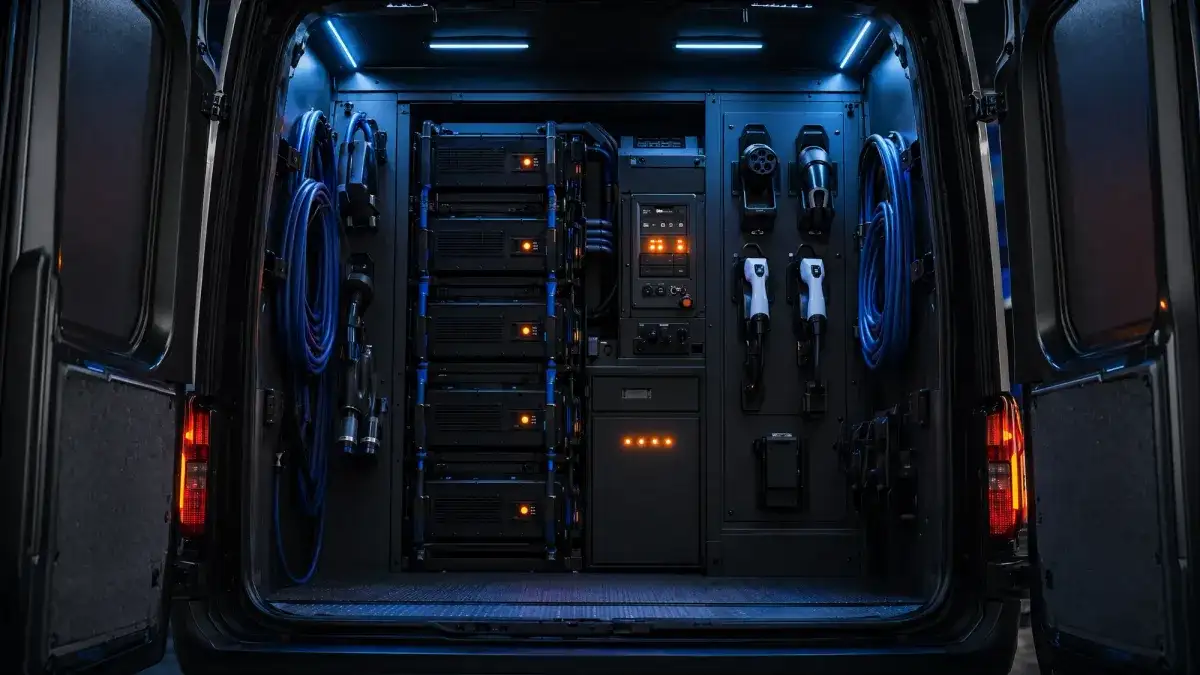
There is a fundamental power-source distinction in EV charging that most owners never think about until a hurricane wipes out the local grid: the difference between grid-tied charging (every fixed station) and off-grid mobile charging (truck-based). This explains the difference and when each one matters.
There is a fundamental power-source distinction in EV charging that most owners never think about until a hurricane wipes out the local grid. Every Tesla Supercharger, every ChargePoint station, every home wall box is grid-tied: it draws power from the utility in real time as you charge. Mobile EV charging trucks are off-grid: they carry their own power on board, usually a combination of battery banks and clean-burning generators. Rapid Charge EV runs the off-grid side of this equation across Broward, Miami-Dade, and Palm Beach; this guide explains the distinction and when each model matters.
What grid-tied charging actually means
Grid-tied is straightforward. The charging station is connected to the utility's electrical service. When you plug in, the station draws current from the grid, converts and conditions it as needed for your vehicle's charge port, and the electrons flow into your battery. The station itself stores no meaningful energy. It is a conduit, not a reservoir.
Every public charging station you have ever used in South Florida is grid-tied. The Brickell Supercharger pulls from FPL. The ChargePoint at Aventura Mall pulls from FPL. Your home wall box, if you have one, pulls from FPL. The infrastructure is shared with everything else in the building: your AC, your lights, your refrigerator. EV charging is just one of the loads on a system designed to handle all of them.
Grid-tied charging is efficient and scalable when the grid is healthy. It is also exactly as available as the grid is.
What off-grid mobile charging means
Mobile EV charging trucks operate differently. The truck carries its own power source on board. The exact configuration varies between operators, but the typical setup is a high-capacity lithium-ion battery pack supplemented by a clean-running generator that can recharge the pack between service calls. The truck delivers power to the vehicle's charge port through onboard charging equipment, the same way a fixed station would, but without any dependency on the local grid at the customer's location.
Off-grid is not a marketing term. It is a technical description of the power architecture. The truck can charge a vehicle in a parking deck where the building is offline. On the side of I-95 with no infrastructure nearby. In a hurricane-affected neighborhood where the utility is days away from restoration. The energy is on the truck. The grid is irrelevant to the actual transaction.
Rapid Charge EV's complete guide to mobile EV charging goes deeper on how the trucks are built and how the service works. The off-grid nature is the underlying design choice that makes the rest of the service possible. Our V2G and V2H guide covers the related but distinct case of using your own EV battery as a power source for your home.
Where grid-tied is the right answer
Grid-tied charging is the default for a reason. When the grid is up and the station is available, it is the most efficient way to move energy into an EV. The vehicle is at the station. The station is at the grid. Energy flows the shortest path.
Three scenarios where grid-tied is clearly the right tool:
Road-trip fast charging: Tesla Superchargers and CCS DC fast chargers deliver power at rates mobile charging is not designed for. If you need to add 200 miles of range in 25 minutes on a Tampa drive, a Supercharger is the right answer.
Routine home charging: if you have a working home wall box and a predictable daily schedule, overnight grid-tied charging is the cleanest option. Mobile is overkill for the routine case.
Workplace and destination charging: parking decks, offices, hotels, and condos with installed chargers are using grid-tied power. Use what is available.
Where off-grid mobile is the right answer
Off-grid mobile is the right answer when grid-tied is unavailable, impractical, or has failed. Specific scenarios where the off-grid architecture genuinely matters:
Hurricane and storm outages: when FPL is restoring service across the metro and your neighborhood is on day three of no power, grid-tied charging is offline by definition. Mobile dispatch from a service area with restored power is the only option.
Stranded with no station in range: you are at 2% on a stretch of A1A or the Florida Turnpike with no public charger you can reach. Mobile brings the energy to you.
Tower and condo gaps: your building has no installed chargers and the public network nearby is queued. Mobile dispatch into the building's parking deck delivers charge using truck power, no building electrical involvement.
Event-day surge: stadium nights and major festivals can overwhelm the nearest public charging network. Mobile dispatch handles vehicles that cannot wait in queue.
Off-hours and remote-area calls: 2 AM in Doral, the Keys on a holiday weekend, the rural interior of Palm Beach County. Mobile goes where stations do not.
The reliability dimension
The deeper distinction between grid-tied and off-grid is reliability under stress. The grid is robust 99.something percent of the time. The other 0.something percent of the time is exactly when an EV stranded without power matters most.
Hurricanes are the obvious case. South Florida loses power to storms every year. Major storms mean a week or more of outages across significant areas of the metro. During those windows, every grid-tied station in the affected zone is offline. Off-grid mobile charging dispatched from a working part of the service area is the only continuity option.
Demand-response events are a subtler case. When the grid is stressed but not down, FPL and other utilities can ask high-load customers to reduce draw. Mobile charging is not part of that program. Off-grid power means the truck operates on its own schedule, not the grid's.
Routine infrastructure failures (transformer outages, single-station equipment failures) are also off-grid mobile's domain. The local outage takes down a specific station. Off-grid mobile is unaffected.
The geographic dimension
South Florida's geography makes off-grid mobile more valuable than it would be in a denser, more compact metro.
The tri-county footprint (Broward, Miami-Dade, and Palm Beach) spans roughly 100 miles north to south. Public charging density varies enormously across that footprint. Brickell, Aventura, Doral, downtown Fort Lauderdale, and Palm Beach Gardens are well-served. Large stretches of interior Broward and Palm Beach County are not. The Keys are a chronic charging desert. Mobile charging fills geographic gaps that fixed infrastructure has not yet closed.
The metro's hurricane exposure compounds the geographic issue. A storm that wipes out grid power in eastern Broward might leave western Palm Beach functional, or vice versa. Off-grid mobile can dispatch from a working area to a non-working one, something grid-tied charging by definition cannot do.
The hybrid reality
Most EV owners in South Florida who think about this distinction long enough end up using both. The pattern looks something like this. Grid-tied charging is the routine workhorse: home wall box for daily use, public DC fast charging for road trips, workplace or destination charging for opportunistic top-ups. Off-grid mobile charging is the safety net and the specific-use-case tool: emergencies, hurricanes, condo gaps, events, the away-from-home scenarios where the routine system breaks down.
Treating them as competing alternatives misses the point. They are complementary infrastructure with different strengths.
Bottom line
Grid-tied charging is the efficient default when the grid is up and stations are available. Off-grid mobile charging is the resilience layer that keeps EVs moving when grid-tied options are not enough. In a hurricane-exposed metro with significant geographic spread and uneven public charging density, the off-grid layer matters more than it would in Boston or Phoenix. South Florida EV owners are well served by having both in their toolbox.
If you have questions about whether mobile dispatch fits a specific situation (scheduled service, emergency standby, fleet uptime, hurricane planning), call Rapid Charge EV at (954) 278-4454 or email support@myrapidchargeev.com. We dispatch across Broward, Miami-Dade, and Palm Beach 24/7.
Frequently Asked Questions
What does grid-tied EV charging mean?
Grid-tied charging is any charging station (public Supercharger, ChargePoint, home wall box, workplace charger) that draws power from the utility grid in real time as you charge. The station itself stores no meaningful energy; it is a conduit between the grid and your battery.
What does off-grid mobile EV charging mean?
Off-grid mobile charging is a truck-based service where the energy comes from the truck itself, usually a combination of onboard lithium-ion battery packs and a clean-running generator. The truck does not depend on the local grid at the customer's location, which is why it can charge a vehicle in a hurricane-affected neighborhood, on a highway shoulder, or in a parking deck.
Is off-grid mobile charging slower than grid-tied?
Mobile charging delivers power at rates comparable to a high-end Level 2 home charger or a moderate DC fast charger, slower than top-tier Tesla V3 or V4 Supercharging. But the comparison assumes the Supercharger is available and not queued. In South Florida peak hours, total time (queue plus charge) often favors mobile dispatch.
Should I rely on grid-tied or off-grid mobile charging in South Florida?
Most owners use both. Grid-tied as the routine workhorse (home wall box, public road-trip charging, workplace top-ups). Off-grid mobile as the resilience layer for emergencies, hurricanes, condo gaps, events, and away-from-home scenarios. They are complementary, not competing.
Vehicle-to-grid charging turns your EV battery into a household power source. In hurricane-prone South Florida, that is a meaningfully different value proposition than it is anywhere else. Call (954) 278-4454.
Charge to 80%, run down to 20%, repeat. The rule is real, the science is real, and it works. The South Florida version has wrinkles generic guides miss. Call (954) 278-4454.
Yes, mobile units deliver real charging on the spot in Broward, and the honest answer about speed has two parts: how fast the charge flows, and how fast the truck reaches you across the county's sprawl. Call (954) 278-4454.