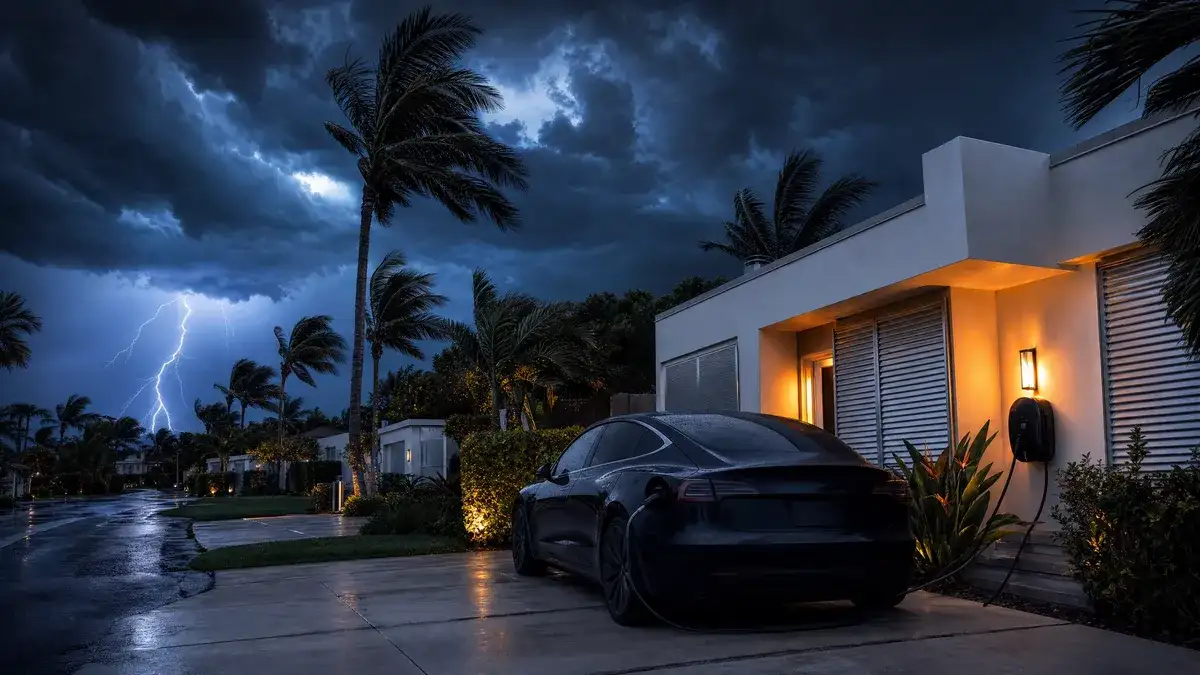
Hurricane season changes the math on EV ownership in South Florida. Power outages can run days; flooding considerations are very different for EVs than for combustion vehicles; saltwater exposure can be catastrophic. This is the full prep playbook, written for South Florida EV owners, not generic.
Florida hurricane season runs June through November. For EV owners in South Florida, the season changes the math on charging, parking, evacuation, and post-storm recovery in ways that don't apply to combustion vehicles. This is the full prep playbook, written specifically for South Florida and informed by Rapid Charge EV's post-storm dispatch experience across all three counties.
Read this before the first warning of the season. Most of the prep happens before a storm is even forecast.
Pre-storm prep, 48 to 72 hours out
When a hurricane warning is posted for your area, the South Florida public charging network goes from "crowded" to "crushed" within hours. Everyone realizes at the same time that they need to top off. Stations along I-95 (the primary evacuation route) and across the Aventura / Doral / Boca clusters fill within 12-24 hours of the first major watch.
If you can top off 48-72 hours before expected landfall, do it. That's when the stations are still operating normally.
Target a full charge if your EV will be staying put. If you're evacuating, full charge plus a clear plan for stops along the route. We discuss evacuation routes in a separate section below.
Three additional pre-storm steps:
Park in a covered location if at all possible, a parking garage, a covered carport, an interior tower deck. Direct flying debris during high winds is a real risk and EV bodywork (especially Tesla aluminum) damages easily.
If you can't park covered, park away from trees, light poles, and signs. The post-storm tow market for vehicles crushed by falling debris is real.
Charge your portable equipment (laptops, phones, portable battery banks) from the EV before the storm. Most modern EVs offer some V2L capability for low-power devices through the cabin USB-C ports or via dedicated outlets on certain models.
During the storm, where to park, what to disable
Once the storm is overhead, you're past the active-decision phase. The vehicle stays where you parked it.
Disable any features that might trigger during the storm and drain the battery, Tesla Sentry Mode is the classic example. The constant motion detection and camera recording during high winds and flying debris will rapidly burn through battery, and the security recordings aren't useful since you can't review them in real-time anyway.
If your EV is plugged into a Level 2 home charger, the charger will automatically stop when grid power fails. The EV won't drain back through the wall. Once power returns, charging resumes automatically on most setups.
Power loss, V2H, V2L, and the generator alternative
South Florida outages after major storms can run anywhere from 4 hours to 14 days. The decision of whether you can rely on your EV for backup power depends entirely on your vehicle.
Vehicle-to-Home (V2H): currently offered by Ford on the F-150 Lightning paired with the Ford Charge Station Pro and the Sunrun Home Integration System. The Lightning's large battery can power a typical Florida home for 3-10 days depending on usage patterns. This is the strongest V2H option on the market today.
Vehicle-to-Load (V2L): the Hyundai Ioniq 5, Ioniq 6, Ioniq 9, Kia EV6, and Kia EV9 offer V2L through dedicated outlets. You can plug a refrigerator, a window AC, or other 110V devices directly into the vehicle. Useful but not a whole-home solution.
Tesla: most current U.S. Tesla models do not support V2H or V2L. This may change with future Cybertruck features or Powerwall integration, but as of 2026 Tesla owners cannot generally back-feed their homes during a blackout.
Other EVs (Rivian, Lucid, BMW, etc.): varies. Check your specific manual.
For most South Florida EV owners without V2H, the conventional approach during extended outages is a fuel generator for the home + a fully-charged EV in the garage. The EV provides emergency mobility once roads reopen.
Post-storm, flood considerations
This is the most important section. Saltwater is potentially catastrophic for EV batteries. Fresh-water flooding is less dangerous but still requires inspection.
Saltwater scenarios: storm surge along A1A, the barrier islands (Sunny Isles, Bal Harbour, Surfside, South Beach, Singer Island, Boca beach corridor), flooding into low-lying coastal neighborhoods (parts of Coconut Grove, Brickell, the Edgewater corridor at peak high tides during storm surge).
If your EV has been driven through or has been parked in saltwater, do not drive it, do not charge it, and do not assume it's fine because it looks dry. Salt water inside a high-voltage battery pack can cause electrical shorts that lead to thermal runaway, a fire that's extremely difficult to extinguish and that may not start for hours or days after the exposure.
The correct sequence after saltwater exposure: tow on a flatbed to a qualified inspection facility (usually a dealership or specialized EV repair shop). The inspection will determine whether the battery pack has been compromised. Insurance is often involved at this stage, comprehensive coverage typically covers this scenario but check your specific policy.
Fresh-water flooding (interior flooding, parking lot flooding from rainfall) is less dangerous but still requires inspection. Don't drive a flooded EV until a qualified shop has cleared it.
Your home power is out but your neighborhood is otherwise functional. We dispatch and charge in your driveway, no grid required.
Local public charging stations are offline due to outages but the road network is open. We dispatch from a region with power and bring the charge to you.
You need to evacuate post-storm (toward a damaged-but-not-destroyed inland home, or to family further north) and your EV is below the range needed.
Emergency situations, medical access, family safety, where waiting for the local grid to restore isn't an option.
Scenarios where mobile charging isn't the right call: any case with suspected flood damage (tow first, charge second after inspection), any case where the EV has unexplained warning lights post-storm (mechanical inspection first), and any case where roads are still blocked by debris (we can't reach you anyway).
Evacuation considerations
If you're evacuating in an EV, the math is different from an ICE car. Two factors matter most.
First: route choice. I-95 north has the most consistent Supercharger and CCS coverage between South Florida and the Carolinas. I-75 north (the Turnpike to Alligator Alley to Tampa) has thinner charging on the Florida segment. If you have a choice, I-95 is generally easier for EVs.
Second: station crowding. During mandatory evacuations, Tesla Superchargers along I-95 fill quickly. Expect 20-60 minute queues at popular sites, Vero Beach, Melbourne, Daytona, Jacksonville. Plan stops more conservatively than usual.
Departure timing matters. Driving north on Tuesday before a Friday landfall is dramatically easier than Thursday afternoon. Earlier is always better.
Insurance and damage assessment
Hurricane damage to EVs gets complicated for insurance reasons we won't fully address here, coverage varies by policy and we don't give insurance advice. Two general considerations to discuss with your carrier before storm season:
Does your comprehensive coverage include flood damage to the battery pack specifically? (Standard coverage often does, but check.)
What's the threshold for a totaling decision on an EV with battery damage? Battery replacement costs are high enough that the math is different from ICE vehicles.
Worth a 10-minute call to your carrier in early June, before the season is active. Don't wait until you have damage to find out.
Bottom line
Hurricane prep for South Florida EV owners is a multi-layer process. Pre-storm: charge fully, park covered, disable battery-draining features. During storm: leave it parked, stay safe. Post-storm: inspect carefully before driving, especially after any flooding, and treat saltwater exposure as a do-not-drive situation until a qualified shop has cleared the vehicle.
For a broader look at South Florida EV charging strategy beyond storm season, our range anxiety guide covers 12 specific commute scenarios across the metro. Worth reading proactively.
If you're post-storm with a non-flooded EV that's just out of charge and the local grid is still down, call Rapid Charge EV at (954) 278-4454 or email support@myrapidchargeev.com. We dispatch across Broward, Miami-Dade, and Palm Beach 24/7.
Frequently Asked Questions
If a hurricane is forecast, when should I top up?
48-72 hours before expected landfall, while public charging stations are still functioning normally. Once a warning is issued, Superchargers and CCS stations across South Florida fill with the same evacuation crowd, you don't want to be queuing on day-of.
Can my EV power my house during a blackout?
Some modern EVs support vehicle-to-home (V2H) power transfer. The Ford F-150 Lightning supports it natively with the Ford Charge Station Pro hardware. The Hyundai Ioniq 5 and Kia EV9 support V2L (vehicle-to-load) for plugging in individual appliances. Tesla currently does not offer V2H on most models in the U.S. Check your specific vehicle's capability before assuming you can rely on it.
What happens if my EV gets flooded?
Saltwater is the dangerous case. Saltwater inside an EV battery pack can cause shorts and thermal runaway, fires that are extremely difficult to extinguish. If your EV has been in saltwater (storm surge), do not drive it, do not charge it, do not enter it if there's any visible damage. Have it towed on a flatbed to a qualified inspection facility. Fresh-water flooding is less dangerous but still requires professional inspection before driving.
Should I evacuate in an EV?
It can work but requires planning. Evacuation routes (I-95 north, I-75 west) have decent Supercharger and CCS coverage but stations get crowded. Plan to depart with a full charge, identify your stops in advance, and don't wait until the last 48 hours. ICE vehicles have a real advantage during evacuation because gas stations vastly outnumber EV charging stations along evacuation routes, but EVs are workable if you plan ahead.
Jacksonville hurricanes mean evacuation decisions, bridges that close in high wind, and days of outages after landfall. Here is the EV owner's storm playbook, before, during, and after. Call (954) 278-4454.
Florida summers are different. Heat affects EV charging in ways that surprise owners who learned the basics in cooler climates. Here is how to prepare for a mobile charging visit in the hot season. Call (954) 278-4454.
If you're driving an EV from a northern home to your South Florida winter residence, the charging logistics are different than your summer routine. Here's the full playbook. Call (954) 278-4454.