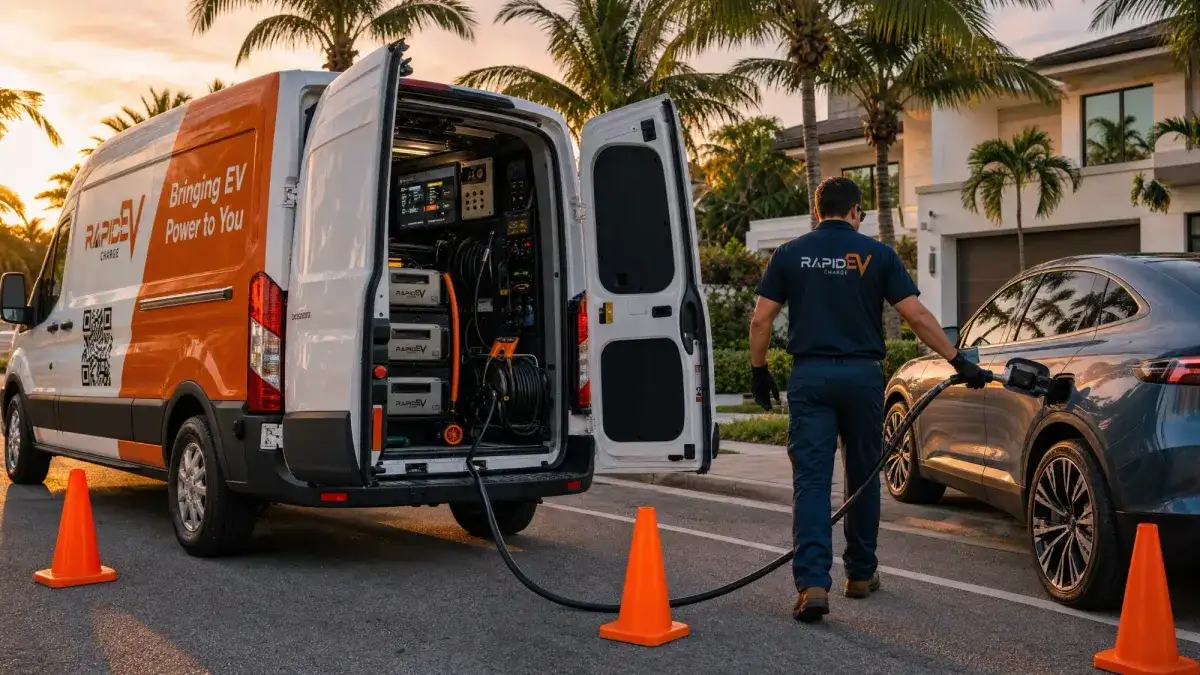
What's Inside a Rapid Charge EV Truck: A Walkthrough
Mobile EV charging is a relatively new service category. Most customers calling for the first time aren't sure what to expect. This is the full equipment walkthrough, what the truck is, what it carries, what dispatchers see when you call, what happens from arrival to departure. No marketing fluff.
Mobile EV charging is a service category most customers haven't used before. Calling for the first time, you have a reasonable concern: what's actually going to show up? Is it a real truck with real equipment, or some guy with a portable extension cord?
This is the walkthrough of what Rapid Charge EV actually runs, written with the doors open. What's in the truck, what dispatchers see when you call, what happens from the moment we arrive at your location to the moment you drive away. Photos in our service pages show the trucks; this post is about the operational details, the standards we hold every truck in the fleet to, day shift and night shift alike.
The truck itself
Our newer service vehicles are built on EV cargo platforms, the same chassis class as commercial delivery vans. The EV platform matters operationally: quieter at residential dispatch locations, no exhaust idling concerns in covered parking garages, smaller carbon footprint per service call.
Some legacy vehicles in our fleet are still ICE-based. We're transparent about this. What matters for the customer experience is the charging delivery, the response time, and the technician, not the truck's powertrain.
The trucks carry standard commercial markings, visible from a distance, clearly identified as Rapid Charge EV, not unmarked. If you're stranded in a parking lot at midnight, you should be able to see us coming and know it's the right vehicle.
The charging equipment
The charging hardware is the actual service. The truck carries a self-contained DC fast charging cabinet, not a portable trickle charger, not a long extension cord into a building. The cabinet generates its own power; the truck does not need to plug into building electrical to charge your EV.
Connector coverage: Tesla NACS, CCS-1, and J-1772, all on every truck. That combination covers every passenger EV sold in the U.S., including Lucid Air, Porsche Taycan, BMW i-series, Mercedes EQ models, Genesis GV60, Rivian R1T/R1S, Tesla Model S/3/X/Y/Cybertruck, Ford Mach-E and F-150 Lightning, Hyundai Ioniq 5/6/9, Kia EV6/EV9, Chevrolet Bolt and Silverado EV, Audi e-tron, Volvo, Polestar, Volkswagen ID models.
Voltage and amperage range: the equipment supports the full range that modern EVs use. Older J-1772-only vehicles charge at Level 2 speeds; modern CCS and NACS vehicles charge at DC fast rates capped by the vehicle's own onboard rate limit.
Battery storage and capability
The on-board battery storage in the charging cabinet is sized to handle multiple service calls per shift. We don't typically deliver a full 0-100% on-site, that would take hours per call and isn't usually what the customer needs.
What we deliver: enough range to get you to your destination, or to the next reliable Supercharger or DC fast station, comfortably. Most calls land in the 30-60% delivered window. For a Tesla Model Y that's roughly 80-200 miles of added range, plenty to reach Brickell from PortMiami, or Aventura from FLL, or West Palm Beach from Boca.
Customers with longer trips planned (a drive to Naples, an Orlando trip) sometimes ask for more. We accommodate when feasible, and we're honest when on-site charging isn't the right tool, sometimes a Supercharger stop after we deliver an initial charge is the better answer.
Safety equipment and protocols
DC fast charging involves high voltage. The equipment is engineered with the same safety standards as fixed Supercharger and Electrify America installations, ground fault detection, overcurrent protection, thermal monitoring on every connector cycle.
Technicians carry standard PPE for high-voltage work, insulated gloves, eye protection, traffic safety vests for roadside scenarios. Reflective gear is non-optional on highway calls.
The trucks carry traffic cones, hazard triangles, and high-visibility markers for I-95, Turnpike, and causeway dispatches. We don't expect customers to provide their own roadside safety equipment.
What dispatchers see when you call
Behind the (954) 278-4454 phone number is a dispatch console that shows real-time position of every truck currently in the field, current call queue, available capacity, and live traffic data on the major South Florida arteries (I-95, I-595, Florida's Turnpike, US-1, A1A, the causeways).
When you call, the dispatcher routes you to the truck that can reach you fastest based on actual current conditions, not the truck that's nominally closest on a map. A truck stuck in I-95 traffic isn't the closest in practice; the dispatch system handles that.
The ETA you get is what we believe is realistic, not aspirational. Customers told a 30-minute ETA often see us in 25; customers told 60 see us in 55-65. We don't quote 20 minutes if we can't actually be there in 20.
A typical service call from arrival to departure
Here's what actually happens, start to finish, on a typical mobile charging call.
Truck arrives at your location. The technician confirms it's you (matches your call info), confirms your EV's make/model/charge port location, and positions the truck for safe charging.
Connector check. The technician selects the right cable (NACS, CCS, J-1772), plugs into your EV's charge port, and initiates the session.
Charging starts. You can stay in the vehicle if you want, or step out and talk to the technician. Most customers walk away and let it run.
Charge proceeds. Depending on EV model, vehicle state, and how much range you need, this takes 20-60 minutes. The technician monitors the session and can answer questions while it runs.
Charge completes. Once the agreed-on range is delivered, the technician disconnects, secures the truck equipment, and confirms the EV powers on and enters "ready to drive."
Payment. We accept the standard payment methods used by other roadside services. Pricing depends on your specific situation, quoted upfront before dispatch, not surprise-billed afterward.
You drive away. Truck moves to its next call or returns to base.
Total time from your call to your departure: typically 60-90 minutes for emergency dispatch, less for scheduled service.
Why this transparency matters
Mobile EV charging is novel enough that customers reasonably ask whether the service is real. Equipment transparency is the answer to that. Real trucks with real DC fast charging hardware, real dispatchers with real-time visibility, real safety protocols.
We've been operating across Broward, Miami-Dade, and Palm Beach counties for years. The trucks are visible at routine service calls every day. If you've been in a Brickell tower deck, a PortMiami terminal lot, or an Aventura condo garage, there's a reasonable chance you've seen one of our trucks in action.
Bottom line
What's in the truck: real DC fast charging equipment, three connector types covering every modern EV, on-board battery storage for multiple calls per shift, professional safety gear, and a technician trained on the specific procedures for every major EV brand.
What's not in the truck: a long extension cord, a magic battery that delivers a 100% charge in 5 minutes, or anything you couldn't see at a fixed Supercharger station.
If you have been holding off on calling because you were not sure what you would actually get, call Rapid Charge EV at (954) 278-4454 or email support@myrapidchargeev.com. We dispatch across Broward, Miami-Dade, and Palm Beach 24/7.
Frequently Asked Questions
Are your trucks really electric or just branded that way?
The fleet is moving toward fully electric platforms. The newer trucks are EV-based. Some legacy vehicles in the fleet are still ICE. We're transparent about this, what matters for customers is the charging delivery, not the underlying truck powertrain.
How much charge can one truck deliver?
Enough to bring multiple stranded EVs back to drivable range per shift. We don't typically deliver a full 0-100% charge on-site, that's slow and rarely the right answer. Most service calls deliver 30-60% of charge, which gets the customer to their destination or to a Supercharger comfortably.
What if my EV has a connector you don't carry?
Every truck carries Tesla NACS, CCS-1, and J-1772. That covers every passenger EV currently sold in the U.S., Tesla, Rivian, Lucid, Ford, GM, Hyundai, Kia, BMW, Mercedes, Porsche, Audi, VW, Volvo, Genesis. If you're driving something pre-2018 with a Tesla NACS-style proprietary connector, mention it when you call.
What does dispatch actually see when I call?
Live position of every truck in the field, expected availability based on current calls, real-time traffic on major South Florida routes. We give you an ETA that accounts for the actual conditions, not an aspirational quote.
Lucid holds the EV efficiency crown, and its 900-volt battery architecture is the reason. Here is how Air and Gravity packs are built, what they hold, and how fast they really charge. Call (954) 278-4454.
Drivers ask whether a portable charger in the trunk makes the charging truck unnecessary. The honest answer depends on what you mean by portable, how much range you need, and where you are stopped. Call (954) 278-4454.
A village with no commercial strip never gets a public charger, so its EVs run entirely on home equipment. Here is who shows up when a driveway node goes dark. Call (954) 278-4454.