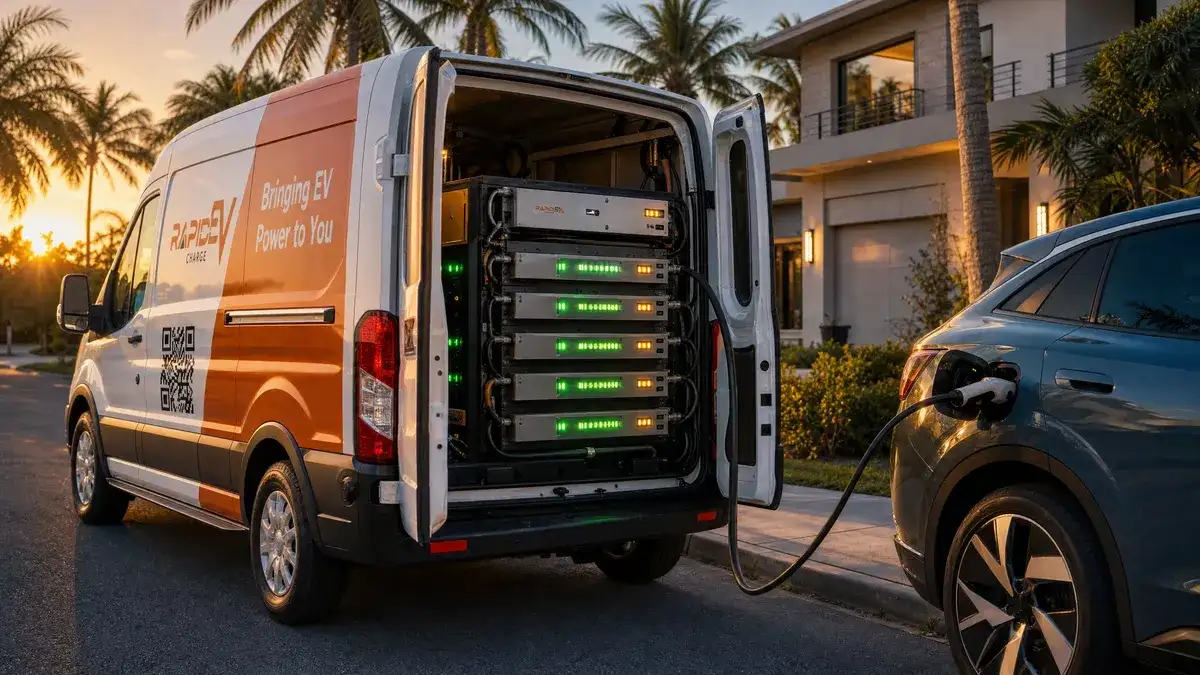
What If a Mobile EV Charger Runs Out of Power Mid-Service?
This is one of the questions we get most often from customers thinking about mobile EV charging for the first time. The answer is straightforward, the operational reality is more interesting than the marketing version, and addressing it directly is more useful than pretending it cannot happen.
It is a fair question. Mobile EV charging trucks carry their own power on board (batteries, generators, or a hybrid of both), which means by definition they have finite capacity. So what happens if a truck runs out of power during a service call? This post answers that directly and explains how operators like Rapid Charge EV design dispatch to prevent it.
The honest reality of onboard capacity
A mobile charging truck is not magic. It carries a specific quantity of energy in onboard batteries, refilled by a generator that runs at controlled intervals between service calls. The total capacity per shift depends on the truck's configuration, the energy delivered per call, and how often the generator runs to top up the onboard pack.
A typical setup can deliver multiple full or partial vehicle charges per shift before the truck itself needs to be returned to base for a deeper refill. The exact number depends on the truck's hardware and on what the calls actually require. A morning of three on-demand emergency calls (each requiring maybe 30 minutes of charge) draws differently from a single afternoon scheduled visit topping up a fleet vehicle for an hour.
Dispatch knows the truck's remaining capacity in real time. It is one of the inputs into deciding which truck takes which call. A truck running low on onboard power is dispatched to short calls near its current location, not to a complex multi-charge job 40 miles away.
How operators prevent mid-service shortfalls
Several layers.
Pre-dispatch capacity check: before a truck accepts a call, the dispatcher confirms the truck has more than enough capacity for the requested service plus a margin. Trucks are not sent on calls where they would arrive with marginal reserve.
Route planning: dispatch routes account for the energy cost of traveling to the call, the charging session itself, and the return to base or to the next call. The truck always has a planned reserve.
Multi-truck coordination: if a high-volume day or a stranding cluster (post-event, post-storm) is depleting onboard capacity across the fleet faster than usual, additional trucks are activated. We operate with this expansion capacity built into the model.
Generator-based recharge: the onboard generator can refill the truck's battery pack between calls if needed. This is not a substitute for returning to base for a deep refill, but it extends the truck's range between full refills.
Continuous monitoring: the truck's onboard capacity is visible to the dispatcher throughout the shift. Trucks approaching their reserve threshold are routed back to base for a refill before they take another full-size call.
Net effect: a mid-service shortfall is a designed-against scenario, not a routine one. The protocols exist specifically to prevent it.
What happens in the unlikely scenario it does occur
If, despite the protocols above, a truck encounters an unexpected capacity issue mid-service, the response is structured. The technician on site contacts dispatch immediately. Dispatch identifies the next available truck and routes it to the location. The first truck delivers as much charge as possible to get the vehicle to a safe state (out of an active travel lane, into a parking lot, or with enough range to reach a public charging station). The second truck completes the job.
In practice this almost never happens at the scale of normal operations. But the contingency is real and the protocol is clear. We do not improvise on this.
If the unusual situation results in a service experience that falls short of what you expected, that is a conversation we want to have, directly, with a specific resolution path. Refund and credit handling depends on the specific situation. The principle is that the customer should not bear the cost of an operational shortfall on our end. Specifics get worked out call by call.
The South Florida operational reality
Our service area is large. Broward, Miami-Dade, and Palm Beach span roughly 100 miles north to south. Trucks dispatch from depot locations within that footprint and travel to calls. The geography matters for capacity planning in several ways.
Distance to call eats range. A truck dispatching from a Broward depot to a Palm Beach call burns onboard energy on the drive. Dispatch accounts for this when assigning trucks. Generally we route the truck closest to the call, but if the closest truck is approaching its capacity threshold, the next-closest takes the call.
Traffic and weather slow travel. Same vehicle, same call, different conditions, different actual energy expended getting there. We build margin into capacity planning for typical and worst-case scenarios.
High-volume periods stress the system more. Hurricane recovery, major event days, and big festival nights are when dispatch density spikes. We have fleet-activation protocols for these windows that bring extra trucks online before the spike, not during.
Our inside the truck walkthrough goes into more detail on the equipment side of the operation. The capacity-management side is the same operation viewed from the dispatcher's screen.
What this means for you as a customer
Practical takeaways.
You can ask about capacity. When you call, the dispatcher knows what truck is being assigned and what its current capacity is. If you want to confirm, it is a fair question.
Provide accurate information. Telling us your actual state of charge and the actual destination range you need lets dispatch size the call correctly. Underreporting or overreporting wastes capacity on both ends.
Schedule when you can. Scheduled visits get cleaner capacity allocation than emergency dispatches. If your need is predictable, scheduling it lets the operation plan around it.
Trust the protocols. Mid-service capacity issues are designed-against. We have not had one cause a customer-facing failure in normal operations, but if it ever did, the response is structured and the customer-experience principle is clear.
Bottom line
Mobile charging trucks have finite onboard power. That is the architectural truth. Operators that take the service seriously design dispatch and capacity management to ensure that finite limit does not become a customer-facing problem. We do that. The protocols are layered, the monitoring is continuous, and the contingency response is clear if something unusual happens.
If you have questions about how dispatch capacity works for a specific call you are thinking about, call Rapid Charge EV at (954) 278-4454 or email support@myrapidchargeev.com. We dispatch across Broward, Miami-Dade, and Palm Beach 24/7.
Frequently Asked Questions
How many vehicles can a mobile charging truck service in a shift?
Varies with the truck's configuration and the size of the calls. A typical truck can deliver multiple full or partial charges per shift before returning to base for a deeper refill. Short emergency dispatches versus long scheduled visits draw differently against onboard capacity. Dispatch tracks remaining capacity in real time and assigns calls accordingly.
What happens if a truck unexpectedly runs low mid-call?
Designed-against scenario, not a routine one. If it occurs, the technician contacts dispatch immediately, the first truck delivers enough charge to get the vehicle to a safe state, and the next available truck is routed to complete the job. The customer should not bear the cost of an operational shortfall on our end; specifics get worked out call by call.
How do operators prevent this from happening?
Layered protocols. Pre-dispatch capacity checks before a truck accepts a call. Route planning that accounts for travel, charging, and reserve. Multi-truck coordination during high-volume periods. Continuous capacity monitoring on the dispatcher's screen. Generator-based recharge between calls. The system is designed to make mid-call shortfalls rare to the point of nonoccurrence.
Can I ask about a truck's capacity when I call?
Yes. When you call, the dispatcher knows what truck is being assigned and what its current capacity is. If you want to verify it has enough capacity for your specific call, it is a fair question and the dispatcher will give you a straight answer.
Miami-Dade has Supercharger queues downtown and forty empty miles to the south. The county's charging deserts are real, specific, and survivable with the right plan. Call (954) 278-4454.
People who search for EV charger service want one of three things: a broken charger fixed, a new charger installed, or power brought to the car right now. Here is how to tell which one you need today, what to check first, and when a delivered charge is the fastest fix. Call (954) 278-4454.
Palm Beach schedules charging by the season: October-to-April standing service for seasonal residents, household arrangements for estates, multi-EV garages on one cadence. Call (954) 278-4454.