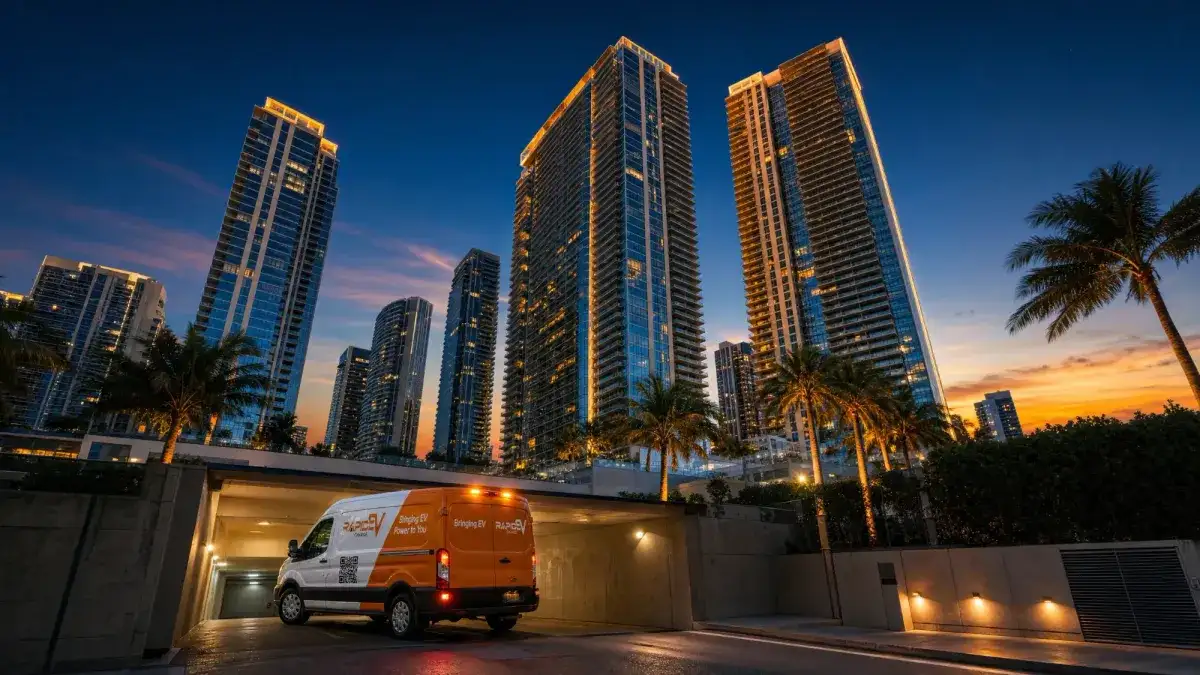
If you've heard the term but aren't sure exactly what mobile EV charging is, or how it differs from a Supercharger, a home wall box, or a tow truck, this is the definitive explainer. Written by the operator that runs the trucks in Broward, Miami-Dade, and Palm Beach.
Mobile EV charging is a service where a truck-mounted charger comes to your vehicle's location and delivers usable battery charge on the spot, no fixed station, no tow required. It works in driveways, parking decks, side streets, hotel lots, on the shoulder of I-95, anywhere your EV happens to be. This guide, written by Rapid Charge EV, the operator running these trucks across Broward, Miami-Dade, and Palm Beach, explains what mobile EV charging is, how it physically works, who uses it, where it fits in the broader charging picture, and, honestly, what it can't do.
What mobile EV charging actually is
The simplest framing: mobile EV charging is to fixed stations what mobile mechanics are to repair shops. Instead of you bringing the vehicle to the charger, the charger comes to you. The truck carries the power source on board, typically a high-capacity battery pack, a clean-burning generator, or a hybrid of both, and the truck's onboard charging system connects to your vehicle's port the same way a wall box would.
It's worth being clear about what mobile charging is not. It is not towing. It is not a Supercharger network. It is not a replacement for home charging if you have a wall box at home and a reliable routine around it. It is a separate category of service that exists to bridge the gaps left by all of those.
If you've ever wondered why mobile charging exists at all, couldn't drivers just use a Supercharger or get towed?, the answer is that for a huge number of real-world situations, both options are slower, more expensive, or operationally impossible. We've written a separate decision guide on mobile EV charging versus towing if you want to think through which one fits your scenario.
How it physically works
Our trucks carry several components working together. The energy source, a battery pack sized for multiple service calls per shift, supplemented by a clean-running generator that recharges the pack between stops. An onboard charging system that conditions the power and outputs it through the connectors your vehicle uses. Cabling and adapters for the three connector types in common US use. And the dispatch and diagnostic tools that let the technician confirm the vehicle is charging correctly before leaving.
On a typical service call, the technician arrives, identifies the connector, verifies access to the charge port (which sometimes requires opening a frunk or accessing a hidden release if the vehicle is fully dead and locked), connects the equipment, starts the session, and monitors for any abnormalities. A standard emergency visit lasts 15 to 45 minutes depending on how much charge you need and what charge rate the vehicle accepts. The technician stays on-site the entire time; you're not left with equipment to return.
Charge rate is one of the most common questions. Mobile chargers deliver power with commercial-grade Level 2 and Level 3 DC equipment, 25 to 120 kW depending on the call and what your vehicle accepts, fast enough to add meaningful range in 15 to 45 minutes. The math is favorable: most calls don't need a full charge, just enough to get you to wherever you're going next.
The three service types
Mobile charging splits into three operational models. Each works for different situations.
Emergency / on-demand
You're out of charge, or close to it, in a location where you can't reach a station. You call Rapid Charge EV at (954) 278-4454, we dispatch, we charge. This is what most people picture when they think 'mobile charging', the roadside rescue model. Our emergency mobile EV charging service handles this. Response time depends on where you are in the tri-county service area and what's happening on the roads at that hour.
Scheduled / residential
You don't have home charging, typically because you live in a condo or high-rise that hasn't installed it, or because the install process is dragging on. You schedule a recurring visit, weekly or bi-weekly, and we charge the vehicle in your assigned spot while you're upstairs. Our scheduled home and condo service is built for this. Most customers using this model fall into the same handful of profiles: Brickell, Aventura, Sunny Isles, Edgewater, Bay Harbor, the Beach high-rises.
Fleet / commercial
Businesses operating EV fleets need predictable charging without taking vehicles out of rotation. The office and fleet model puts charging on a contracted schedule at the business's location, dealerships, last-mile delivery operations, corporate campuses. The economics work differently from residential; the use case is consistent uptime rather than emergency response.
Connector compatibility
Three connectors cover essentially every passenger EV on US roads:
NACS (North American Charging Standard), Tesla's connector. Used by all Tesla vehicles and now standard for most new non-Tesla EVs entering the market in 2025-2026.
CCS-1 (Combined Charging System), the legacy non-Tesla DC fast standard. Used by Ford, GM, Hyundai, Kia, Rivian, Lucid, VW, and most pre-NACS-transition vehicles.
J-1772, the Level 2 AC connector. Older Bolts, Leafs, and any non-Tesla EV's AC charging port. Generally slower than CCS, but covers older vehicles that don't accept the faster standards.
When you call, we confirm the connector. Different vehicles have different access patterns, Tesla port releases via the app or a charge cable trigger, Ford uses a manual button, some legacy CCS-equipped vehicles need the door manually opened. The technician knows the access pattern for the major models.
Who actually uses mobile EV charging
Five customer profiles cover most of our call volume.
1. Condo and high-rise residents
Brickell, Aventura, Edgewater, Sunny Isles, Bay Harbor, downtown Miami, Hallandale Beach, Hollywood high-rises. Towers built before 2018 mostly lack installed EV charging. Building electrical wasn't designed for it, HOA approval is slow, and the few installed stations are perpetually queued. Mobile charging fills the gap, sometimes permanently, sometimes while the HOA install grinds through approvals.
2. Fleet and commercial operators
Dealerships needing to keep test-drive EVs at appropriate state of charge. Last-mile delivery operations running EV vans. Property management companies with EV fleets. The use case is uptime, vehicles can't go offline waiting at a public charger.
3. Road-trip travelers stranded mid-route
I-95, the Turnpike, I-75, A1A, drivers running between Miami and Palm Beach who miscalculate range or arrive at a Supercharger to find it queued or down. We dispatch to the breakdown lane and provide enough charge to reach a fixed station.
4. Event attendees and tourists
F1 Miami at Hard Rock Stadium. Concerts at the Hard Rock or Kaseya Center. Port of Miami cruise return travel where vehicles sat in long-term parking with vampire drain. Tourists who didn't realize how dense (or sparse) South Florida's charging map is for their rental EV.
5. Snowbirds and seasonal residents
Drivers who split time between Florida and somewhere else. October to April they're here, in a condo or rental, and the calculus of installing permanent charging for a six-month stay doesn't work. Mobile dispatch fills the winter without a wall-box project.
What mobile charging can't do
This part matters. Mobile EV charging is a tool, not a magic wand. Things it doesn't do:
Match DC fast charging speed. A Supercharger or 350 kW CCS station will charge faster than any mobile truck can on a service call.
Repair the vehicle. If your EV has a battery management fault, a 12-volt failure, or a charge port issue, mobile charging may diagnose the problem but it can't fix electrical hardware. We coordinate with shops for that.
Substitute for permanent infrastructure long-term. If you're driving 200 miles a day and have a home that supports a wall box, you should install one. Mobile dispatch is a bridge or a backup, not a replacement.
Charge in unsafe locations. We don't operate on active travel lanes, in flooded areas, or in any environment where the technician or your vehicle would be in danger. We'll coordinate a short tow to a safe lot and charge there.
Saying that out loud isn't a pitch, it's the honest scope of the service. Knowing what mobile charging doesn't do is part of knowing when it's the right call.
When mobile charging is the right call
The fit is clearest when the alternative is significantly worse. You're stranded with no usable station within range, mobile charging beats a tow. You live in a tower with no installed chargers, recurring mobile beats trying to live off public charging. You operate a fleet that can't take vehicles offline, contracted mobile beats public-network risk. You're a snowbird with a 6-month stay, mobile beats a wall-box project you'll abandon when you leave.
Where mobile charging isn't the right call is equally important. You have a working home wall box and a routine that fits your driving, mobile is overkill. You're 10 minutes from a working Supercharger with adequate range, drive there. You need a road-trip fast-charge, mobile isn't built for that pace.
The South Florida context
South Florida is a structurally hard market for EV ownership in ways most national coverage misses. The metro is sprawling, Broward, Miami-Dade, and Palm Beach span over 100 miles north-to-south with no consistent charging density between population centers. The condo and high-rise stock that defines the coastline wasn't built for EVs. The climate destroys range, sustained heat, high humidity, A/C running constantly. And the Tesla Supercharger network, while present, is operating at capacity in the major nodes (Brickell, Aventura, Doral, Boca, Palm Beach Gardens) with queue times that grow worse every quarter.
Mobile EV charging matters more here than it would in a metro with denser infrastructure. We've written a complete South Florida range anxiety guide that walks through 12 specific commute scenarios, Brickell to Boca, Coral Gables to the Keys, Aventura to FLL, and what charging strategy each one really needs. If you live in this metro and drive an EV, that guide and this one are companions.
Our service-areas page lists every neighborhood and city we dispatch to. The short answer is the entire tri-county region, but the specifics matter for response time and routing.
Bottom line
Mobile EV charging is a specific service category that fills specific gaps. Done well, it's invisible, your vehicle is charged when you need it and you didn't think about the logistics. Done poorly, it's a marketing pitch with no operational reality behind it. The questions worth asking when you're evaluating mobile charging in your area: who runs the trucks, what equipment do they carry, what's the actual response footprint, and which connectors do they support? Those are the real differentiators.
If you have a question about whether mobile charging fits your situation, call Rapid Charge EV at (954) 278-4454 or email support@myrapidchargeev.com. We dispatch across Broward, Miami-Dade, and Palm Beach 24/7.
Frequently Asked Questions
What is mobile EV charging in one sentence?
Mobile EV charging is a service where a truck-mounted charger comes to your vehicle's location and delivers usable battery charge on the spot, no fixed station, no tow required.
Can mobile EV charging fully charge my car like a Supercharger?
It depends on the visit type. A typical emergency or top-up call adds enough range to get you home or to a fixed station, averaging 15 to 50 miles, and more than that when the vehicle and the situation warrant it. A scheduled home or condo visit can deliver a larger charge over a longer window. Mobile charging is not designed to replace DC fast charging for road-trip pace, but it's more than enough for the use cases most owners actually encounter.
Which EVs are compatible?
Effectively all current passenger EVs sold in the US. Our trucks carry NACS (Tesla), CCS-1 (most other brands, Ford, Hyundai, Kia, Rivian, Chevy, etc.), and J-1772 (Level 2 connector used by older or non-Tesla AC charging) adapters. When you call, we confirm the connector before dispatch.
Is mobile charging only for emergencies?
No. Roughly half our calls are scheduled, recurring home or condo charging for residents without installed wall boxes, plus fleet contracts. The other half are on-demand emergencies. Both models work; they're different services that share the same physical equipment.
Jacksonville is the largest city by land area in the contiguous United States, and its charging map has real holes. Here is the complete guide to getting a charge delivered anywhere in the metro. Call (954) 278-4454.
Charge to 80%, run down to 20%, repeat. The rule is real, the science is real, and it works. The South Florida version has wrinkles generic guides miss. Call (954) 278-4454.
Yes, mobile units deliver real charging on the spot in Broward, and the honest answer about speed has two parts: how fast the charge flows, and how fast the truck reaches you across the county's sprawl. Call (954) 278-4454.