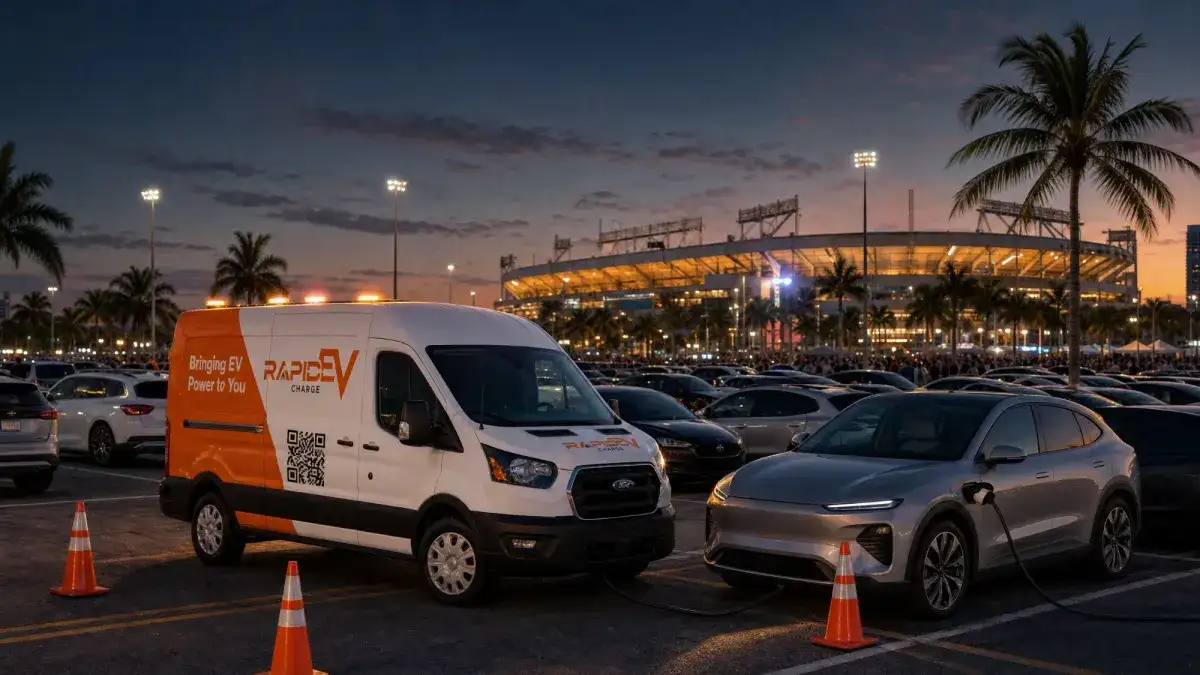
South Florida's event calendar runs heavy year-round, and the EV-charging infrastructure around major venues consistently underdelivers when 50,000 attendees arrive at the same parking lot. Mobile charging is the operational answer. This is the operator's view of how it works for both organizers and individual attendees.
South Florida hosts a lot of events. Sports at Hard Rock Stadium and Kaseya Center. F1 Miami in the spring. Art Basel in early December. Ultra in March. Cruise traffic at PortMiami year-round. Concerts at every venue from Mid-Beach hotels to the Bayfront. Conventions at the Miami Beach Convention Center and the Greater Fort Lauderdale Broward County Convention Center. Weddings at the larger Coral Gables and Palm Beach estates. The EV-charging infrastructure around these venues consistently underdelivers when concentrated EV traffic arrives. Mobile EV charging is the operational answer, and Rapid Charge EV stages it across the tri-county event calendar.
Why events stress public charging infrastructure
Public charging is sized for typical daily demand, not for event-day spikes. A stadium-area Tesla Supercharger that handles 200 sessions on a typical day might see triple that demand on a game day or a concert night. The infrastructure does not scale up for the event. Queues form, sessions back up, and drivers who showed up at 5 percent state of charge after the event find themselves waiting an hour at the station.
Three specific patterns we see at South Florida events.
Pre-event surge: EVs arriving for an event are often at lower-than-usual state of charge because the drivers are coming directly from work or from far parts of the metro. The nearest stations to the venue fill quickly in the hours before the event.
During-event accumulation: nearby stations remain busy throughout the event as attendees try to top up before driving home. The 30-to-60-minute Supercharger session is roughly the length of pre-show time many attendees have.
Post-event surge: the worst of the three. Tens of thousands of vehicles leave the venue at the same time. Local roads back up. Nearby stations fill within minutes of the event ending. Drivers who hoped to charge on the way home find themselves in a 90-minute queue or pushing range to make it home.
Our Hard Rock Stadium event-day post covers the individual-attendee version of this in detail. The institutional version, what event organizers and venue operators should know, is the focus here.
What mobile EV charging looks like as an event service
Mobile dispatch for events differs from emergency dispatch in important ways. Pre-arranged service. On-site for the duration of the event. Multi-vehicle coordination instead of one-at-a-time emergency response. Different operational model.
What it looks like in practice. The venue or event organizer contracts a provider like Rapid Charge EV for the event. Trucks stage on or near the venue grounds. Attendees who pre-register or who request service on site get vehicles charged during the event itself, while they are at the show, the game, the concert, the convention. By the time the event ends, their vehicle has the range to go home. No post-event station queue.
Multi-truck setups for larger events. A single truck might handle 6 to 10 vehicles over a 4-hour event window. For a stadium event with thousands of EV attendees, that ratio is meaningless. The right configuration is multiple trucks staged at the venue, coordinated dispatch, and a system for matching vehicles to charging slots.
South Florida event categories where mobile charging fits
Not every event needs mobile EV charging support. Some clearly do.
Stadium events
Hard Rock Stadium for Dolphins games, F1 Miami, major concerts. Kaseya Center for Heat games and concert dates. FLA Live Arena in Sunrise. Loan Depot Park (Marlins) in Little Havana. All of these have parking capacity in the thousands, EV attendance growing year over year, and limited installed charging on site. Mobile service is the practical answer for the EV-owning attendee base.
Festivals
Art Basel in Miami Beach in early December. Ultra Music Festival in downtown Miami in March. Calle Ocho in Little Havana. South Beach Wine and Food Festival. These events draw international attendees, many of whom are not familiar with the local charging network, and they concentrate EV traffic in the densest parts of Miami-Dade (downtown Miami, Miami Beach) where charging density is already strained on normal days.
Corporate events at large venues
The Miami Beach Convention Center, the Greater Fort Lauderdale Broward County Convention Center, the major hotels with conference facilities in Brickell, Aventura, and Mid-Beach. Conventions and large corporate gatherings often involve attendees who arrived in rental EVs or who are far from their home charging routine. Mobile service for the attendee base is a meaningful guest-experience enhancement.
Private events at estates and large venues
Weddings at the larger Coral Gables, Pinecrest, and Palm Beach estates. Private parties at the Mid-Beach historic hotels. Charity galas at the major venues. Smaller scale than stadium events, but the same dynamic: attendees arriving with various states of charge, valet operations that do not have time to manage charging logistics, host or organizer wanting a smooth attendee experience. Mobile service handles it.
Conventions and trade shows
Trade shows and conventions running multiple days bring attendees who park in long-term lots and need their vehicles charged before they drive home. Mobile dispatch into the convention's parking garages during the show is operationally clean. It does not require permanent infrastructure investment by the venue for an episodic use case.
What event organizers should know
Planning EV-charging support for an event is a different exercise from planning catering or AV. A few principles.
Estimate EV attendance honestly. For a major South Florida event in 2026, 10 to 20 percent of attendee vehicles being EVs is realistic. For events with younger or higher-income attendee profiles, the share can be higher. Plan capacity accordingly.
Pre-event coordination matters. Mobile charging operators need lead time to stage trucks, coordinate access, and brief technicians. Last-minute bookings for stadium-scale events are not the right time to plan this.
Communicate availability to attendees. EV-owning attendees who know mobile charging will be available at the venue plan differently than those who do not know. Pre-event communication is part of the value.
Coordinate with venue ops. Truck access, staging locations, attendee-routing to charging zones, payment handling. These are operational details that should be settled in advance with venue management.
Hot-weather and storm contingencies. Outdoor events in South Florida summer mean heat, humidity, and afternoon thunderstorms. Charging operations need to plan around these. Our Florida heat prep post covers the operational realities.
What individual EV-owning attendees should know
If you are going to a South Florida event with your EV, a few practical points.
Arrive with margin. Do not show up at the venue at 8 percent state of charge expecting on-site charging to save you. Some events have mobile service, some do not, and queues are real. Plan for a return drive even if charging fails.
Check whether on-site charging is available. Major events may publicize EV-charging support in advance. Convention centers, stadium events, and large venues increasingly do.
Pre-register if pre-registration is offered. Some event mobile-charging operators run a pre-reg system that guarantees a slot. This is the smoothest path.
Know the closest public charging alternatives. If on-site is full or unavailable, where is the nearest reliable station? Our Tesla Supercharger waits post covers the network around the major South Florida event venues.
Expect post-event traffic and station queues. Even with planning, the post-event window is the worst time to need a Supercharger. Build buffer into your range plan.
Temporary mobile vs permanent installation
Venues that host frequent events sometimes ask: should we install permanent charging or use mobile for events? Honest answer: depends on the use case.
Permanent installation makes sense when daily and routine event-day demand both justify the capital expense. A major stadium that hosts 80 events per year and has steady EV growth is a candidate for substantial permanent infrastructure. The math works.
Mobile makes sense for episodic events, venues without consistent daily demand, or as the surge capacity layered on top of a smaller permanent installation. A convention center that hosts 30 events per year with widely varying EV attendance is better served by mobile service for the spikes than by overbuilding permanent infrastructure that sits unused most days.
The right answer for most venues is a hybrid: some permanent installation for daily demand, mobile service for event-day surge. We work with venues on both ends of that spectrum.
Bottom line
Event-day EV charging is a use case the public charging network was not built for and probably will not be built for at the required scale anytime soon. Mobile EV charging is the operational answer. For event organizers, it is a guest-experience enhancement and an operational layer that does not require permanent infrastructure. For individual attendees, it is the alternative to waiting an hour in a post-event Supercharger queue.
If you are organizing an event in South Florida and want to talk through mobile charging options, call Rapid Charge EV at (954) 278-4454 or email support@myrapidchargeev.com. We dispatch across Broward, Miami-Dade, and Palm Beach 24/7.
Frequently Asked Questions
Why does public charging struggle on event days?
Public stations are sized for typical daily demand, not for event-day spikes. A stadium-area Supercharger that handles 200 sessions on a normal day might see triple that on a game day. The station does not scale up for the event. Pre-event surges, during-event accumulation, and post-event surges all stack on top of the normal day's traffic.
Can mobile charging service a whole event's EV attendees?
Depends on the scale. For smaller events (weddings, corporate events at large venues), a single truck can handle the EV-owning attendee group across the event window. For stadium-scale events with thousands of EV attendees, multi-truck setups and pre-registration are required. We coordinate the configuration to the specific event.
Should event organizers build permanent charging or use mobile?
Depends on usage. Venues with consistent daily and event-day demand often justify permanent infrastructure. Venues with episodic event demand and inconsistent daily use are better served by mobile for the spikes. Many large venues use a hybrid: some permanent installation plus mobile surge capacity.
How do individual attendees use mobile charging at events?
Pre-registration is the smoothest path when the event offers it. Some events publicize mobile-charging support in advance and let attendees sign up for a slot during the event. If not pre-registered, ask at the venue or call our dispatch directly. We work with venues across Broward, Miami-Dade, and Palm Beach.
Brickell, Doral, Aventura, Boca, Palm Beach Gardens, the Tesla Supercharger queues in South Florida hit different. Here's the pattern and the workaround. Call (954) 278-4454.
THE PLAYERS, Florida-Georgia weekend, Rockville at the stadium, festivals at the Beaches: Jacksonville's event calendar strands EVs in predictable ways. Mobile charging serves both the organizers and the drivers. Call (954) 278-4454.
Charge to 80%, run down to 20%, repeat. The rule is real, the science is real, and it works. The South Florida version has wrinkles generic guides miss. Call (954) 278-4454.