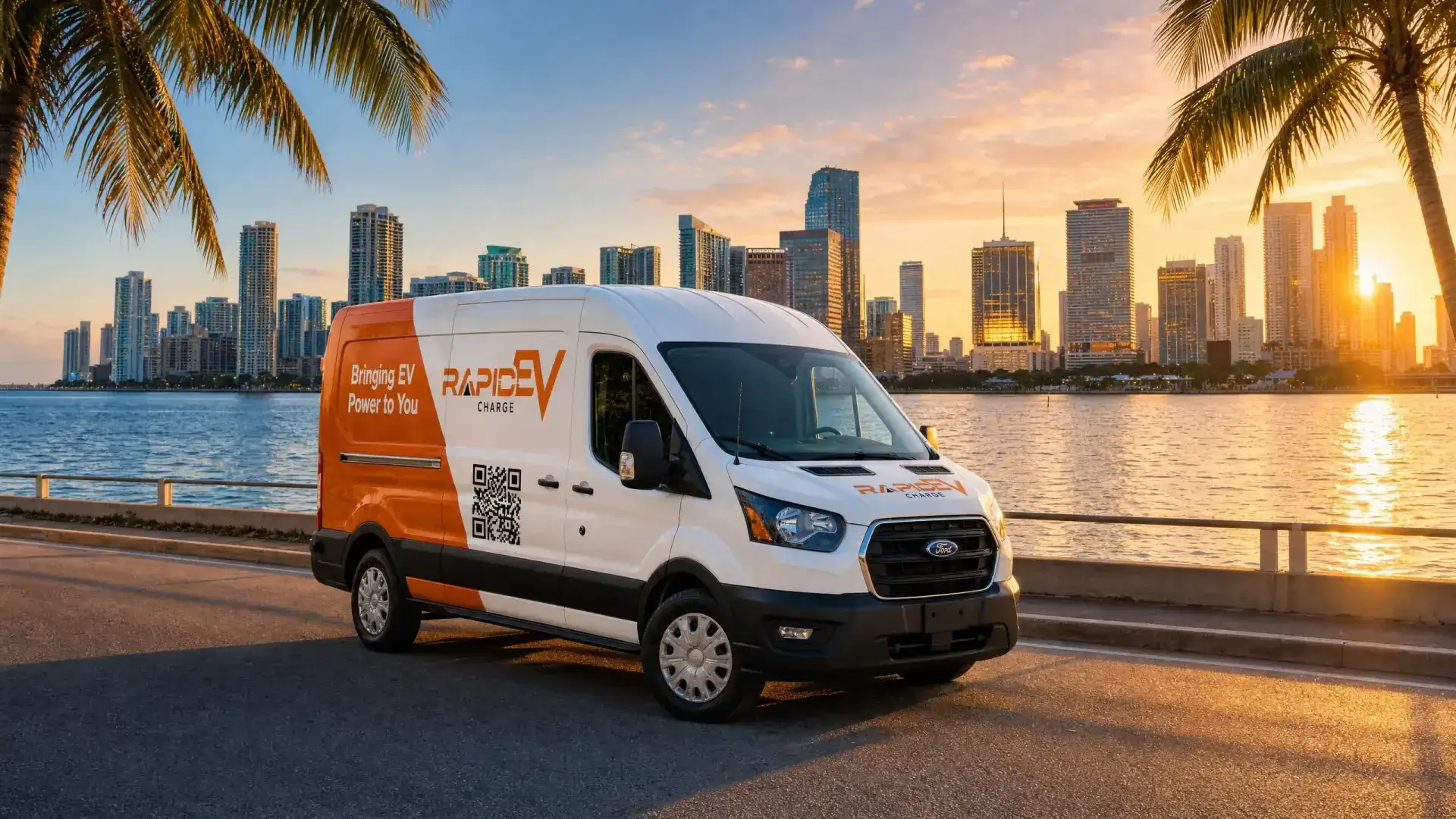
Miami-Dade is the vertical county: more EVs per garage elevator than per driveway. Mobile charging works differently here, more valet handoffs, more building coordination, more water in the way, and this guide covers the local reality from Aventura to Florida City.
Miami-Dade does not park like the rest of Florida. Its EVs live in tower decks above Brickell, wait with valets on Collins Avenue, and cross causeways to get anywhere. Mobile charging in this county is therefore a different service in practice than it is one county north, and Rapid Charge EV's Miami-Dade dispatch log proves it daily: more building coordination, more handoffs, more geography between the truck and the car. This is the local guide.
The Miami-Dade version of the service
Mechanically it is the same offer as everywhere: self-contained DC fast equipment on a truck, every US connector, 15 to 50 miles of range delivered in 15 to 45 minutes, no grid hookup needed. The general explainer is our complete mobile EV charging guide. What changes here is everything around the cable: who hands over the car, how the truck reaches it, and what the county's water-and-tower geography does to the logistics.
The signature Miami-Dade pattern is the absent-owner session. In Broward we mostly charge cars whose owners are home. Here, the majority of residential calls run through a building: valet releases the vehicle, or the resident leaves it in its deeded spot with the port unlocked, and the session happens while they are upstairs, at work, or at dinner. The service molds itself to vertical living.
Coverage across the county's zones
The urban core, Brickell, downtown, Edgewater, Wynwood, is the tower heartland and the volume center. Response there is distance-short and traffic-honest. The beach corridor, Miami Beach and South Beach up through Surfside, Bal Harbour, Bay Harbor Islands, and Sunny Isles Beach, runs on hotel valets and oceanfront condo decks, with causeway timing folded into every ETA.
The middle ring is the workhorse zone: Coral Gables and its canopy streets, Doral's warehouse-and-office grid, Hialeah's dense neighborhoods, Miami Shores, North Miami, and North Miami Beach. Steady dispatch, mixed driveway-and-building calls, and the county's best balance of distance and flow.
The south and the edges stretch the map: Cutler Bay, Homestead, and Florida City down US-1; Key Biscayne across its causeway; the Krome Avenue fringe at the Everglades line. Full coverage, honest distances. The deep south is simultaneously the farthest reach and the place the service matters most, because public infrastructure thins exactly as the miles grow, our Miami-Dade charging deserts post maps that gap in detail.
What makes this county hard for EVs
Tower stock without charging. The majority of the county's condo inventory predates EV-ready electrical, and building retrofits move at board speed. Residents wait years or skip the wait with delivered charging.
Valet custody. Hotel and luxury-tower valets control thousands of EVs that their lots cannot charge; the handoff pattern exists precisely for this.
Water in every direction. Causeway crossings punish thin margins, and an island address means every charging option involves a bridge.
Heat-soaked garages and lots. August pack temperatures slow charge acceptance everywhere; shaded decks beat surface lots by real minutes.
The tourist layer. Rental EVs add demand that does not know the local network, concentrated exactly where infrastructure is thinnest, the beach.
Who uses mobile charging here
The tower resident is the anchor profile: a Brickell or Aventura professional whose building has four chargers for four hundred units, on a weekly or bi-weekly standing visit. Then the visitor class, hotel guests and rental drivers solving the beach's valet-lot gap. Then the business layer: Doral logistics operators, downtown firms with small executive fleets, dealerships managing inventory charge. And around them, the emergency stream this county generates like no other, cruise-day discoveries at PortMiami, causeway misjudgments, nightlife exits at 3 AM.
If your building is the bottleneck in your EV life, the fastest fix is a call to (954) 278-4454 to set up the first visit; one session establishes the access pattern with your front desk or valet, and every visit after is routine.
Scheduled vs emergency in the vertical county
Schedule it if your charging gap is structural: your tower has no installed chargers, your valet lot has no plugs, your week is predictable. The standing visit converts a permanent infrastructure problem into a solved logistics detail. Call it when the day breaks: the dead battery in the deck, the cruise clock, the causeway stall, covered in our Miami-Dade emergency dispatch guide.
The distinctly Miami-Dade advice: set up the scheduled relationship before you need the emergency one. Buildings that already know the truck wave it through at 2 AM.
A first tower visit, start to finish
Here is the first appointment as it actually runs for a typical Miami-Dade customer, say, a resident of an Edgewater tower with no installed charging. The setup call gathers the building name, the parking arrangement (deeded spot on level three, or valet custody), the vehicle and connector, and the window that suits the deck's rhythm; mid-day is popular because decks empty out. The resident gives the front desk or valet a one-line heads-up, and that is the whole onboarding.
On the day, the truck enters as vendor traffic through the service entrance, the same path the water-delivery and detailing vans use. Self-park: the technician works at the deeded spot, port unlocked per the arrangement. Valet: the stand releases the car to a staging spot and re-queues it after. The session runs its 15 to 45 minutes, the battery management system in charge of the pace, and the confirmation text reaches the resident in a meeting across town or an apartment forty floors up.
By the second visit the building treats the truck as furniture: security recognizes it, valet has the workflow, and the resident's involvement drops to reading the confirmation. Changes flow by text, pause for travel, add the partner's new EV, move the window for season traffic on the causeways.
Emergency calls compress the same sequence into a rescue, and buildings that know the routine make those rescues dramatically smoother. To start the scheduled version, call Rapid Charge EV at (954) 278-4454 with your building's name; the dispatcher has probably already been there.
What Miami-Dade drivers ask most
Will my building object? Almost never, because nothing about the visit touches the building: no electrical connection, no installation, no common-area modification. The truck is vendor traffic, indistinguishable from the water-cooler delivery in the eyes of most property managers, and the handful of buildings with strict vendor rules have processes the dispatcher already knows.
Does it work for renters and rentals? Completely, and that matters in a county where so much of the housing is leased and so many of the EVs are rentals. No ownership, no installation rights, no problem: the service needs vehicle access, not a deed.
What about hurricane season in the towers? The pre-storm pattern is tower-specific: decks fill, valets compress schedules, and residents who top up two days early skip the chaos entirely. Post-storm, dispatch resumes building by building as access clears, and the flood rule is absolute, any vehicle that met saltwater gets an inspection, never a charge. Coastal tower managers who coordinate post-storm service for residents have become one of our steadiest Miami-Dade relationships.
The local bottom line
In Miami-Dade, mobile charging is the workaround for a county built upward before EVs existed. It thrives here because it solves the access problem, the car in the deck, the keys with the valet, the charger forty floors below the owner, that fixed infrastructure cannot. Every community from Aventura to Florida City is on the service-areas list; the emergency and scheduled pages cover both engagement models.
If you want charging delivered to your tower, hotel, business, or roadside anywhere in Miami-Dade, call Rapid Charge EV at (954) 278-4454 or email support@myrapidchargeev.com. We dispatch across Broward, Miami-Dade, and Palm Beach 24/7.
Frequently Asked Questions
Do I need my building's permission for a charging visit?
Usually no formal permission, just access. Most Miami-Dade towers treat the truck as standard vendor traffic through the service entrance or parking deck. Valet buildings hand the vehicle over the same way they would for detailing. A heads-up to your front desk smooths the first visit; after that it is routine.
Which neighborhoods get the fastest response?
The middle ring, Coral Gables, Doral, Miami Shores, North Miami, and the core outside rush hour. Brickell and downtown are close to everything but traffic-bound at peak. The honest slow ends are the far south (Homestead, Florida City) and the barrier-island tips; we quote those distances straight.
Can tourists or rental-EV drivers use the service?
Yes, and plenty do. Visitors in rental Teslas discover the Miami Beach hotel-valet charging gap the hard way; a session at the hotel lot solves it. You need the vehicle, a phone, and a way to authorize access if a valet holds the keys.
Does the service reach Key Biscayne and the islands?
All of them: Key Biscayne over the Rickenbacker, the Venetian islands, Bal Harbour, Bay Harbor Islands, Surfside, and the beach communities. Bridge and causeway traffic is the only variable, and it is built into the ETA you get.
Miami-Dade has Supercharger queues downtown and forty empty miles to the south. The county's charging deserts are real, specific, and survivable with the right plan. Call (954) 278-4454.
Miami-Dade doesn't sleep, but its chargers do. Nightlife exits at 3 AM, port shifts, locked decks: the county's after-midnight charging answer, honestly. Call (954) 278-4454.
Miami-Dade strands EVs in ways no other county does: causeways with no shoulder, valet garages, the empty miles south of Kendall. Here's who to call and how dispatch actually works here. Call (954) 278-4454.