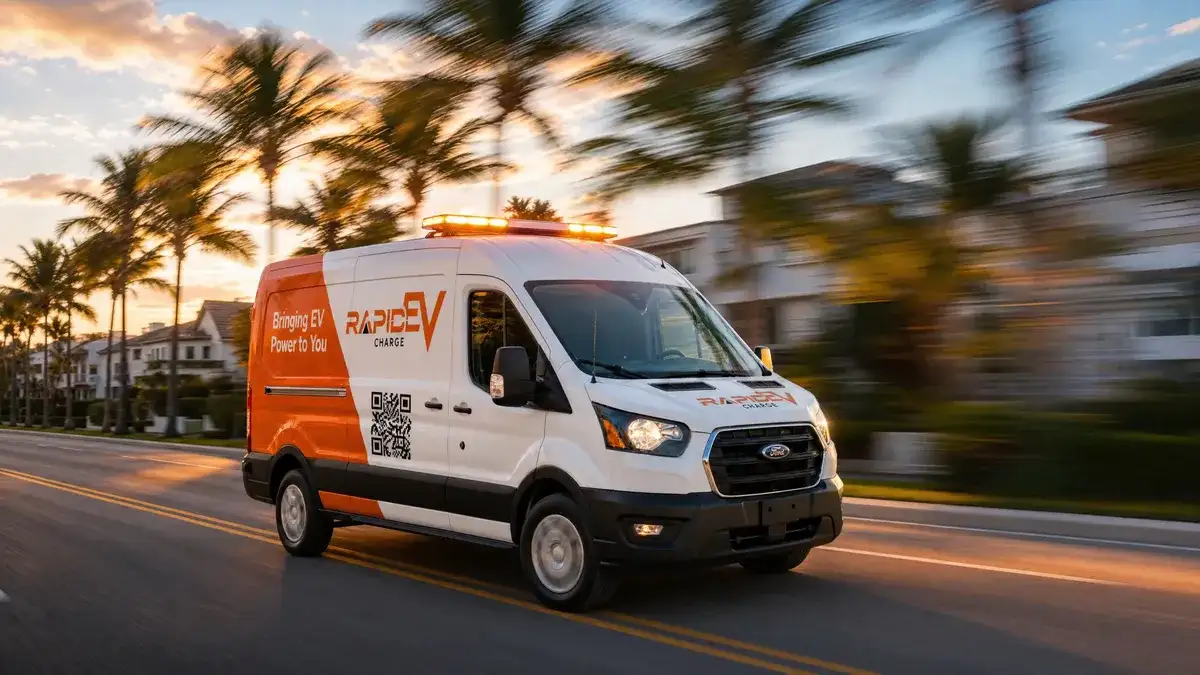
Mobile EV charging is new enough as a service category that a lot of plausible-sounding myths circulate. Here are the ones we hear most often and what is actually true.
Mobile EV charging is new enough as a service category that a lot of plausible-sounding myths circulate. Rapid Charge EV has run thousands of dispatches in South Florida and the same misconceptions keep coming up in customer calls. Here are ten of them, addressed directly.
Myth 1: Mobile charging damages your battery
It does not. Mobile EV chargers deliver power through your vehicle's standard charge port using the same protocols a Level 2 home charger or a moderate-rate DC fast charger would use. The output is voltage-regulated, current-controlled, and conditioned the same way grid-tied infrastructure conditions its output. Your vehicle's onboard battery management system sees the same kind of charge profile it sees from any approved charging source. The chemistry does not care whether the electrons came from FPL or from a truck-mounted battery pack.
Myth 2: Mobile charging is only for emergencies
Roughly half our call volume is scheduled, not emergency. Recurring home or condo charging for residents without installed wall boxes, fleet contracts for commercial vehicles, snowbird seasonal service for vehicles that sit for months and need maintenance charging. The emergency dispatch is the most visible use case but it is not the dominant one in terms of total service hours.
Myth 3: It is always slower than a public Supercharger
Sometimes, but not always, and the comparison is more nuanced than the headline. A Tesla V3 or V4 Supercharger delivers power faster than a typical mobile charging session can. That is true. But the comparison assumes the Supercharger is available, not queued, and operational. In South Florida, the major Supercharger nodes (Brickell, Aventura, Doral, Boca Raton, Palm Beach Gardens) routinely have 20-to-40-minute peak-hour queues. A 45-minute mobile session beats a 30-minute Supercharger session plus a 30-minute queue. Total time matters, not just charge rate.
Myth 4: It is too expensive to be practical
Pricing depends on your specific situation (distance, time of day, type of call), and we do not quote ranges out of context. What is fair to say: the operating cost of mobile charging is fundamentally different from public fast charging because the energy and the dispatch are both included. Whether that is the right cost structure for your use case depends on what you are solving for. Emergency calls have different economics than scheduled service. Fleet contracts have different economics than residential. Call (954) 278-4454 for a quote on your specific scenario.
Myth 5: Only Teslas can use mobile charging
Our trucks carry three connectors. NACS for Tesla. CCS-1 for Ford, GM, Hyundai, Kia, Rivian, Lucid, VW, and most other modern non-Tesla EVs. J-1772 for Level 2 AC charging on older models. The connector capability covers essentially every passenger EV currently on US roads. When you call, we confirm the connector before dispatch.
Myth 6: Mobile charging means you cannot go on long trips
Mobile charging is not a road-trip primary tool. That is true. But it does not preclude road trips. Most South Florida EV owners who do regular long drives use a hybrid strategy. Home charging for daily use. Public DC fast charging on the road. Mobile dispatch as the safety net if a planned charging stop falls through. Our complete mobile EV charging guide covers the strategy in detail.
Myth 7: Truck generators are bad for your battery
The output a mobile charging truck delivers is conditioned and regulated before it reaches your vehicle. Your battery sees a clean charge profile, not raw generator output. The onboard equipment between the generator and your charge port is doing the same work a utility transformer and substation do between a power plant and your home wall box. Modern mobile chargers are clean-power devices. The headline image of a noisy gas generator with frayed cords is not what actually happens.
Myth 8: You have to be home for mobile charging
Dispatch goes wherever you are: highway shoulders, parking decks, condo garages, hotel lots, the beach, an event venue, a yard with the right access. The whole point of mobile is that the energy comes to your vehicle, not that the vehicle has to come to a specific location.
Myth 9: Mobile charging voids your manufacturer warranty
It does not. Manufacturer warranties cover defects in the vehicle's hardware and software. Charging the vehicle through its standard charge port using an approved Level 2 or DC charging source is exactly what the warranty contemplates. Mobile charging falls within that envelope. If you have a specific question about your vehicle's warranty and a charging scenario, the manufacturer's customer service is the right place to verify, but we have not encountered a manufacturer that treats mobile charging differently from any other Level 2 source.
Myth 10: Mobile EV charging is a fad that will not last
EV adoption is accelerating in South Florida and across the US. Public charging infrastructure is growing but it is not growing fast enough to close the gap. Condo and high-rise residents in particular face a structural charging problem that public stations will not solve in the near term. Mobile charging exists because the gap exists, and the gap is getting larger, not smaller. Our urban mobility and EV infrastructure post goes into this in detail. The service category is here to stay.
If you have heard a specific claim about mobile charging that does not appear on this list, call Rapid Charge EV at (954) 278-4454 or email support@myrapidchargeev.com. We dispatch across Broward, Miami-Dade, and Palm Beach 24/7.
Frequently Asked Questions
Does mobile EV charging void the manufacturer warranty?
No. Manufacturer warranties cover defects in the vehicle's hardware and software. Charging through the standard charge port using an approved Level 2 or DC charging source is exactly what the warranty contemplates. Mobile charging falls within that envelope. If you have a specific question about your vehicle's warranty and a charging scenario, the manufacturer's customer service is the right place to verify.
Is mobile EV charging slower than a Supercharger?
Sometimes, sometimes not. Tesla V3 and V4 Superchargers deliver power faster than mobile charging is designed for, but that comparison assumes the Supercharger is available and not queued. In South Florida peak hours, mobile dispatch often beats a station session plus queue on total time.
Do mobile chargers damage EV batteries?
No. The output is voltage-regulated, current-controlled, and conditioned exactly the way a Level 2 home charger or a moderate DC fast charger would condition it. Your vehicle's battery management system sees the same kind of charge profile it sees from any approved source.
Can only Teslas use mobile EV charging?
No. Our trucks carry NACS (Tesla), CCS-1 (Ford, GM, Hyundai, Kia, Rivian, Lucid, VW, most modern non-Tesla EVs), and J-1772 (older AC connectors). Connector capability covers essentially every passenger EV on US roads.
Charge to 80%, run down to 20%, repeat. The rule is real, the science is real, and it works. The South Florida version has wrinkles generic guides miss. Call (954) 278-4454.
Yes, mobile units deliver real charging on the spot in Broward, and the honest answer about speed has two parts: how fast the charge flows, and how fast the truck reaches you across the county's sprawl. Call (954) 278-4454.
In Miami-Dade, the speed of mobile charging is less about the cable and more about the city: towers, causeways, and traffic decide how fast help arrives. The honest breakdown. Call (954) 278-4454.