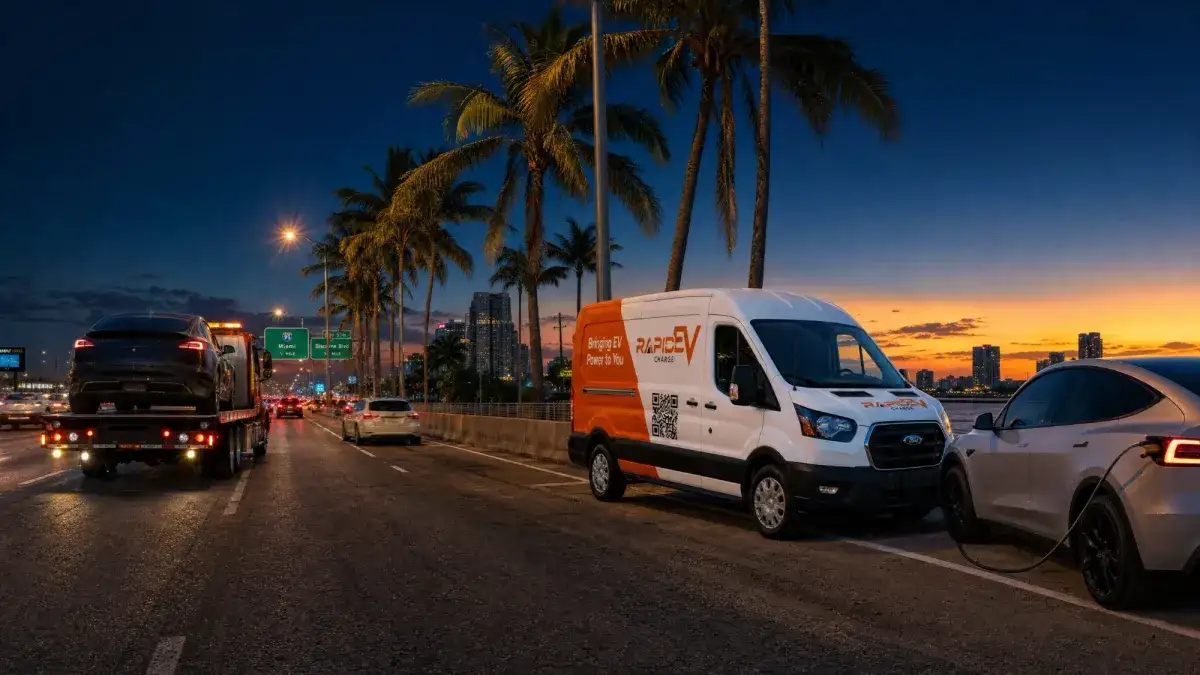
Mobile EV Charging vs Towing: When Each Makes Sense
The hardest part of an EV breakdown isn't the breakdown itself. It's the 30 seconds where you're trying to figure out who to call. Mobile charging? Tow truck? Both? Neither? This is the decision framework we walk customers through.
Your EV is stopped and not moving. You're trying to figure out whether to call mobile charging or a tow truck. That decision matters, making the wrong call costs you time, and in some cases money. This is the decision framework we use at Rapid Charge EV when we triage calls. Read it before you need it.
The fundamental question: power or mechanical?
Every EV breakdown falls into one of two categories. Power problem (no charge, dead 12-volt, charging port issue) or mechanical problem (drivetrain, suspension, brakes, anything else). The right service depends entirely on which one you're dealing with.
Power problems mobile charging can solve: main battery at 0% with no other warnings, main battery low and you need a top-off to reach the next station, dashboard reads "plug in" with no other error codes.
Mechanical problems mobile charging cannot solve: any error code referencing drivetrain, motor, inverter, transmission. Any warning light unrelated to charge state. A vehicle that fails to enter "ready to drive" after you put charge in it. Damage from a collision. Damage from water (saltwater is catastrophic, discussed below).
Decision tree, when to call mobile charging
Call mobile charging when all of the following are true:
The EV is functional aside from being low or at 0% charge.
All doors open normally (12-volt is alive).
The dashboard or app shows the main battery is critically low but no other warning lights.
You're in an accessible location, a parking lot, a residential driveway, a road shoulder, a parking garage.
You need to drive the EV after charging, you're going home, you're going to work, you're catching a flight.
Common scenarios for on-site emergency charging: stranded on I-95 with 0% battery, returned from a cruise to a depleted EV at PortMiami, parked at a hotel valet with a dead Tesla after sitting for 3 days, condo resident whose home charging plan didn't work today.
Decision tree, when to call towing
Call towing when any of the following are true:
The 12-volt is fully dead and doors won't open (you may need a 12-volt jump first, then mobile charging, sometimes a tow is more straightforward).
There's a warning light unrelated to charge state (any motor, drivetrain, brake, or steering warning).
The EV won't enter "ready to drive" mode after charging.
Visible damage from collision or water exposure.
You're in an unsafe location where charging on-site isn't feasible, the middle of a fast-moving lane, an active accident scene, a flooded road.
You suspect saltwater damage, this requires inspection at a dealership or qualified shop before any electrical work, charging included.
Saltwater is the one factor that overrides every other consideration. If your EV has been driven through flooded saltwater (storm surge, beach access), do not charge it. Do not drive it. Have it towed on a flatbed to a qualified service center for inspection. Saltwater inside a high-voltage battery system can be catastrophic and dangerous.
Decision tree, when to call neither
Some situations don't need an emergency call at all.
You're at home with a dead battery and a household outlet: you can trickle charge from a 120V outlet (slow, but free). It'll add 3-5 miles per hour. Not useful in an emergency, but if you're not going anywhere for 12 hours, it works.
You're at a hotel and can wait until morning: many hotels in South Florida have at least L2 charging available. Plug in overnight if it's an option.
You're 10 minutes from a Supercharger and have just enough range to reach it: drive there. Don't sit on the shoulder calling us if you can safely make it to a station.
Mixed scenarios, when you need both
Some calls require both services in sequence.
Scenario: 12-volt dead, doors won't open. Sequence: 12-volt jump first (a separate roadside service we dispatch through our network), then mobile charging once the main system comes online.
Scenario: EV stranded in a position where on-site charging isn't safe (narrow bridge, blocked driveway, fire-lane block). Sequence: short tow to a nearby safe lot (a few blocks away), then mobile charging in the lot.
Scenario: EV stopped in a flooded area but you're not sure if the battery touched saltwater. Sequence: tow to a service center for inspection, then make a charging decision based on the inspection.
When you call Rapid Charge EV at (954) 278-4454 and your situation falls into a mixed scenario, we coordinate. You don't have to figure out the sequence yourself.
South Florida-specific factors
Three South Florida realities change the math.
First: heat. South Florida temperatures above 90°F accelerate battery degradation and increase the urgency of getting a depleted EV out of the sun. If you've been parked in direct sun in August, the priority is shading or moving the EV as fast as possible. Sometimes that means towing to a covered location even if charging would otherwise work.
Second: distance. South Florida is sprawled. The closest tow operator may be 30 minutes away. Mobile charging dispatched from central Miami-Dade can sometimes reach you faster than the tow operator.
Third: time of day. Late-night calls (10 PM-2 AM) have different operator availability for both services. Mobile charging coverage is 24/7. Some towing operators don't run overnight.
What each option actually costs you
Cost belongs in this decision, but only if you count the whole trip rather than the first line item. A metro-area tow in South Florida generally starts around 250 dollars and rises with distance. That figure covers transport and nothing else: the car arrives at a charging station where you still pay for the session, still wait through it, and still need a working stall to be free when you get there.
Delivered charging is a single fee that ends with the car driveable where it already sits. So the comparison is not one price against another. It is one price against a price plus a session plus the hour you spend riding in someone else's truck. That is why the arithmetic usually favours charging whenever the car is mechanically fine.
The exception is worth stating plainly, because it runs the other way: if the fault is mechanical, a tow is the cheaper option at any price, because a charge cannot fix it and you would be paying for both.
Common misconceptions
"I can just plug into a regular outlet at home and charge." Yes, but slowly. A standard 120V outlet adds 3-5 miles per hour. For a stranded EV with critical urgency, that's not useful. Mobile dispatch delivers DC fast charging, usable range in 30 minutes.
"Any tow truck can move my EV." A traditional hook-and-chain or wheel-lift tow can damage an EV's drivetrain. EVs need flatbed towing. Most major Florida towing companies now use flatbeds by default, but verify before the truck arrives.
"I just need to push it home and figure it out tomorrow." Pushing a modern EV any meaningful distance isn't realistic, they're heavy. And the drivetrain shouldn't be rolled in neutral on most EVs (Tesla, Rivian, Lucid all have specific procedures for moving a disabled EV).
What to tell the operator when you call
When you call (954) 278-4454, have these pieces of information ready:
Your exact location, street, intersection, garage level, lot section, mile marker if on a highway.
EV make and model.
Current battery percentage if visible (in the app or on dashboard).
Any warning lights or error messages on the dashboard.
What happened, did it run out, was there a warning, did something break?
Whether the doors open normally (12-volt status check).
With these pieces of information we can usually determine in under a minute whether you need mobile charging, a tow, both, or something else.
Bottom line
Most EV breakdowns are power problems and mobile charging solves them. A meaningful minority are mechanical problems and require a tow. A few are mixed and need both. The decision is rarely ambiguous once you walk through the framework above.
For broader EV charging strategy across South Florida, not just emergencies, our range anxiety guide breaks down 12 specific commute scenarios and the right approach for each. Worth reading proactively rather than reactively.
Is this a power problem or a mechanical problem? If the only thing wrong is that the battery is at 0% or close to it, you have a power problem and mobile charging solves it. If the EV won't enter drive mode after you put power in it, or if there's a warning light unrelated to charge state, you have a mechanical problem and need a tow to a service center.
Can mobile charging fix a dead 12-volt battery?
Sometimes, depending on the EV. Modern EVs can charge the 12-volt from the main pack once the main pack has power, so delivering charge to the high-voltage battery sometimes restores the 12-volt indirectly. But not always. If the doors won't open or the screen is completely dark, the 12-volt is the immediate problem and a jump is needed first, which is a separate service from charging.
Will a regular tow truck damage my EV?
A traditional hook-and-chain or wheel-lift tow can damage an EV's drivetrain because the wheels spin the motor during transit. EVs need flatbed towing. This is standard now at most major towing companies, but verify before the truck arrives.
What if I'm not sure which it is?
Call (954) 278-4454 and describe what you're seeing, the EV's state, what's on the dashboard, what error messages if any. We'll triage on the phone before dispatching. About 80% of the time we can determine remotely whether it's a charge problem or a mechanical problem.
The Turnpike is the hardest road in South Florida to run out of charge on. Long exit spacing, toll logistics, and thin charging. Here's the playbook, written for this specific road. Call (954) 278-4454.
Apartment hunting with an EV changes the checklist. Here is where charging-equipped buildings actually cluster in South Florida, the exact questions to ask a leasing office, and the fix when your building offers nothing. Call (954) 278-4454.
Board approval for an EV charger is a paperwork problem dressed as a political one. Here is how Florida owners actually get to yes, and what covers the months in between. Call (954) 278-4454.