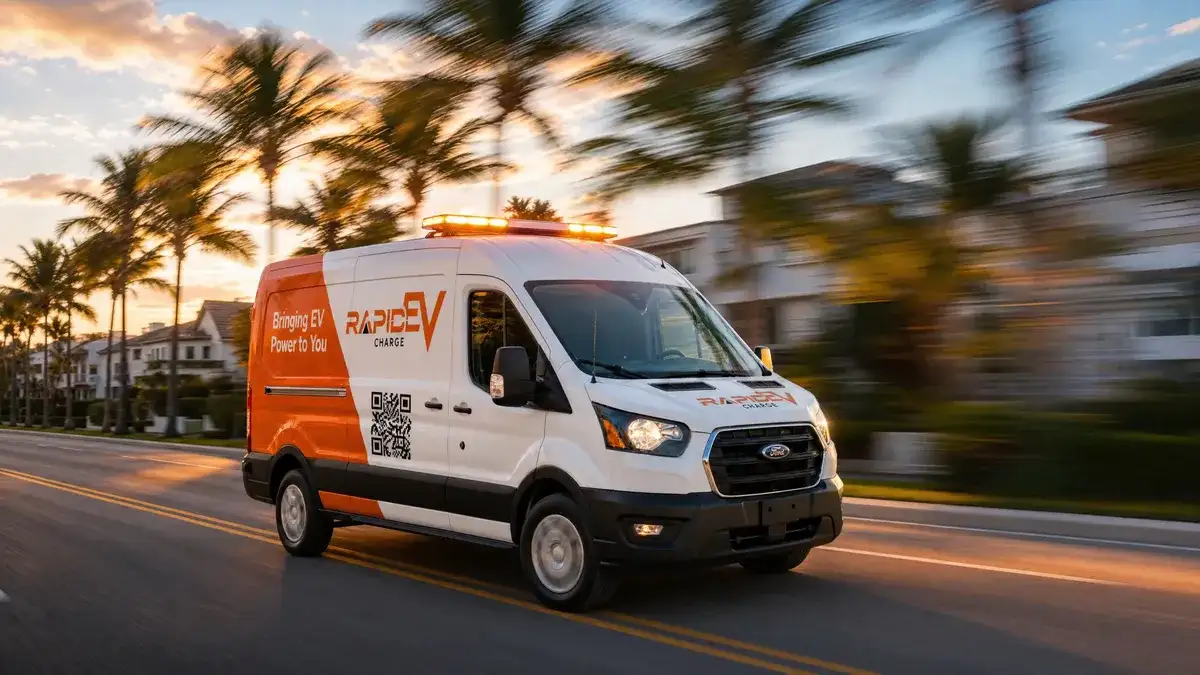
On-demand is the service model people picture when they think 'mobile EV charging', but the dispatch is more specific than that. This explains what happens from the moment you call, what the response time math actually looks like in South Florida, and the situations on-demand fits versus the ones where scheduled is the better tool.
On-demand EV charging is the call-now-get-charged-now model. You're out of charge, or close to it. You call. A truck dispatches to your location and delivers usable range on the spot. The technician leaves. You drive away. The whole process from call to driving away is typically under 90 minutes, though that number depends heavily on where you are and what's happening on the roads.
This post explains how Rapid Charge EV runs the on-demand model specifically, what it is, how dispatch actually works in the field, and when it's the right service versus when something else fits better. If you want the broader picture of what mobile EV charging is in general, our complete mobile EV charging guide is the place to start.
On-demand versus scheduled versus subscription
Three operational models exist in mobile EV charging. They're often discussed interchangeably, which causes confusion.
On-demand is reactive. You call when you need charge. The truck dispatches. There's no advance arrangement. Response time depends on dispatch availability and your location. This is the model most people associate with 'roadside EV charging' or 'emergency charging.'
Scheduled is proactive. You arrange recurring service, weekly, bi-weekly, monthly, and the truck shows up at a known time at a known location. This is how condo residents and snowbirds use mobile charging for routine power, not just emergencies. The scheduled home and condo service handles this model.
Subscription is a contract structure that can wrap either on-demand or scheduled service, typically used by fleet operators who want guaranteed response or guaranteed charging windows. It's not a separate service so much as a way of structuring access to one of the two underlying models.
Most individual consumers either need on-demand (occasional emergencies, road trips that didn't go to plan) or scheduled (recurring condo or rental charging). Knowing which you're solving for matters more than the marketing labels.
What actually happens from call to charge
The dispatch flow for an on-demand call breaks down into five real steps.
1. The call
You call Rapid Charge EV at (954) 278-4454. We need four pieces of information fast: your location (cross-streets or a dropped pin if you're on a highway), your vehicle (year, make, model), your state of charge (the dashboard percentage if you can see it, or 'dead' if it's already shut down), and your destination, where you actually need to get to. That last piece sets how much charge we'll deliver.
2. The quote and ETA
We give an honest ETA based on what truck is closest, where it is, and what traffic is doing. We give a quote based on your situation. Both numbers are real numbers, not marketing. If we say 45 minutes, we mean 45 minutes, give or take traffic. If we can't get to you in a reasonable window, we say that and recommend an alternative.
3. Dispatch and travel
The technician confirms the connector type before leaving, loads any specific equipment needed for your vehicle, and travels to your location. During this window you should stay where you are if it's safe, keep hazard lights on, and answer the phone, sometimes the tech calls during travel for clarifying details (which level of the garage, which side of the highway, etc.).
4. On-site charging
The tech arrives, confirms the vehicle and connector, plugs in, and starts the session. Most on-demand calls last 15 to 45 minutes of actual charging, enough to add the range you need. The tech stays on-site, monitors the charge, and confirms the vehicle is accepting power normally. You can sit in the vehicle, wait nearby, or step away if you're somewhere safe.
5. Sign-off and drive
When the charge is complete, the tech unplugs, confirms your dashboard shows the expected state of charge, handles payment, and clears the scene. You drive away on the power that was just delivered. That's the entire on-demand cycle.
Response time realities in South Florida
South Florida is a 100-mile-long service area. A call from Brickell to a downtown Miami location at 10 AM on a Tuesday is dispatched fundamentally differently from a call out near Jupiter at 6 PM on a Friday. We give you the actual ETA on the call rather than a generic number on the website because location and timing dominate the math.
Broad rules of thumb: weekday mornings and mid-mornings are fastest. Late afternoons during rush hour are slowest. Weekend evenings, especially during event season, can stretch. Holiday weekends are unpredictable. North Palm Beach and the far ends of the Keys are the longest reaches. The core urban corridor, Hollywood through Coral Gables, plus Aventura, has the fastest response by far.
If you're routinely calling on-demand from the same location, it's often worth converting to scheduled. Predictable need is what scheduled is built for, and the response math gets easier when we know in advance.
When on-demand fits
The on-demand model fits a specific shape of need:
Stranded, you can't reach a station and need energy to get moving.
Travel surprise, a road trip went off plan, the Supercharger is queued or down, you need bridge charge to reach the next station.
Event spillover, you stayed longer than expected at a concert, game, or work event and the battery doesn't have what you thought it did.
Bad-day routine break, your normal home or workplace charging fell through (wall box fault, parking lot blocked, etc.) and you need a one-off bridge.
Visiting drivers, you're in South Florida for a few days, rental or borrowed EV, no home base, public charging didn't pan out.
In each of these, the defining characteristic is that the need is unpredictable. You couldn't have scheduled it.
When on-demand isn't the right model
On-demand is the wrong tool when the need is predictable. If you're calling us every Tuesday because your condo doesn't have charging and you commute 50 miles a day, that's a scheduled service situation, not an on-demand one. The on-demand pricing structure assumes one-off urgent dispatch; recurring need is structured differently because the operational model is different.
It's also the wrong tool when on-the-go is the wrong frame entirely. If you're commuting between West Palm and downtown Miami daily and you're constantly running on the edge, that's not a dispatch problem, it's a planning problem. Our range anxiety guide walks through 12 specific commute scenarios and the right strategy for each. Sometimes the answer is mobile charging, sometimes it's a workplace charger or an installed home wall box, sometimes it's a different commute schedule.
Quick top-up versus full charge
Realistic expectations matter. A typical on-demand emergency visit delivers enough range to reach a fixed station or get you home, usually 15 to 50 miles depending on the call. Full battery-to-100% charges are unusual on emergency calls. They're more common on scheduled service.
Why the difference? Emergency calls are bridge events. You don't actually need 100%, you need enough. Scheduled calls are planned events with longer windows; full charges are practical there. On-demand is sized for the bridge.
Bottom line
On-demand EV charging is the right tool for unpredictable charging needs in South Florida, emergencies, travel surprises, events, bad-day breaks in your normal routine. It's not the right tool for predictable, recurring need; that's what scheduled service is for. Knowing which model you're actually solving for makes the dispatch faster and the pricing fairer.
You call, give us your location, vehicle, and approximate state of charge, and we dispatch the nearest available truck. The technician arrives, identifies your connector, plugs in, and delivers usable range, typically 15 to 50 miles depending on what you need. Total time on-site is usually 15 to 45 minutes.
How fast is the response in South Florida?
Highly variable by location and time of day. Tri-county coverage spans Broward, Miami-Dade, and Palm Beach, about 100 miles north-to-south. A call from Brickell at 10 AM is dispatched faster than a call from Jupiter at 6 PM with rush-hour traffic on I-95. We give an honest ETA when you call rather than a marketing number.
Is on-demand more expensive than scheduled charging?
Pricing depends on your specific situation, distance, time of day, type of call. We give a clear quote during the dispatch call. Generally, scheduled recurring service is structured differently than one-off on-demand calls because the operational model is different.
When should I call on-demand versus tow versus public charging?
On-demand is the right call when you can't safely reach a fixed station, you don't need vehicle repair (just energy), and you're somewhere a truck can access. We've written a separate guide on mobile EV charging versus towing that walks through the decision logic in more detail.
In Miami-Dade, the speed of mobile charging is less about the cable and more about the city: towers, causeways, and traffic decide how fast help arrives. The honest breakdown. Call (954) 278-4454.
The right adapter unlocks thousands of new charging stalls. The wrong one overheats in your charge port. Here is how NACS, CCS1, and J1772 adapters actually work and how to buy safely. Call (954) 278-4454.
Palm Beach charges well at its famous nodes and barely at all in between. The western communities and the in-between cities live in the gaps, and the season squeezes everything. Call (954) 278-4454.