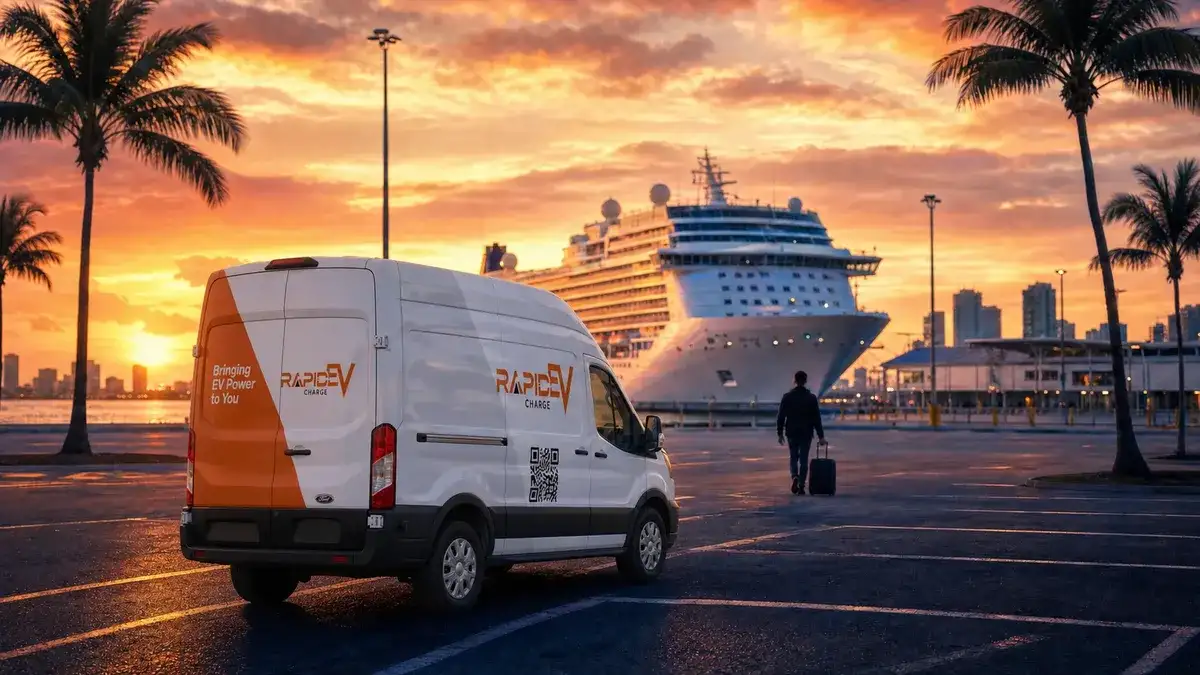
Stranded at PortMiami After a Cruise? EV Charging Guide
Cruise turnaround days at PortMiami generate more EV charging calls per square mile than any other location in Miami-Dade. The good news: this is one of the most predictable scenarios we handle, and there's a clear path from "my battery is dead" to "I'm on I-95 northbound in 45 minutes."
You spent a week at sea. You're tired, your luggage is heavy, and you just want to drive home. You hit unlock on the EV app and the battery reads 2 percent. Or you walk to the car and the screen is dark. Or the doors won't even open because the 12-volt is dead.
PortMiami cruise-return scenarios are one of Rapid Charge EV's most-dispatched call types, especially on Saturday and Sunday turnaround days. The pattern is so consistent we have a standard playbook for it. Here it is.
Why this happens
Three things conspire against an EV parked at PortMiami for a week.
First: vampire drain. Modern EVs continuously consume small amounts of power even when parked, keeping the climate control system on standby, running security cameras (Tesla Sentry Mode is notorious for this), monitoring the battery management system, supporting over-the-air updates. A few percent per day on most EVs. Multiply by seven days at sea and you're easily down 20%+.
Second: Florida heat. Sustained 85-90°F days in a parking lot with no shade accelerate battery degradation patterns and increase the cooling system's idle draw. The same EV parked for a week in October versus August will lose meaningfully more charge in August.
Third: the 12-volt battery. EVs use a small 12-volt auxiliary battery for door locks, infotainment, and other basics. When the main pack drains far enough, the system can fail to maintain the 12-volt, at which point the doors won't unlock, the screen is dark, and you can't even get to the charging port. This is a common Tesla failure mode after extended sealed parking.
First 3 things to check before calling
Before you reach for the phone, run these checks. They'll save you and us time.
Try the physical key card or fob to unlock. App-based unlock fails when the 12-volt is dead; the physical key may still work.
Look for the manual frunk release (Tesla: behind the tow eye cover; Rivian: on the driver-side wheel well). If the doors won't open, you may need to manually reach the 12-volt to jump it before any charging can begin.
Check your charge percentage in the app one more time. Some EVs read 0% on the dashboard but actually have a few miles of reserve. Knowing the real number changes our approach.
When to call mobile charging vs. something else
Mobile charging is the right call when: the EV is functional but low (above 0% or just at 0% with reserve), all doors open normally, and you just need power to get out of the port.
Mobile charging is not the right call when: the 12-volt is fully dead and doors won't open (you need a tow or a 12-volt jump first), there's visible water damage from a storm during your absence (electrical inspection required), or the vehicle won't enter "ready to drive" mode after we deliver charge (mechanical issue, not a charge problem).
When in doubt, call (954) 278-4454. Describe what you're seeing, we'll triage. About 90% of cruise-return EV calls are straightforward mobile-charge scenarios. The other 10% need a tow first, and we coordinate that through our dispatch network.
What dispatch looks like at PortMiami
PortMiami access is straightforward. The truck enters via the standard cruise terminal gates. You meet us at your vehicle. Tell us when you call: the terminal letter (A through J), the parking lot section, and your row number if you remember it. If you don't remember exactly, the terminal letter is enough, we'll find you.
Charging itself takes 15 to 45 minutes for a typical "get me out of here and home" amount of range. We don't try to fill the battery on-site, that's slow and unnecessary. Once you're at 30-50%, you're well past the range needed to reach Brickell, Aventura, FLL, or wherever you're going next.
Pricing depends on your specific situation, contact us when you call and we'll quote upfront before dispatch.
Tips for next time
If you cruise out of PortMiami regularly, three habits will reduce your future emergency calls.
First, charge to 80% the day before you board. Don't leave with 40%. The math on a week of vampire drain is well-documented and a higher starting state of charge fixes most of it.
Second, turn off Sentry Mode (Tesla) and equivalent security camera features on Rivian, Lucid, and others before parking. They burn more power than most owners realize over a multi-day window.
Third, use the EV app to monitor charge level mid-cruise. Most ships have Wi-Fi that works for EV app pings. If you see the battery dropping faster than expected, you can pre-schedule a charge for your return day, and walk off the ship to a topped-off EV.
Cross-bay and beyond
Cruise traffic at PortMiami connects into the broader Miami-Dade driving footprint, from the port you're 5 minutes to downtown Miami, 10 minutes to Brickell, 25 minutes to Coconut Grove, an hour to Fort Lauderdale in light traffic. If you're stranded at the port and worried about the range to your home, our broader South Florida range anxiety guide walks through the most common commute scenarios and what each one actually needs.
If you are back at PortMiami with a battery that will not make the drive home, call Rapid Charge EV at (954) 278-4454 or email support@myrapidchargeev.com. We dispatch across Broward, Miami-Dade, and Palm Beach 24/7.
Frequently Asked Questions
How long can I leave my EV at PortMiami before it dies?
Depends on the vehicle, the season, and how aggressively you've configured features like Tesla Sentry Mode. A typical sealed-up Tesla left for 7 days in Florida heat can lose 15 to 30% of charge to vampire drain. Some Rivians and Lucids burn less. A vehicle that started the week at 90% is usually fine; one that started at 40% may not be.
Can you actually reach the cruise terminal lots?
Yes. The port's long-term lots are vendor-accessible. Tell us the terminal letter (A through J), the lot section, and your row when you call. We coordinate with port security at the gate if needed.
How long does the on-site charge take?
Typically 15 to 45 minutes for enough range to get you home and recharged. We won't bring your battery to 100% on-site, that's slow and unnecessary. We give you what you need to get out of the port and to your next destination.
Is this only an emergency call or can I schedule it for cruise day?
Either. Frequent cruisers schedule us to top off the day of arrival so the EV is ready the moment they walk off. Call us a few days before your trip if you want to set up a pre-scheduled charge.
A week at sea is the longest most EVs ever sit unplugged. This checklist covers what to do before you hand over the luggage at Port Everglades and what to do if the car is lower than expected when you walk back to it. Call (954) 278-4454.
Sailing out of Jacksonville's cruise terminal means an EV sitting in a lot for a week. Here is the pre-cruise plan, the honest math on parked battery drain, and the rescue call when the return does not go to plan. Call (954) 278-4454.
Plantation's population doubles by day, and so do its dead batteries: office garages, mall lots, and the Sawgrass commute. Here is who dispatches mobile EV charging to the workday city. Call (954) 278-4454.