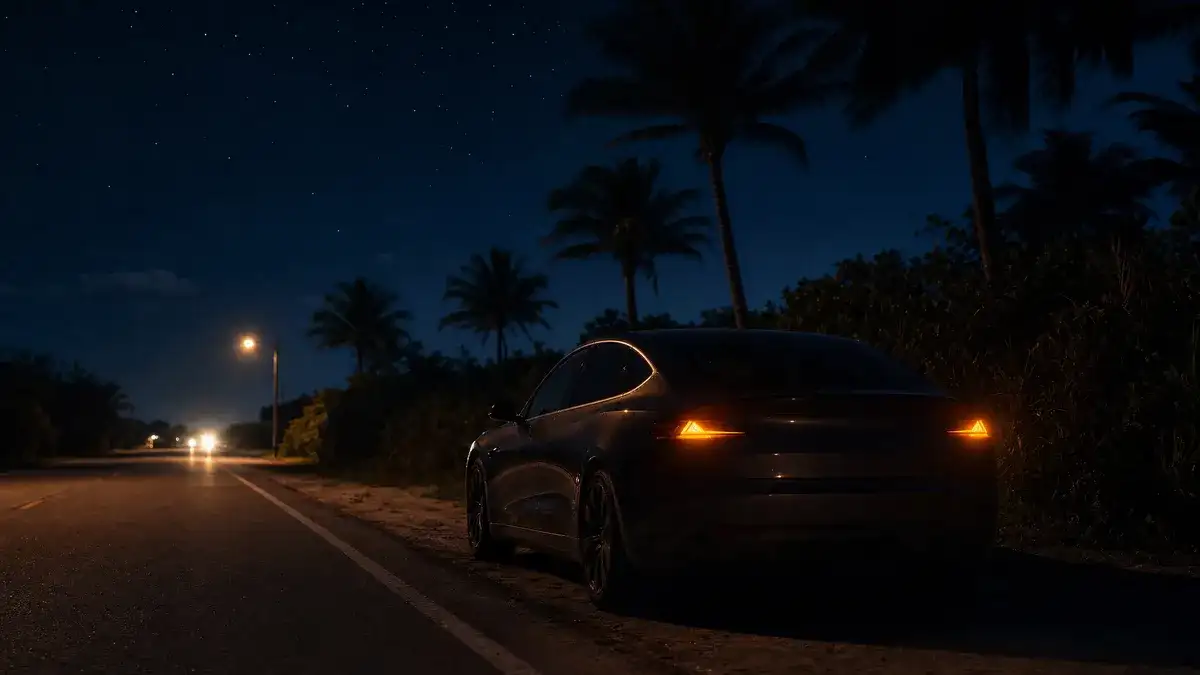
Stranded at 2 AM: A South Florida Mobile Charging Story
This is the kind of call that explains the service category better than any feature list. A composite based on actual operational reality of late-night dispatch. The details are real even though the specific customer is anonymized.
The call came in at 2:07 AM. A Tesla owner, somewhere in Wynwood, stranded with effectively no charge. He had been at a late dinner with friends, lost track of state of charge, and the vehicle had shut down a couple of blocks from where he parked. He was tired, embarrassed, and unsure if anyone even worked at this hour. He had called the dispatch number that turned up first in a Google search. Rapid Charge EV does work this hour. This is the story of that dispatch.
The call: 2:07 AM
The dispatcher answered on the second ring. The customer was apologetic, which most of them are at this hour. People do not call mobile EV charging at 2 AM because their day is going well. The dispatcher walked him through the four questions: where are you, what vehicle, what state of charge, where are you trying to get to.
Wynwood, near Northwest 2nd Avenue and 26th Street, parked in a public lot. A 2024 Model Y Long Range. Dashboard showed zero, vehicle was off, not responsive to the app. He was trying to get home to a condo in Edgewater, about ten minutes away in normal conditions.
The dispatcher confirmed the connector (NACS, standard for Tesla), pulled up the nearest available truck, and gave him an ETA: 35 minutes. Wynwood at 2 AM is empty. Empty roads should be fast roads. The dispatch radius from our nearest position to his location was the limiting factor, not traffic.
What the dispatcher sees
On the dispatcher's screen at this hour: a map of the tri-county area with the small handful of active trucks, the current call in the queue, and a sparse highway network compared to the daytime version of the same view. I-95 and the Palmetto are essentially empty. The major causeways are quiet. The Brickell-to-Wynwood corridor that takes 30 minutes at 5 PM takes 8 minutes at 2 AM.
The dispatcher also sees the operational reality that is invisible from the customer side. Other trucks on other calls. Trucks returning to base for a refill. The handful of routine maintenance issues that always seem to surface in the small hours: a generator fault on one rig that had to be cycled, a tablet update that lost connection for ten minutes. None of it visible to the customer. All of it the texture of running a 24/7 operation.
The dispatcher made the call assignment, confirmed it with the technician on shift, and sent the customer a follow-up text with the technician's name and ETA. Standard procedure. The customer's anxiety dropped maybe 15 percent. It is real to him now.
The drive
The technician was finishing a previous call in Doral. He pulled out of the lot at 2:14 AM, took the Palmetto Expressway north, exited at the Julia Tuttle, and crossed into Miami proper. The roads were empty. Traffic lights cycled to red and green for no one. The skyline of Brickell to his right was lit but quiet.
Wynwood at 2 AM is a different city from Wynwood at 10 PM. The galleries are closed. The bars are shutting down. The streets are mostly empty except for the occasional car heading home or a delivery truck staging for tomorrow's runs. The technician knew the area. He has done calls in every part of it.
He arrived at 2:39 AM. The customer was sitting in the driver's seat of his vehicle, the doors unlocked. The truck pulled in front of the Tesla. The technician got out, identified himself, and started the standard pre-charge protocol.
The arrival
Three things happen in the first minute when a technician arrives on a dead-battery call. First, safety check. Is the vehicle in a safe position? Is anyone at risk from passing traffic? Is the environment hot, cold, wet? Tonight: no traffic, mild temperature, dry. Best-case operational environment.
Second, vehicle verification. Right model, right connector, charge port location confirmed, any visible damage or warning indicators noted. The Model Y was clean, lock-disengaged after the technician used a charge-cable contact to wake the system. Standard for a fully-shut-down Tesla.
Third, customer status. Awake, coherent, hydrated. The technician asked. The customer said yes, he had water in the car, he was fine, he just wanted to get home. The technician confirmed the destination and walked through what was about to happen: 15 to 45 minutes of charging, enough to deliver a working margin of range, more than enough to get to Edgewater and home.
The charge
The technician connected the NACS cable from the truck to the Tesla's charge port. The vehicle came alive: dashboard lit, climate system whirred, the familiar Tesla startup sequence. The charge began. On the truck's display: voltage, current, kilowatt-hours delivered in real time, the vehicle's state of charge updating on its own dashboard.
While the charge ran, the technician did the things technicians do during a 35-minute session. Checked the cable connection. Monitored the output. Stayed on-site, visible to the customer but not crowding him. The customer pulled out his phone and started scrolling. The streetlights buzzed overhead. A delivery van rolled by on Northwest 2nd. Wynwood at 2 AM kept being Wynwood at 2 AM.
Twenty minutes in, the vehicle's dashboard showed 12 percent state of charge. Enough to drive home, but the customer wanted a little more buffer. The technician extended the session another 15 minutes. By 3:22 AM the vehicle was at 22 percent. Plenty for a ten-minute drive to Edgewater with margin.
The resolution
The technician disconnected the cable, coiled it back into the truck, and walked the customer through the rest of the process. The vehicle would drive normally now. He recommended setting a charge limit reminder for next time, but he did not lecture. People who call us at 2 AM have already learned the lesson. The job is to get them home, not to scold them.
Payment was handled through the standard process. The technician confirmed the customer was good to drive, watched him pull out, and called dispatch to clear the scene. 3:31 AM. Total time from call to clearance: about 90 minutes. Roughly half driving, half charging, a few minutes of safety check and verification.
The technician headed back toward base for a quick refill before the next call, or for the end of his shift if the night was finally quiet. Either way, the work cycle continued.
What this kind of call says about the service
Late-night dispatch is different from daytime dispatch in specific ways.
Customers are more apologetic. They feel like they have done something wrong. Most have not. They have just hit a routine charging issue at an inconvenient hour.
Roads are faster. Travel time from depot to call drops significantly compared to rush hour. The 30-minute call radius doubles in geographic terms.
Calls are typically simpler. Daytime emergencies often involve accidents, complex parking, weather, traffic. 2 AM calls are usually just dead batteries in safe locations.
The customer's emotional state matters. A stranded EV at 2 AM is an isolating experience. The technician's job is partly technical and partly to make the customer feel less alone with the problem.
The 24/7 promise is operational, not marketing. If Rapid Charge EV says we dispatch at all hours, we mean it. The dispatcher takes the call, the technician runs the route, the system works the same as it does at noon.
Why we do this hour
Some operators in this space do not dispatch overnight. They run business hours and a couple of extension shifts. We made the decision to run round-the-clock mobile charging for a specific reason. The calls that come in at 2 AM are exactly the ones where the alternative options are worst. Public Superchargers do not close, but their queues are unpredictable. Tow trucks operate overnight but a tow plus next-day charging is a 12-hour ordeal compared to a 90-minute dispatch. Friends and family at 2 AM are usually not great options either.
Late-night service is also disproportionately when the customer remembers the experience. A daytime call that goes well is a daytime call that went well. A 2 AM call that goes well becomes the story they tell their friends, their colleagues, the people who ask about whether mobile EV charging is real or a marketing concept. It is real. It is real at 10 AM, and it is real at 2 AM, and the operational version of real is what we do.
What you can take from this
Three things if you are an EV owner reading this in case you ever need it.
First, save (954) 278-4454 in your contacts. It is the cheapest insurance you can carry as an EV owner in this metro. Our 7 things to check before your EV hits 10% post covers the prevention version of this.
Second, do not feel embarrassed if you ever call us at 2 AM. The dispatcher and the technician have done it hundreds of times. The math is simple: you need charge, we have charge, the rest is logistics. We do not lecture and we do not gatekeep.
Third, the texture of how this works is not magic. Trained technician, equipped truck, dispatch system that knows where everyone is and how much capacity is available, a network of depots that keep the trucks fueled and ready. Our inside the truck walkthrough covers the equipment side. The MacArthur Causeway emergency guide covers what to do if your version of this happens on a bridge instead of in a parking lot. The South Florida range anxiety guide covers the planning version. The pieces are operational, not magical.
Bottom line
Mobile EV charging is a service category that is hard to fully understand from a website. The actual operational reality, what happens between the call and the resolution, the texture of the dispatch and the drive and the charge, is what makes it more than a marketing concept. We run dispatches like this one every night. Most of them resolve cleanly. The customers go home. The technicians head to the next call. The service continues.
Details in this account are anonymized and composited to protect customer privacy. The dispatch sequence and operational reality are authentic.
If your version of this story ever happens, call Rapid Charge EV at (954) 278-4454 or email support@myrapidchargeev.com. We dispatch across Broward, Miami-Dade, and Palm Beach 24/7.
Frequently Asked Questions
Do you really dispatch at 2 AM in South Florida?
Yes, 24 hours a day, 7 days a week, across Broward, Miami-Dade, and Palm Beach counties. Late-night calls are a real and recurring part of our operation. The same dispatch system, technicians, and trucks operate overnight as during the day.
Is response time longer at night?
Travel time is often faster at night because traffic clears, but the active fleet at 2 AM is smaller than during the day, so depending on where you are and where the nearest available truck is, total response time varies. We give an honest ETA when you call.
Should I feel embarrassed calling at 2 AM?
No. Our dispatchers and technicians have handled hundreds of late-night calls. The math is simple: you need charge, we have charge, the rest is logistics. We do not lecture and we do not gatekeep. Late-night calls are exactly what 24/7 service exists for.
Where can I read more about how mobile charging actually works operationally?
Our inside the truck walkthrough and complete guide to mobile EV charging both cover the equipment and service-model side in depth. The 2 AM story is a snapshot of how all that infrastructure looks from the inside on a specific kind of call.
The airport run that landed late, the night shift that ran long, the dark stretch of Heckscher Drive: 2 AM strandings are Jacksonville's loneliest breakdowns. Here is who actually answers, and how the call goes. Call (954) 278-4454.
The Turnpike is the hardest road in South Florida to run out of charge on. Long exit spacing, toll logistics, and thin charging. Here's the playbook, written for this specific road. Call (954) 278-4454.
Charge to 80%, run down to 20%, repeat. The rule is real, the science is real, and it works. The South Florida version has wrinkles generic guides miss. Call (954) 278-4454.