What Is Vehicle-to-Grid (V2G) Charging? A Florida Guide
Vehicle-to-grid (V2G) and vehicle-to-home (V2H) bidirectional charging is one of the most important EV technology trends of the next five years. For South Florida specifically, the hurricane backup-power use case is the one that matters most. Here is the operator's view of how it works, what equipment you need, and where mobile charging fits in.
Vehicle-to-grid (V2G) charging is bidirectional EV charging: your electric vehicle's battery can send power back out through the charge port, into your home, into the utility grid, or to specific connected loads. For South Florida specifically, the hurricane backup-power case (vehicle-to-home, or V2H) is the one most owners will care about. This guide, written from Rapid Charge EV's operator vantage across Broward, Miami-Dade, and Palm Beach, walks through how V2G and V2H work, which vehicles support them today, what equipment a real installation requires, the Florida regulatory landscape, and where mobile EV charging fits into a V2G household.
How V2G actually works
A standard EV charging session is one-way: the charger pulls AC power from the grid, the vehicle's onboard charger converts it to DC and stores it in the battery, and that energy stays in the battery until the motor consumes it. V2G adds the reverse path: the battery can discharge through the charge port, the system converts DC back to AC at the right voltage and frequency, and the resulting power flows out to wherever it is needed.
Doing that safely requires three things working together. A vehicle with the inverter hardware and software that permits discharge. A charger (sometimes called a bidirectional charger or DC charging station) that supports the reverse flow. And either a home electrical setup that can accept the inbound power (for V2H) or a utility-approved grid interconnection (for V2G). When the system is working, the vehicle becomes a large lithium-ion battery pack on wheels, capable of running a home for days or pushing power back into the grid for compensation.
V2H, V2G, V2L: three different things
The acronyms get used interchangeably in marketing materials but they describe different technical capabilities.
V2L (vehicle-to-load) is the simplest and most widely available. The EV has one or more standard household outlets, usually 120-volt, that can power small loads directly: a fridge, a fan, a TV, lights. The Hyundai Ioniq 5, Kia EV6 and EV9, and some Ford and GM EVs ship with V2L outlets. No special home wiring required. Limited capacity, but useful for tailgating, camping, or short outages.
V2H (vehicle-to-home) is bigger. The vehicle connects to a bidirectional charger that ties into the home's electrical panel, usually through a transfer switch or a dedicated critical-loads subpanel. When the grid goes down, the system automatically switches to draw power from the EV battery instead of the utility, and essential circuits stay live. This is the hurricane backup use case.
V2G (vehicle-to-grid) is the most complex. The vehicle sends power back through the home's electrical service, through the utility meter, and into the broader grid, typically as part of a utility demand-response program. V2G can generate revenue for the vehicle owner during high-demand periods. It requires utility approval, specific equipment certifications, and interconnection agreements that vary by jurisdiction. V2G is technically feasible in Florida but not yet widely available.
Which EVs support bidirectional charging today
The list changes year to year as manufacturers add and certify capability. As of 2026, the practical landscape:
Ford F-150 Lightning: V2H supported through the Ford Intelligent Backup Power system using the Ford Charge Station Pro. Mature, well-documented, available in South Florida. The most plug-and-play V2H product on the US market.
Kia EV9: V2L standard, V2H capability with the right bidirectional charger (verify support for your specific model year before purchasing equipment). One of the better non-Tesla SUV options for V2H households.
Hyundai Ioniq 5, Hyundai Ioniq 6, Kia EV6: V2L outlets included. V2H with additional equipment depending on model year.
Chevrolet Silverado EV and GMC Sierra EV: V2H supported with the GM Energy V2H Bundle. Hardware shipping but availability rollout has been uneven.
Nissan Leaf: limited V2X capability via CHAdeMO with specific bidirectional chargers. Older model years were pioneers but the CHAdeMO connector itself is fading.
Tesla Model 3, Model Y, Cybertruck: Tesla has signaled bidirectional capability on newer hardware but as of early 2026 has not shipped a consumer V2G product. Verify status before counting on it.
Rivian R1T and R1S: V2H roadmap announced but availability has been delayed. Check the latest from Rivian directly.
Two things to keep in mind. First, the vehicle's hardware capability is necessary but not sufficient: you need a compatible charger and the right home electrical setup. Second, capability differs by model year and trim, sometimes by a single software update. Verify with your specific vehicle, not the general model name.
Why this matters more in South Florida than elsewhere
Most V2G coverage in national media is written for households that occasionally lose power for a few hours during a winter ice storm or a summer brownout. South Florida operates on a different scale of outage exposure.
Hurricane season runs June through November. Major storms hitting the Florida coast can take a meaningful share of FPL's service territory offline for days. Even non-hurricane events (severe thunderstorms, flooding, infrastructure failures) contribute to a baseline level of grid disruption that owners in less storm-prone metros do not experience.
An EV with V2H capability genuinely changes the calculus of household resilience. A typical EV battery holds 70 to 130 kilowatt-hours of energy, enough to run essential household circuits (refrigerator, ceiling fans, internet, medical equipment, a couple of LED light circuits, intermittent AC use) for days, not hours. For households with elderly residents, infants, refrigerated medication, or work-from-home requirements that cannot tolerate week-long outages, that capability is meaningful in a way it is not in a Phoenix suburb.
Our hurricane prep guide for Florida EV owners covers the broader storm-readiness picture for EV households. V2H is the highest-impact addition to that playbook when the budget and infrastructure allow it.
What equipment a real V2H install requires
V2H is not plug-and-play in the way a Level 2 charger install is. The system has multiple components and the installation is a real electrical project.
Bidirectional charger: the centerpiece. For Ford Lightning, the Ford Charge Station Pro is the matched product. For other vehicles, options include the Wallbox Quasar 2, dcbel r16, Emporia bidirectional units, and a growing list of others. Compatibility with your specific vehicle and home electrical service matters more than any single feature.
Electrical panel work: most V2H installs require panel upgrades, a dedicated transfer switch, or a critical-loads subpanel that isolates the circuits that will run on EV power during an outage. South Florida homes built before 2000 often have older panels (Federal Pacific, Zinsco, undersized service entrances) that need updates first. Coral Gables, Coconut Grove, Pinecrest, and older Boca Raton neighborhoods are common cases.
Permits and utility approval: any electrical work touching the meter or the service entrance requires permits. For V2G specifically (grid-tie, not just V2H backup) you also need utility interconnection approval from FPL, which has specific requirements for the inverter equipment and the interconnection agreement. V2H, where you are not pushing power back to the grid but only to your house during an outage, is simpler regulatorily but still requires permits.
Installer: this is not a DIY project. Find an electrician experienced with EV charging and ideally with bidirectional systems. The market for that specific expertise is small but growing in South Florida.
The FPL and Florida regulatory landscape
Florida Power & Light serves most of South Florida and sets the practical rules for what V2G and V2H installations look like in this market. The key dynamics:
Net metering exists in Florida but has been subject to ongoing legislative and regulatory adjustments. The economics of selling power back to the grid (V2G) depend on what the current net-metering rules are when you install. Check the current FPL net-metering tariff before planning around any specific revenue assumption.
Interconnection: FPL has a process for approving customer-owned generation interconnected to the grid, which is what V2G requires. The process can take weeks to months, the equipment has to be on FPL's approved equipment list, and the installer's experience with the process matters a lot.
V2H is regulatorily simpler because the EV is not sending power back to the grid, only to the home's internal circuits during an outage. The transfer switch isolates the home from the grid during the outage, which is exactly what utility codes require. V2H installs still require permits but they do not require interconnection approval.
The friction in Florida specifically: net-metering economics have been less favorable than in some states, which has slowed adoption of full V2G compared to V2H. Most South Florida V2H households we work with are using the system primarily for backup power, not for grid-export revenue.
Where mobile EV charging fits
A V2H household has a robust home power and charging setup. So what does mobile EV charging add?
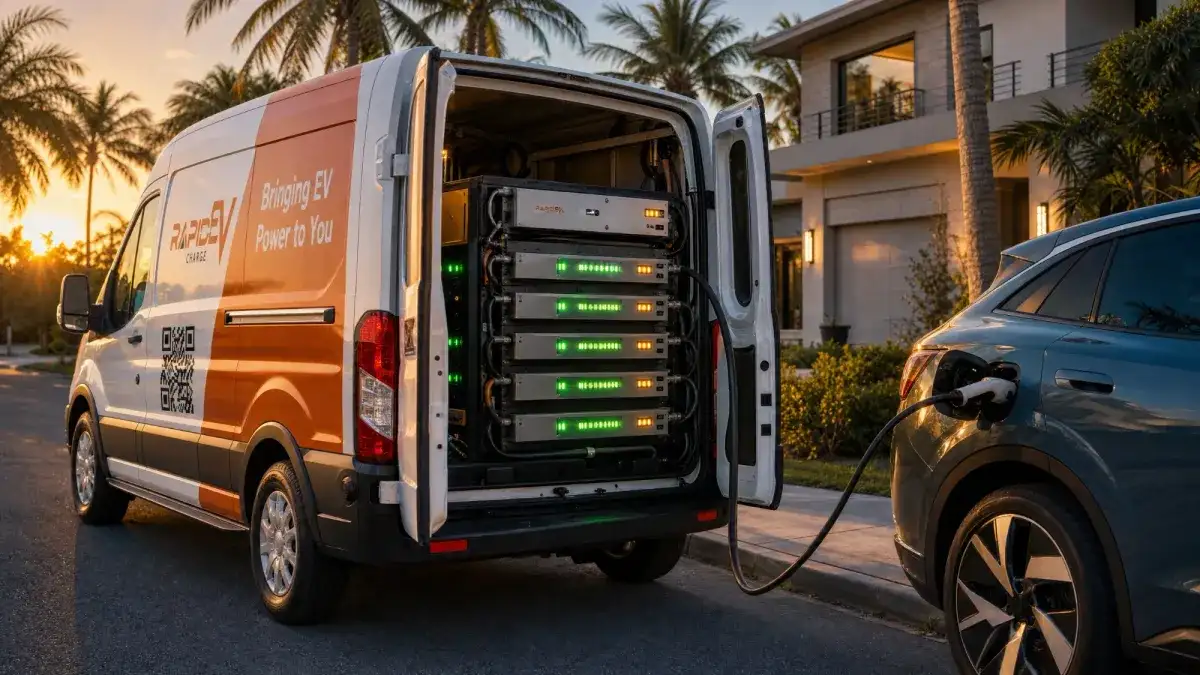
Two scenarios. First, when you are away from home. V2H protects your house. It does not protect your vehicle from running out of charge on a Tampa road trip or in a Brickell parking deck. Rapid Charge EV's mobile dispatch fills that gap, one call to (954) 278-4454 covers it. Second, when the home system itself has issues. Bidirectional chargers are sophisticated equipment and they can fail. Storm damage to the home panel, a fault in the charger, a software issue with the vehicle: any of these can take the V2H system offline temporarily. Mobile charging is the redundancy that keeps you moving while you sort out the home issue.
Our complete mobile EV charging guide and the on-demand charging guide cover the broader service model. For V2H households specifically, mobile is the away-from-home and equipment-failure safety net, not the primary charging method.
Limitations and tradeoffs
Honest list of things to think about before committing to V2H.
Battery cycling: using the EV as household backup means more discharge cycles on the battery. Modern lithium-ion packs are designed for this kind of use, but the cumulative effect over years is real. Worth understanding.
Cost and complexity: bidirectional chargers, panel work, transfer switches, permits, and installation add up. This is a serious capital expense for serious resilience benefit. Run the actual math for your situation.
Equipment availability: bidirectional chargers compatible with your specific vehicle may have lead times. The Ford Charge Station Pro is the most readily available; others can take weeks or months to source and install.
Manufacturer warranty interactions: most manufacturers explicitly support bidirectional use on capable vehicles, but the specifics matter. Verify your vehicle's warranty language on V2H/V2G use before installation.
Regulatory shifts: net-metering rules, interconnection requirements, and utility incentives have changed multiple times in Florida over the past decade. Plan for the current rules, but expect them to evolve.
Bottom line
Vehicle-to-grid and vehicle-to-home charging are real, available today on specific vehicles, and meaningfully valuable in South Florida for the hurricane backup use case. V2H is the practical entry point. V2G is technically feasible but currently complicated in Florida. The equipment is more expensive than a standard EV charger, the installation is a project, and the household value depends heavily on whether you actually use the backup capability during outages.
If your V2H-capable vehicle is the one that needs a charge, call Rapid Charge EV at (954) 278-4454 or email support@myrapidchargeev.com. We dispatch across Broward, Miami-Dade, and Palm Beach 24/7.
Frequently Asked Questions
What is vehicle-to-grid (V2G) charging in one sentence?
V2G is bidirectional EV charging that lets your vehicle send power back out through the charge port, into your home (V2H), into the utility grid (V2G), or to specific loads (V2L), turning the EV battery into a household-scale power source instead of a one-way fuel tank.
Which EVs actually support V2G or V2H today?
The Ford F-150 Lightning with the Ford Intelligent Backup Power system is the most mature V2H product in the US market. The Kia EV9, GM Silverado EV, certain Hyundai/Kia models with V2L outlets, and some Nissan Leaf trims also support bidirectional power in different forms. Tesla has signaled bidirectional charging for future hardware but has not shipped a consumer V2G product yet. Capability changes year to year, so verify with your specific vehicle and model year.
Why does V2G/V2H matter especially in South Florida?
Hurricane season. South Florida loses power for hours to days every year, and major storms can mean a week or more of outages. An EV with V2H capability turns the vehicle into a household battery that can keep refrigerators, AC fans, medical equipment, and essential outlets running through an outage. In a metro with our storm exposure, that is a meaningfully different value than V2G means in Boston or Phoenix.
What equipment do I need for V2G/V2H at my home?
At minimum: an EV with bidirectional charging capability, a bidirectional-capable charger (the Ford Charge Station Pro for Lightning, Wallbox Quasar, dcbel r16, and a small but growing list of others), electrical panel work and often a transfer switch or critical-loads subpanel, and utility approval for grid-interconnection if you want full V2G (not just V2H). Installation is a project, not a plug-and-play addition.
Every Tesla Supercharger and home wall box is grid-tied: it pulls power from the utility. Mobile EV charging trucks are off-grid: they carry their own power. Here is what that distinction actually means. Call (954) 278-4454.
Charge to 80%, run down to 20%, repeat. The rule is real, the science is real, and it works. The South Florida version has wrinkles generic guides miss. Call (954) 278-4454.
Range anxiety isn't abstract in South Florida. It's specific routes, specific traffic, specific charging gaps. Here are the 12 scenarios we get the most calls about and the strategy for each. Call (954) 278-4454.