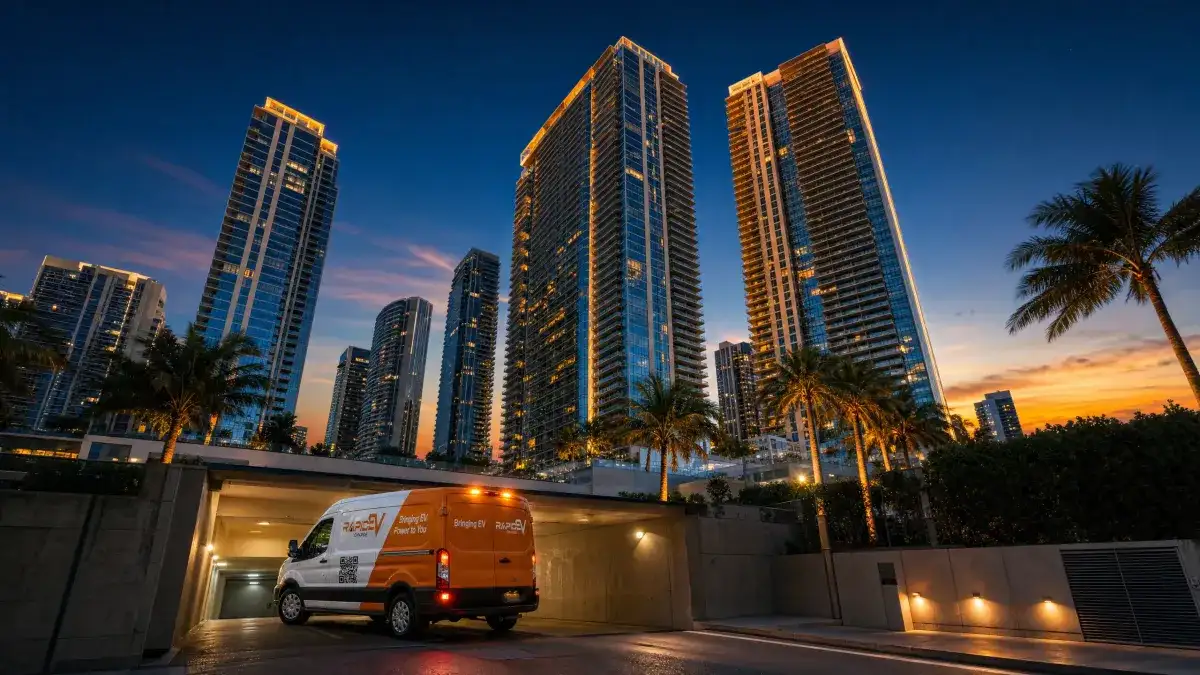
A vertical city where almost nobody controls their own outlet needs a different charging answer. This is what Plan B looks like, garage level by garage level.
Your building on Hallandale Beach Boulevard has three hundred parking spaces, four chargers, and tonight, none for you. One is broken, two are occupied, and the fourth is blocked by a sedan that does not even plug in. This is the most ordinary EV emergency in Hallandale Beach, a city where most owners live in towers and almost nobody controls their own outlet. The answer to who provides mobile EV charging here is Rapid Charge EV, and in this city the service amounts to something specific: a charger that comes to your parking space.
The city rundown lives on our Hallandale Beach service page. Below is the longer answer: how delivered charging works in a vertical city, where the calls concentrate, and what Plan B actually looks like when the building's hardware is the problem.
A vertical city squeezed between two others
Hallandale Beach packs its EVs into a few dense corridors: the high-rise wall along Hallandale Beach Boulevard, the Golden Isles and Three Islands enclaves, the condo stock spreading toward the Hollywood line, and the constant traffic exchange with Aventura across the county border. Most of those buildings predate the EV era; their chargers, where they exist, are retrofits, few in number and heavily shared. The city's drivers are experienced queue managers by necessity. Walkable as the city is, its charging is not: the gap between where residents park and where electrons flow is measured in floors, not miles.
The calls follow the density:
High-rise garages on and near Hallandale Beach Boulevard: residents whose building chargers are full, broken, or blocked.
Gulfstream Park: racing days, casino nights, and dinner traffic on shared pedestals.
US-1 and Federal Highway: the commuter spine between Aventura and Hollywood.
A1A and the beach corridor: visitors, seasonal residents, and second homes.
I-95 at exit 18: the city's interstate moment, brief but reliable.
How a tower dispatch works
Tower calls run on access details. The dispatcher needs the building name, the garage level, and the space number, plus whatever the front desk or valet requires to clear a service truck, and that coordination happens while the truck is en route, not after it arrives. Valet buildings are routine: the same release process the building runs for detailing works for charging. The session itself happens at your space, NACS or CCS or J-1772 as the car requires, and the car is back above its floor before the evening ends.
Overnight is when the tower pattern peaks. Residents discover the empty battery at the end of the evening, not the start, and the building's shared chargers are at their busiest exactly then. It is why this city generates more late-night calls than its size suggests, and why a 24/7 dispatch matters more here than in the suburbs.
Residents who hit the building-charger wall monthly rather than yearly usually graduate from emergency calls to a standing arrangement, the tower-friendly cadence we describe in the urban infrastructure review. The building's queue stops being your problem entirely.
The Gulfstream rhythm
Gulfstream Park gives the city its event-driven layer. Racing days and casino nights concentrate hundreds of cars, a meaningful slice of them electric, around pedestals that were never sized for peaks. The Gulfstream stranding is predictable: arrive with a quarter charge, plan to top up while you play, discover at midnight that the plan belonged to everyone. A truck dispatched to the garage row settles it while you finish the evening, which beats both the queue and the nervous drive home down US-1. Seasonal peaks stack on top: winter fills the towers and doubles the evening competition for the same few plugs.
Condo charging, the honest version
Building-level charging in Hallandale Beach is improving on a board-meeting timeline: real progress, measured in fiscal years. Retrofitting a decades-old tower involves load studies, permits, assessments, and patience, the same gauntlet we walked through in the condo charging story, and until a building finishes it, residents live on shared hardware. Delivered charging is not a protest against that process; it is the bridge across it. Boards move at board speed; batteries do not.
Tow, queue, or truck
The Hallandale Beach comparison is sharper than most cities'. A tow out of a tower garage is an ordeal of clearances and release forms. The queue at the building charger has no posted wait time and no enforcement. Emergency mobile charging skips both: the energy arrives at your space, on your schedule, with the building's access process handled in advance. Between Dania Beach to the north and the county line to the south, the same answer holds. Three Islands and Golden Isles homeowners get the suburban version: driveway visits, simpler logistics, same truck.
If your EV is stuck at low charge in a tower garage, a Gulfstream lot, or anywhere along the US-1 corridor, call Rapid Charge EV at (954) 278-4454 or email support@myrapidchargeev.com. We dispatch across Broward, Miami-Dade, and Palm Beach 24/7.
Frequently Asked Questions
Can the truck get into my condo garage?
Usually yes. Most Hallandale Beach towers accommodate the truck with front-desk or valet coordination, which the dispatcher arranges before arrival. Have your building name, garage level, and space number ready.
Do you respond at Gulfstream Park?
Yes. Racing days and casino evenings make it one of the city's regular dispatch locations. Tell us which garage or lot section you are in.
My building has chargers but they are always taken. Is there a recurring option?
Yes. A standing visit on a weekly or as-needed cadence replaces the building queue entirely, which is exactly how many tower residents here use the service.
Which connectors does the truck carry?
All mainstream ones: NACS for Tesla, CCS for most modern EVs, J-1772 for older vehicles. The connector question is settled when you name the car.
Out of charge in Jacksonville, with the nearest fast charger on the other side of a bridge? Here is the step-by-step playbook, and why a tow is usually the wrong answer. Call (954) 278-4454.
The flight was late, the garage is quiet, and the car that was supposed to have plenty of charge does not. Here is what to do at each FLL terminal when you return to a dead EV in the middle of the night. Call (954) 278-4454.
Palm Beach charges well at its famous nodes and barely at all in between. The western communities and the in-between cities live in the gaps, and the season squeezes everything. Call (954) 278-4454.