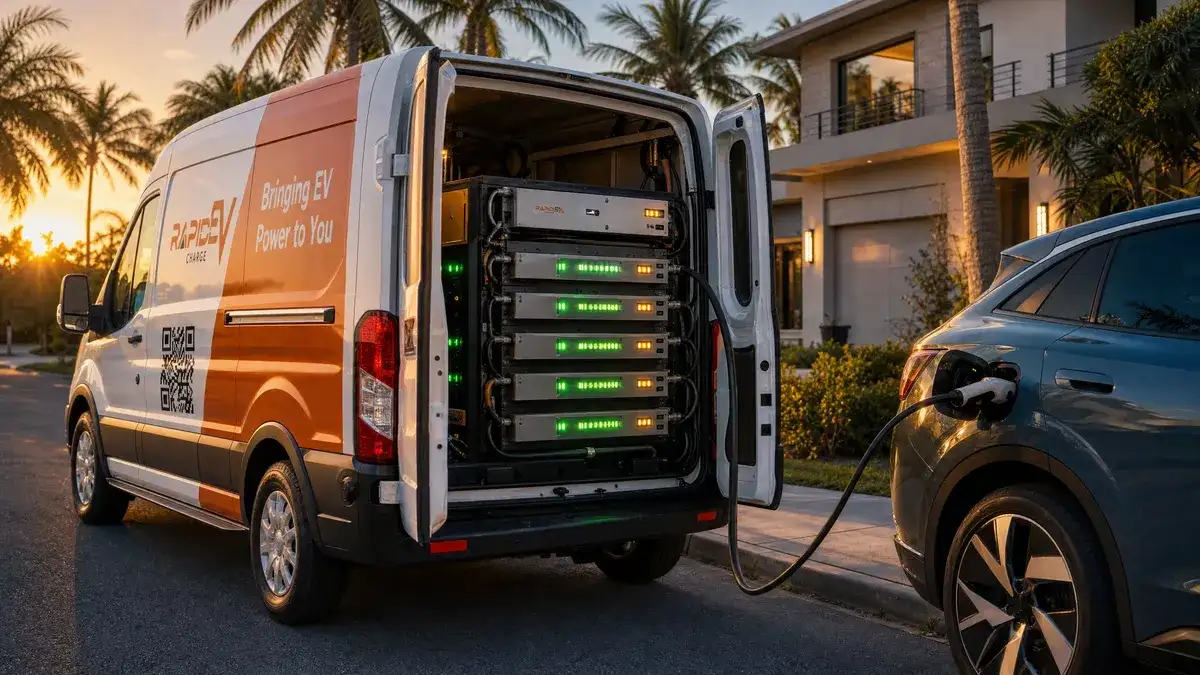
When Tamarac's Home Chargers Fail, the Truck Rolls
A city of measured adopters runs on driveway charging and deserves a backup that comes to the driveway. The delivered answer, from Woodmont to the Turnpike exit.
Tamarac came to EVs the way it does most things: deliberately. A lot of this city's electric cars are a late-in-life first, researched for months, bought for the quiet and the running costs, and charged in the same driveway every night on a routine you could set a clock by. It is a good system with a single point of failure, and when the wall unit quits on a Tuesday, the whole plan quits with it. Who provides mobile EV charging in Tamarac at that moment? Rapid Charge EV does, to the driveway, the carport, or the Commercial Boulevard shoulder, any hour the routine breaks.
The city file is on our Tamarac service page. Below is the local story: why this city's charging is so home-centered, where the calls cluster, and what the backup looks like when the plan needs one.
A city that charges at home
Tamarac's geography explains the habit. The city sits west of the Turnpike on Commercial Boulevard and McNab Road, its retail is neighborhood-scale rather than anchor-scale, and its public charging is correspondingly thin. What it has instead is driveways and carports, older platted neighborhoods, the Mainlands, the Woodmont country-club community, where home charging is not one option among several but the entire arrangement. The city's drivers did the math early: if the car sleeps at home every night, home is the charger. The math holds until the hardware does not. The NW 88th Avenue retail adds a modest public layer, sized for errands rather than emergencies.
Commercial Boulevard, east and west: the city's spine and its steadiest corridor.
The Turnpike at the Commercial exit: through-traffic and homecoming commuters.
Woodmont and the Mainlands: gated and 55+ communities with driveway routines.
McNab Road and the NW 88th Avenue retail: errand traffic on borrowed margin.
The measured-adopter pattern
Tamarac's EV drivers skew careful, which shapes the calls in a particular way: they are rarer than in flashier cities and more time-sensitive when they come, because the household usually has one EV, one routine, and a calendar that assumed both. A failed charger here is not an inconvenience absorbed by a second car; it is tomorrow's cardiologist appointment with no way to get there. Dispatch treats it accordingly, a bridge session in the driveway, sized to the week's actual driving, repeated if the repair takes longer than the part was promised.
The flip side of the careful profile is excellent prevention. Tamarac households respond to one near-miss by building real habits, the charge-by-Thursday rule, the guest-car plan, the saved number, and the city's repeat-call rate is accordingly low. Dispatch regards that as the system working.
The 55+ communities add a practical wrinkle worth naming: many residents prefer the session to happen while they watch, with questions welcome. Technicians expect that here. The visit doubles as a tutorial often enough that some residents schedule their first one before anything has failed at all, just to meet the process. Patience is part of the service everywhere; here it is simply scheduled.
The commuter overlay
Layered over the residential rhythm is the through-traffic: commuters running daily to Plantation, Sunrise, and Fort Lauderdale, plus the Turnpike's contribution at the Commercial Boulevard exit. Those calls look like every commuter city's, the after-work margin that did not survive the errands, the exit taken at single digits, and they get the standard treatment: location, vehicle, percentage, shoulder protocol where it applies, and a session that puts the evening back on schedule. Woodmont's golf calendar adds a mild weekend rhythm of its own.
Fix the hardware, keep the backup
The longer answer for a home-charging city is layered: keep the wall unit maintained, know its failure signs, and keep the backup number where the household can find it. The honest comparison between depending on home hardware and depending on delivered sessions, and when each makes sense, is laid out in mobile charging versus home installation; for most Tamarac households the right answer is both, in that order.
Why the truck beats the drive
When the home charger is down, every public alternative is in another city's retail district, with availability nobody can promise from a Tamarac driveway. A tow gets you infrastructure without independence; the nursed drive bets thin range on Commercial Boulevard's lights. Emergency mobile charging restores independence directly: NACS, CCS, or J-1772 as the car requires, 15 to 45 minutes in the driveway, and the routine resumes where it left off.
If your home charger is down, your battery is low on Commercial, or the Turnpike exit arrived sooner than your percentage did, call Rapid Charge EV at (954) 278-4454 or email support@myrapidchargeev.com. We dispatch across Broward, Miami-Dade, and Palm Beach 24/7.
Frequently Asked Questions
Can you get into Woodmont or the Mainlands?
Yes, both are regular service areas. Coordinate the gate when you call where it applies, and the session runs in your driveway or carport.
I am new to EVs and the home charger just stopped working. What now?
Call with the car and the percentage, and a delivered session bridges you until the installer or electrician resolves it. This is Tamarac's most common call, and there is no judgment anywhere in it.
Do you respond near the Turnpike's Commercial Boulevard exit?
Yes, it is a routine response zone. Get safely off the road, hazards on, and share your direction of travel when you call.
Which connectors are on the truck?
NACS for Tesla, CCS for the modern non-Tesla fleet, and J-1772 for older vehicles, every run.
The Spectre battery guide covers the pack. This one covers the owner's logistics: what to put in the garage, what the electrician needs, which port the car has, and what to do when a valet or club has no plug. Call (954) 278-4454.
Pembroke Pines is HOA country with an EV in every third driveway. Here is the honest home-charging option map for the city's housing mix, installs, approvals, and the service that skips both. Call (954) 278-4454.
A village with no commercial strip never gets a public charger, so its EVs run entirely on home equipment. Here is who shows up when a driveway node goes dark. Call (954) 278-4454.