Stadium-Side Stranding? Washington Park Is Covered
A small unincorporated community absorbs event-night spillover it never asked for and runs its own EVs on thin margins. The delivered answer covers both.
Washington Park spends its evenings in two shadows: the literal one thrown by the stadium lights just to the east, and the infrastructural one thrown by I-95, which walls the community off from the city whose name appears in its mailing addresses. Between Sunrise Boulevard and Broward Boulevard, along the NW 31st Avenue blocks, there is no public EV charging and no plan for any. Who provides mobile EV charging in Washington Park? Rapid Charge EV does, on match nights when the spillover parking arrives, and on the ordinary nights when it is just the neighborhood and its own thin margins.
The quick file is on our Washington Park service page. Here is the longer local answer, in both of the community's modes. Both run on the same dispatch and the same truck; only the clock differs.
Event nights: the spillover mode
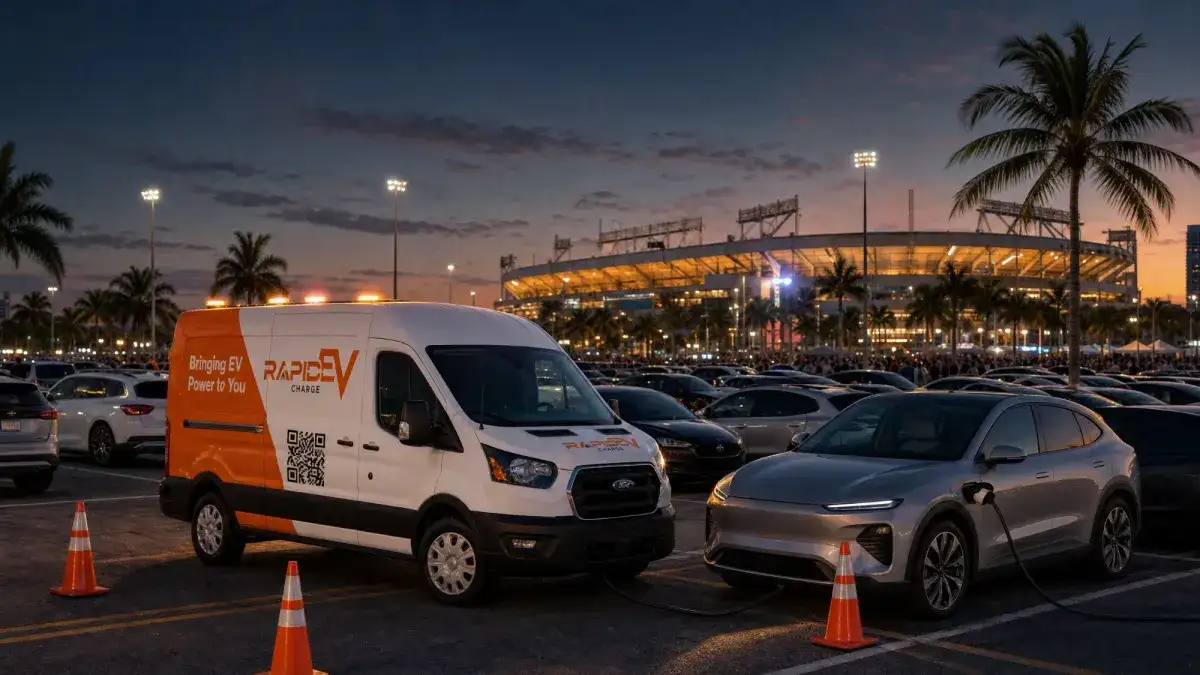
When the stadium fills, its parking spills west, and Washington Park's blocks absorb visitors who will return to their cars three hours later with less battery than they remembered leaving. The event-night call is a visitor call: an unfamiliar neighborhood, a cross street read off a sign, a car at single digits with a drive home across the county. The truck handles it like any precise dispatch, location, vehicle, percentage, with one event-night adjustment: ETAs stretch while the exit wave clears, so calling before you reach the car beats calling from beside it. The session runs at the curb and the visitor leaves with a margin instead of a story. The earlier the call, the better the staging; the wave is predictable even when the score is not.
Event nights also generate the reverse call: residents boxed into their own blocks by visitor parking, discovering their planned evening charging run is now a hostage of the third quarter. The practical fix is the same session at the home curb, and the practical prevention is treating match nights like weather, a thing the neighborhood plans around because it reliably arrives.
Every other night: the neighborhood mode
The community's own EV life looks like the rest of central Broward's unincorporated pockets: apartments and townhouses where home charging was never built, older single-family blocks where an outdoor outlet does slow overnight duty, and routines that borrow infrastructure from Fort Lauderdale and Plantation. The local call is quieter than the event one, a resident's car at 5 percent in the lot, a workday starting in ten hours, and it resolves the same way: a session at the address, overnight if preferred, 15 to 45 minutes to a working margin. Townhouse clusters along the avenue produce the steadiest volume of these calls, and margins here are working habits, not luxuries anyone takes for granted.
The stadium-side blocks: event-night spillover and visitor strandings.
Sunrise and Broward Boulevard edges: commuter traffic at the pocket's borders.
The NW 31st Avenue residential grid: apartment and townhouse routines on thin margins.
The I-95 ramps east of the community: through-drivers off at the wrong percentage.
The I-95 wall
The interstate that borders the community also defines its charging geography: every fast charger the apps suggest is on the other side of it, a short drive that feels long at 4 percent and unthinkable at zero. That east-west asymmetry is the practical reason delivered charging fits this pocket so well, the truck crosses the wall so the resident does not have to, and it is one more local example of the county-wide pattern mapped in our Broward guide. The ramps work the other direction too, delivering through-drivers into the pocket at exactly the percentage that makes leaving it impossible. Delivered charging makes the wall irrelevant.
What is the fix in both modes?
Visitor or resident, the alternatives run the same: a tow that hauls a healthy car across the interstate to charge it, or a crawl that bets the last percentage on the ramps. Emergency mobile charging skips both, with NACS, CCS, and J-1772 aboard for whatever is parked on the block, and any-emergency coverage detailed in our emergency charging overview. Cars at true zero that have locked themselves immobile are part of the standard service; mention it on the call.
The two modes share one practical detail worth repeating: precision beats speed on the phone. The pocket's streets are short and similar, the event-night crowds make landmarks ambiguous, and thirty seconds spent on the exact cross street saves the truck a lap of the neighborhood. Say which mode you are in and the rest follows.
If your EV is low on a stadium-side block, in an apartment lot off NW 31st, or anywhere in the pocket, call Rapid Charge EV at (954) 278-4454 or email support@myrapidchargeev.com. We dispatch across Broward, Miami-Dade, and Palm Beach 24/7.
Frequently Asked Questions
Do you serve unincorporated Washington Park?
Yes. The community dispatches from the Fort Lauderdale and Plantation response zone, and the truck comes to your block, not a boundary line.
I parked near the stadium for an event and came back to a low battery. Can you help?
Yes. Event-night calls from the stadium area and the surrounding blocks are routine. Give the dispatcher your cross street or lot, and expect a slightly wider ETA while event traffic clears.
What does the call require?
Address or nearest cross street, the car's make and model, and the honest percentage. That sets the connector and a realistic arrival time before you hang up.
Jaguars Sundays, Florida-Georgia weekend, stadium concerts: the sports complex swallows tens of thousands of cars, and the EVs among them face queue traffic and zero lot charging. Here is the event-day playbook. Call (954) 278-4454.
Hard Rock Stadium hosts some of the biggest events in South Florida. Its EV charging infrastructure wasn't built for the volume. Here's how to survive event day without queuing for hours. Call (954) 278-4454.
The Everglades is Florida's biggest charging desert, and every EV that visits crosses it on whatever charge it brought. Here is the trip math for Shark Valley, Flamingo, and Alligator Alley, and the safety net. Call (954) 278-4454.