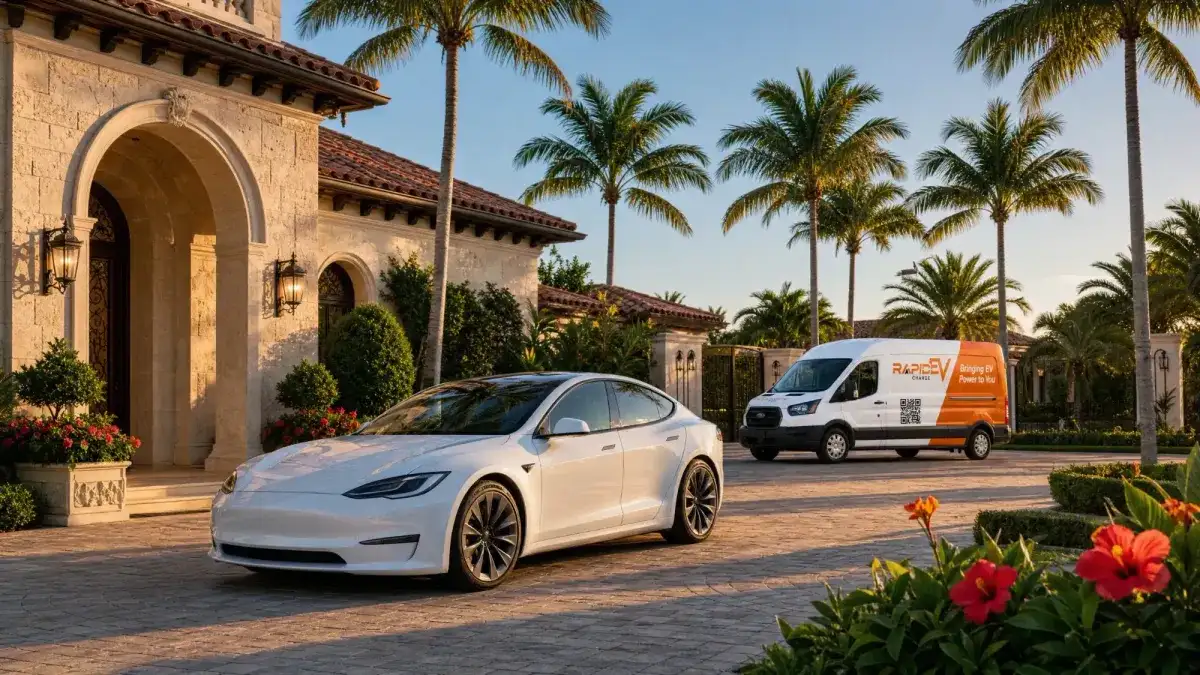
A Charging Truck for Biscayne Park's Shaded Blocks
Green medians, mid-century homes, zero retail: the village's charging is all residential, which makes every home-charger failure a small infrastructure outage.
Biscayne Park is the kind of place people move to precisely because nothing commercial ever happens there: a small village grid of mid-century homes west of NE 6th Avenue, famous locally for its green medians and its tree canopy. The trade-off nobody mentions at closing is electrical. A town with no retail strip has nowhere for a public charger to exist, so every EV in the village runs on home equipment, and a failed wall unit becomes a private infrastructure outage. Who provides mobile EV charging in Biscayne Park when that happens? Rapid Charge EV does, to the driveway or the curb, 24 hours a day.
The reference entry is on our Biscayne Park service page. This post is the village-scale story: what all-residential charging means in practice, which failures actually generate the calls, and why the fix has to drive in.
A village that charges at home or not at all
The village's EV infrastructure is a census of its garages. Mid-century houses with mid-century panels carry retrofit circuits installed one electrician visit at a time, and the whole system works the way private systems do: invisibly, until a breaker trips or a charger bricks itself on a firmware update. There is no fallback inside the boundaries. The nearest public options sit a few blocks over in Miami Shores or North Miami, close on a map and unhelpfully far on a battery that has been waiting on a dead charger for three days.
The village grid off NE 6th Avenue: driveway charging, retrofit-era panels.
Griffing Boulevard and the median streets: curb sessions under the canopy.
The NE 121st Street edge: the village's connection to the commuter corridors.
The failure modes of a private network
The calls from Biscayne Park follow a pattern any electrician would recognize. An older panel takes the summer load of a house plus a car and decides it has had enough. A wall unit dies young, as a fraction of consumer hardware always has. A renovation knocks the garage circuit offline for a month. None of these strand a car on a road; they strand a household's routine, which is quieter and in some ways worse, because the deadline is tomorrow's commute rather than tonight's tow. The fix matches the failure: energy delivered to the driveway while the repair takes its time.
Households mid-repair often skip the rescue framing entirely and book the standing version, a cadence of visits that carries the car until the electrical work lands, the arrangement described in our scheduled charging post. The village's second car follows the same logic: two EVs on one retrofit circuit is an arithmetic problem that a weekly session solves without a permit.
The village's days have a commuter shape. Almost everyone who works, works somewhere else, down NE 6th Avenue toward the city or out to the highways, and the EVs here clock real miles for a town with hardly a stoplight of its own. Village life supplies the rest of the calendar: meetings at the WPA-era log cabin that serves as the recreation center, weekend projects, school runs across the boundary. None of it is dramatic, which is the point. The charging failures here are calendar problems in a place that prizes its calm, and the fix that preserves the calm is the one that does not require leaving. A guest's EV in the driveway gets the same treatment; visiting cars at low charge are a standing village genre.
What a village dispatch looks like
The call needs the address, the car, and the percentage. The truck arrives from the northeast Miami-Dade zone, positions beside the car, and runs the session off its own power, every truck carries all three connector families, so the household's badge mix does not matter. Under the canopy or in the driveway, the session takes 15 to 45 minutes to restore a comfortable margin. The village's narrow streets are not an obstacle; the truck has worked tighter geometry in beach towns and tower decks alike.
The alternatives, honestly
Driving to a Miami Shores or North Miami station works right up until the reason you need it is that the car cannot get there comfortably. The tow is a sledgehammer for a thumbtack. Emergency mobile charging is sized to the actual problem: a quiet failure in a quiet village, resolved at the curb before the school run. In a town whose whole charging network is residential, the service van is the public infrastructure.
If your driveway charger is dark, your panel upgrade is mid-project, or your EV is simply lower than the distance to the nearest plug, call Rapid Charge EV at (954) 278-4454 or email support@myrapidchargeev.com. We dispatch across Broward, Miami-Dade, and Palm Beach 24/7.
Frequently Asked Questions
Do you really dispatch into a village this small?
Yes. Biscayne Park sits inside the northeast Miami-Dade response zone, and the truck comes to the address, not to a population threshold.
My home charger died and the electrician is booked out. Can you bridge the gap?
Yes. One-off driveway sessions cover the week, and a recurring visit covers a longer repair or panel upgrade.
Can you charge at the curb under the trees?
Yes. Driveway or curb both work; the technician positions the truck beside the car and the session runs off the truck's own power.
Five percent feels different when the only way off the island is a causeway with no chargers on it. Here is who brings the charge across the water instead. Call (954) 278-4454.
Neptune Beach is small on purpose, which is why it has no charging infrastructure. Here is who brings the charge to the Town Center, Penman Road, and every beach-access block. Call (954) 278-4454.
A village of a few shaded blocks between the Little River and the boulevard has no charging infrastructure of its own, and never will. Its EVs get charged anyway. Here is how. Call (954) 278-4454.