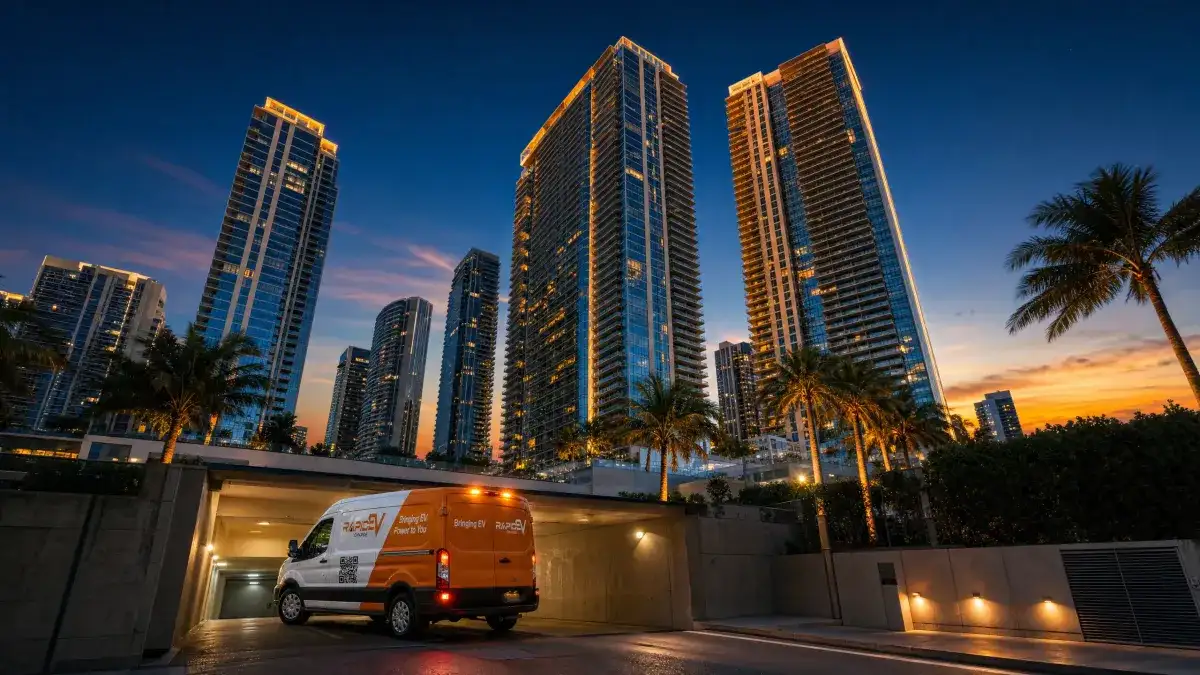
Brickell solved parking by stacking it and then discovered the chargers do not stack with it. The delivered answer for the towers, the valet lanes, and the financial district clock.
Your car is on level nine of a Brickell Avenue tower, the dash reads 6 percent, and the building's two shared chargers have been occupied since Tuesday by the same pair of cars everyone in the resident group chat has opinions about. The meeting is in forty minutes. This is the signature stranding of the most EV-dense blocks in Florida: nobody is on a roadside, nobody is in danger, and nobody can drive anywhere. Who provides mobile EV charging in Brickell when the math runs out nine floors up? Rapid Charge EV does, tower decks, valet lanes, and garage exits, 24 hours a day.
The operational reference is our Brickell service page. This post is the resident-grade answer: how a dispatch threads a vertical city, what the financial district clock does to charging demand, and why the valet handoff is the most rehearsed move in our Miami-Dade playbook.
The densest EV blocks in Florida
Brickell parks vertically. Tens of thousands of residents live on a spine you can walk in twenty minutes, their cars stacked in decks behind key fobs and valet podiums. EV adoption here outruns every neighborhood around it, and the buildings have answered with shared Level 2 stations in numbers that would suit a building one third the size. The waiting lists are real, the etiquette disputes are real, and the practical result is that a meaningful share of Brickell's EVs run week to week on public infrastructure that was never sized to be anyone's primary charger.
There is also a working layer the towers hide: the rideshare and delivery EVs that treat Brickell as their densest market. They run the avenue all evening, queue the same public hardware as everyone else, and operate on margins where a forty-minute charging detour is a real cost. For a driver mid-shift, a session timed to a meal break beats surrendering the night's best hours to a stall queue. The district's charging stress, in other words, is not just residents; it is everyone the district attracts, all drawing on the same undersized public layer at the same peak hours. Their geography never changes, the same dozen blocks, which makes staging predictable even when demand is not.
The Brickell Avenue tower spine: assigned spaces far from any plug.
Brickell City Centre and Mary Brickell Village: shopper and diner strandings in the garages.
Brickell Key: an island annex of towers reached by one drawbridge.
The SW 8th Street edge: commuters crossing into and out of Little Havana.
The Miami River crossings: the chokepoints that decide every ETA.
South Brickell and the Underline blocks: residential decks south of the financial core.
How a tower dispatch actually runs
The call needs four details: the tower, the level, the space, and who holds the keys. With those, the dispatcher solves access while the truck is moving, most buildings route us through a service entrance, and the technician brings the session to the assigned space. Clearance is the one genuine variable in a city of stacked decks, and it has a standard fallback: where a level is too tight, the car meets the truck at a lower level or the exit lane instead. The charging itself is the easy part, governed by the car's own battery management, finished inside the hour with a working margin on the dash.
After a first visit, the building knows the drill: security recognizes the truck, the concierge knows which entrance, and the second call takes half the explaining. The structural version of this story, why towers lag their residents and what a building can actually do about it, is laid out in our Miami condo and high-rise post. Brickell is its densest case study.
The financial district clock
Brickell's charging demand keeps office hours, then keeps going. The morning discovery call comes from the deck at 7:40, a car that did not get its overnight plug. The midday call comes from City Centre, where the public fast chargers queue exactly when the lunch crowd needs them, the same arithmetic described in our Supercharger wait post. The evening call comes from the valet lane, and the late-night call comes after an arena night or a festival weekend, when the whole district surges and every public stall within a mile is spoken for. Dispatch staffs against that clock rather than against the map.
If you are reading this from level nine right now, here is the short version: call Rapid Charge EV at (954) 278-4454 with the tower, the level, and the space, and a truck starts toward the river crossings while you head back to the elevator.
Valet culture and the charging handoff
Half of Brickell's cars are touched by a valet at some point in their day, which makes the handoff a core dispatch skill rather than an edge case. The pattern is consistent: the dispatcher calls the podium, the attendants stage the car where the truck can work, and the session runs without the owner leaving their apartment or their table. Buildings with busy lanes prefer specific windows, and the truck accommodates; the valet's garage choreography is not something a charging session should fight.
The weekend version
Weekends rewrite the district without lowering the stakes. The towers empty toward brunch, City Centre and Mary Brickell Village fill with visitors who drove in from across the county, and the public stalls flip from commuter assets to retail amenities, occupied accordingly. Saturday's signature call is the visitor whose afternoon plans assumed a charge that never happened; Sunday's belongs to residents prepping the week and finding the shared plugs booked solid. The dispatch logic does not change, only the geography of it: garage sections instead of office addresses, restaurant valets instead of building concierges, and the same session at the same parked car.
The island annex
Brickell Key compresses every Brickell pattern onto an island with one bridge. Tower decks, valet podiums, shared chargers with waiting lists, all of it, plus a drawbridge that opens for masts on its own schedule. The dispatch difference is timing, not possibility: the dispatcher folds the bridge into the ETA and the session runs like any other tower call. Residents there tend to book ahead of need; the bridge teaches planning faster than any app.
Mobile versus the alternatives on the avenue
The alternatives all assume the car can move or should. The crawl to a public stall bets single digits against the river bridges and the queue at the far end. The tow extracts a car that was parked safely in its own space, which is absurd on its face. On-site emergency charging treats the deck as the destination: NACS, CCS-1, and J-1772 cover every badge in the garage, and the car is back to a working margin before the next conference call ends. In a neighborhood where the car's job is to be ready, readiness is the entire product.
If your EV is stranded on a deck level, staged in a valet lane, or queued out of a City Centre charger at single digits, call Rapid Charge EV at (954) 278-4454 or email support@myrapidchargeev.com. We dispatch across Broward, Miami-Dade, and Palm Beach 24/7.
Frequently Asked Questions
Can you charge my EV on an upper level of a Brickell tower garage?
Yes. Give the dispatcher the tower, the level, the space number, and the clearance situation. Where a deck is too tight, the technician arranges to meet the car at a lower level or the garage exit instead.
Do you dispatch to Brickell City Centre and Mary Brickell Village?
Yes, both are routine. Share the garage section and level when you call, and whether the car is self-parked or with valet.
How do sessions work when valet has my car?
The dispatcher coordinates with the valet desk, the technician works alongside the attendants, and the session runs wherever the car is staged. It is a rehearsed routine in most Brickell buildings.
Can you reach Brickell Key?
Yes. The island's towers are part of the standard response zone; the only addition is the drawbridge timing, which the dispatcher folds into the ETA.
Flying out of FLL with an EV means one parking decision and two battery questions. Here is what charging actually exists in the garages, why it cannot cover your whole trip, and the plan that works. Call (954) 278-4454.
Doral runs two economies on one street grid: logistics by day, family suburbs by night, and EVs threading both. Here is who dispatches charging to the office park and the cul-de-sac alike. Call (954) 278-4454.
Booking Miami Beach with an EV? Some hotels genuinely charge your car while you sleep; most just valet it somewhere dark. Here is how to tell the difference, and the fix when your hotel has nothing. Call (954) 278-4454.