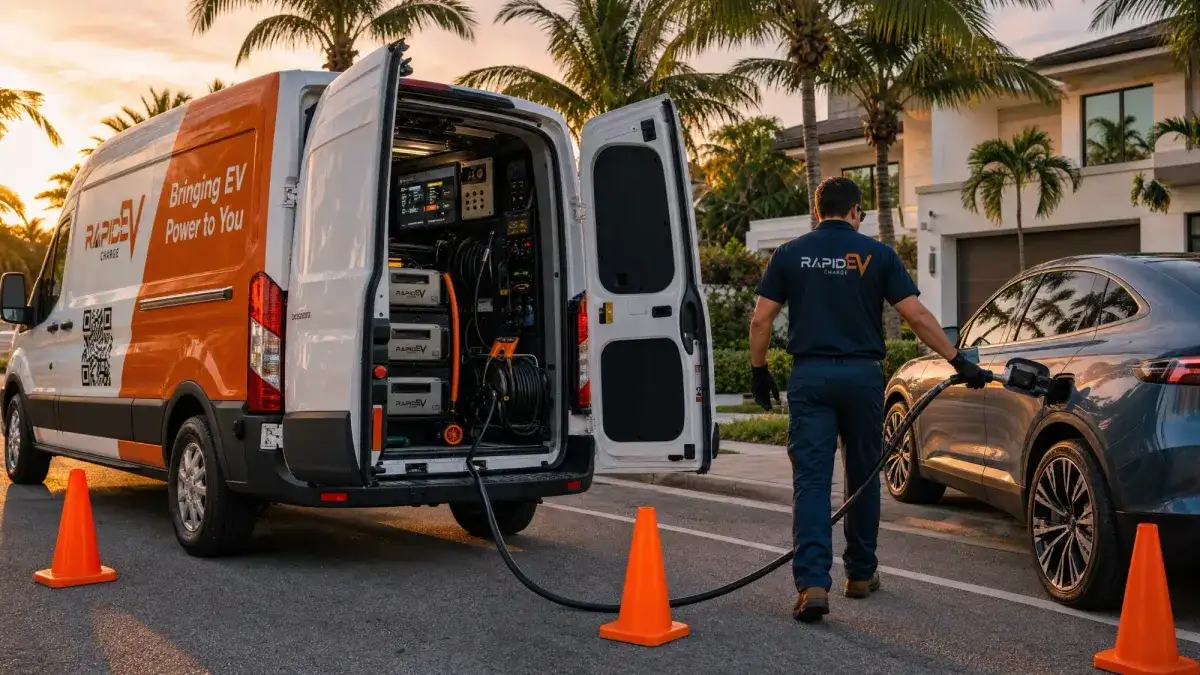
In Hialeah Gardens, the Warehouse Shift Charges Too
West of Hialeah the grid turns to warehouses and townhomes, the public chargers turn scarce, and the charging question follows the shift clock. The delivered answer.
Hialeah Gardens keeps warehouse hours. The city west of the Palmetto wakes before dawn, moves freight and family sedans through the same intersections, and measures its days in shifts rather than meetings. Its EVs, and the count grows every quarter, charge wherever the schedule allows, which inside the city limits is almost nowhere public: the serious stations sit east in Hialeah or south in Doral. Who provides mobile EV charging in Hialeah Gardens when the shift clock and the battery disagree? Rapid Charge EV does, on the workday's actual timetable, 24 hours a day.
The city's reference entry is our Hialeah Gardens service page. This is the shift-clock version: where the calls come from, why the city's charging gap is a timing problem as much as a hardware problem, and how a dispatch works when the deadline is a clock-in.
A city on the clock
The city's geography splits clean. Along Okeechobee Road and the western corridors run the warehouses, yards, and light industry that give the area its rhythm. Off NW 87th Avenue and NW 138th Street sit the townhome and single-family blocks where the workforce actually lives. An EV here often serves both halves in one day, the commute, the school run, the second job, and its charging has to fit into the seams of that schedule. A public-stall detour that costs forty minutes is not an inconvenience here; it is a missed clock-in.
NW 87th Avenue and the residential blocks: driveway and townhome-lot sessions.
NW 138th Street: the retail strip and its handful of contested plugs.
Okeechobee Road and the warehouse frontage: employee-lot and yard dispatches.
Charging on shift time
The city's signature call is scheduled around work, not around the car. The pre-dawn session in a townhome lot before a 6 AM start. The midday top-up in an employee row while a ten-hour shift runs inside. The evening driveway call after the only charger in the household spent the night on the other car. None of these fit the public-charging model, which assumes the driver has time to go to the electrons. The delivered model inverts it, and the inversion is the entire value: the technician works the lot while the shift works the floor, and nobody's timecard notices. The overnight half of that logic, why a 24-hour dispatch matters in a county that strands cars at every hour, is covered in our 24-hour Miami-Dade post.
The work-vehicle layer adds volume. Vans and service vehicles based in the city's yards are adopting electric on fleet math, and a route vehicle that missed its overnight charge needs the fix at the yard, before dispatch, not at a plaza across the Palmetto. Every connector standard rides along, so the yard's badge mix never complicates the visit.
The household half of the schedule
The same clock governs the homes. Two-job households share EVs across split shifts, handing the car off in a driveway at hours no public charger's business model imagines, and the family's charging has to happen in the seams: after the late shift, before the early one, during the Saturday reset. The townhome belts off NW 87th Avenue add the parking variable, assigned spaces with no outlet in reach, which makes the curb session the neighborhood standard rather than the exception.
Growth keeps tightening the math. New townhome rows fill with young families whose first EV arrived before their first dedicated circuit, and the city's housing stock, like its neighbor's, was wired for a different era. The gap between adoption and infrastructure is the same one the whole county runs; here it just runs on a stricter timetable, because the shift clock does not negotiate. A delivered session is the only charging format that reads that timetable natively, which is why the city's bookings skew scheduled rather than panicked.
The two-direction problem
When the battery does run out, the city's position bites. Public fallbacks sit east into Hialeah's traffic or south into Doral's, and both directions ask a low battery to spend range it does not have crossing some of the busiest surface corridors in the county. The drive-out option fails exactly when it is needed most, which is the textbook case for bringing the charge in instead.
How do the alternatives measure against a timecard?
The tow costs the car, the morning, and usually the shift. The public-stall gamble costs range and offers a queue. Emergency mobile charging costs a phone call placed from the break room, and the session finishes before the next bell. In a city that runs on punctuality, that is the only math that closes.
If your EV is short before a shift, flat in an employee lot, or out of margin on NW 87th Avenue, call Rapid Charge EV at (954) 278-4454 or email support@myrapidchargeev.com. We dispatch across Broward, Miami-Dade, and Palm Beach 24/7.
Frequently Asked Questions
Can you charge before an early shift, like 5 AM?
Yes. Dispatch runs all night, and pre-dawn driveway or lot sessions before a shift are a routine call in the city's west.
Do you cover the warehouse district along Okeechobee Road?
Yes, employee lots, yard parking, and the frontage roads included. Tell the dispatcher the business name or the nearest gate.
Where is the nearest public charging otherwise?
Mostly in Hialeah proper or south in Doral, which is the problem: both directions cost range and time a shift schedule does not have. The delivered session removes the trip.
The City Beautiful runs new EVs on old wiring: Mediterranean homes with 1920s panels, a retail core whose chargers fill by lunch, and a gated south coast. Here is who closes those gaps. Call (954) 278-4454.
Hialeah's EVs arrived through used listings and fuel math, not showroom hype, and they live on a grid where home charging is the exception. Here is who keeps them moving. Call (954) 278-4454.
A village of a few hundred homes sits wedged against the airport, jets overhead and zero chargers below. Here is how its EVs get their power delivered to the block. Call (954) 278-4454.