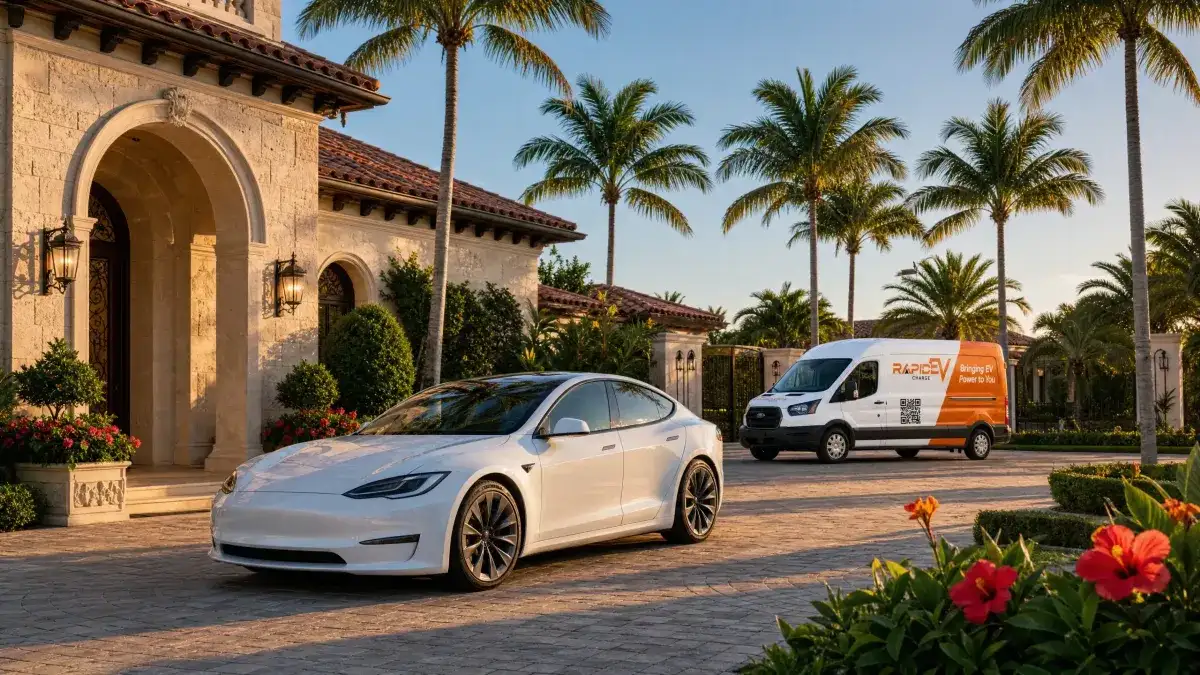
An island village built around discretion gets its charging the same way it gets everything: vetted at the gate, delivered to the address, finished without fuss.
Indian Creek Village is a single loop of road around a golf course, reached by a single bridge, watched by a security operation that knows every vehicle that belongs. Nothing about it is public: not the club at its center, not the waterfront addresses around its edge, and certainly not its charging infrastructure, because there is none. The village's EVs, and its garages hold serious ones, run on private equipment and private staff. Who provides mobile EV charging in Indian Creek when an island garage needs power it cannot make? Rapid Charge EV does, cleared through the gatehouse, any hour it is needed.
Indian Creek dispatch runs through the Miami-Dade coverage hub, the county map that covers the village the way it covers everything between the bays. This post describes the part no map shows: how a charging visit actually clears an island built on vetting, and why the village's calls are the calmest in the county.
The access reality
Every Indian Creek visit is an authorized visit. The household or its estate manager books the session, the dispatcher passes the truck's details and the technician's name ahead of arrival, and the gatehouse does what the gatehouse does. There is no improvising onto the island and no need to: the protocol exists precisely so that legitimate service arrives smoothly. From the bridge to the address takes minutes, the loop road being what it is, and the session runs in the motor court or the garage apron, positioned wherever the household prefers the truck to stand.
The waterfront estates along Indian Creek Island Road: multi-EV garages and guest arrivals.
The motor courts and staff lots: household fleets that include work and security vehicles.
The bridge approach via Surfside: the island's single connection to everything else.
Why an island of home chargers still calls
The village's garages are as well equipped as any in Florida, which is exactly why the failures surprise people. A renovation takes the garage offline for a season. A storm trips circuits nobody resets until Monday. A household fleet grows past its installed capacity, or a guest arrives from across the state with single digits and a dinner to attend. None of these are infrastructure problems in the civic sense; they are logistics problems in households that run on logistics, and they end the same way: a vetted truck, a quiet session, every connector family, one visit.
The standing arrangement suits the island better than the rescue. Estate managers fold a charging cadence into the same calendar that handles landscaping and detailing, the structure laid out in our scheduled charging post, and the result is a fleet that never tests the bridge at 4 percent. The emergency call still exists; on this island it is mostly a guest-car phenomenon.
The bridge math
Driving off-island to charge means Surfside's streets, the beach corridor's traffic, and a public stall whose availability nobody can vouch for, all to solve a problem that never needed the car to move. The village does not send its errands out; it brings its services in. Charging joining that list was a matter of time.
What discretion looks like in practice
Operationally, discretion is a set of small disciplines. The truck arrives inside its window, stages where the household directs, and works without signage theater or idling at the gate. The technician's details are on file with security before the bridge, the session is logged the way the village's other vendors are logged, and the visit ends with the motor court exactly as it was found, plus a charged car. None of this is exotic; it is simply the standard the island holds every service to, and charging either meets it or does not get invited back. The same file makes the second visit faster than the first.
Club evenings supply the calls nobody plans. A dinner on the island draws guests from across the county, and the drive that ended at the gatehouse occasionally ends with single digits. The host's solution is one call: the guest's car charges in the motor court during dessert, and the drive home stops being a topic of conversation. It is the village's most common emergency, if the word even applies.
Alternatives, considered and dismissed
A tow through the gatehouse is the loudest possible solution to the quietest possible problem. The off-island drive spends margin to find margin. Emergency mobile charging matches the village's operating logic instead: authorized, delivered, finished, with the car never leaving the property and the afternoon never noticing.
If a garage on the island is mid-renovation, a guest arrived low, or the household fleet needs a cadence instead of a crisis, call Rapid Charge EV at (954) 278-4454 or email support@myrapidchargeev.com. We dispatch across Broward, Miami-Dade, and Palm Beach 24/7.
Frequently Asked Questions
How does a service vehicle get onto Indian Creek Island?
The same way every approved vendor does: the household authorizes the visit, the dispatcher provides the truck and technician details ahead of arrival, and village security clears it through the gatehouse.
Can household staff arrange the session without the owner on the call?
Yes. Estate managers and staff arrange most island visits; the dispatcher only needs the authorization, the address, and the car.
Can visits run on a standing schedule rather than emergencies?
Yes, and on the island they usually do: a recurring cadence sized to the household fleet, timed to its calendar.
Both Promenade pedestals taken and your battery at 8 percent? Here is who dispatches mobile EV charging across Coconut Creek, from the retail core to Wynmoor Village, and how the call works. Call (954) 278-4454.
Miramar is shaped like a runway, and your odds of reaching a charger depend on which end you are standing on. Here is who dispatches mobile EV charging across the whole stretch. Call (954) 278-4454.
No retail anchors, no charging plazas, no problem: North Lauderdale's EV answer is a house call. Here is how delivered charging covers the small city between Tamarac and Margate. Call (954) 278-4454.