Mobile EV Charging Miami: Ninety Floors Up, 4% Down
The densest EV market in Florida fails in more ways than any other city, which is why its charging answer has to be a dispatch system rather than a station.
Ask what a dead EV looks like in Miami and the honest answer is: which Miami? It looks like a sedan on level twelve of a downtown tower whose two shared chargers have a waiting list. It looks like a bungalow street in Little Havana where nobody has a driveway, a family car at the Port of Miami after seven days of cabin drain, a rideshare EV on the I-95 shoulder at 1 AM. The densest EV market in Florida fails in more distinct ways than any city in the state. Who provides mobile EV charging in Miami, across all of them at once? Rapid Charge EV does, neighborhood by neighborhood, 24 hours a day.
The city's operational map lives on our Miami service page. This post is the dispatcher's-eye answer: how one system reads a city this large, where the calls actually cluster, and why Miami's charging problem is really a dozen local problems that happen to share a skyline.
The scale problem, stated plainly
Miami has plenty of public charging by the spreadsheet and not nearly enough by the sidewalk. Ownership density has outrun the hardware in the exact places people actually live: the downtown and Edgewater towers where building plugs are rationed by list, the pre-war neighborhoods where home charging was never structurally possible, the event nights when an entire district's stalls vanish into a single arena crowd. The city's public network was built for early adopters; the city now contains everyone else. What fills the gap is not one more station. It is a system that treats the whole map as serviceable.
I-95 through the urban core: the highest-volume rescue corridor in the county.
The 836 and the Palmetto: crosstown commuters caught between home and the airport belt.
Downtown and Edgewater towers: deck-level sessions where building plugs are rationed.
Little Havana and Allapattah: curbside charging for blocks that predate the driveway.
Coconut Grove: bungalows under banyans, marinas, and school-run timing.
Wynwood and the arts district: weekend crowds on a weekday charging footprint.
The Port of Miami and MIA: travelers returning to batteries that drained while they were away.
Vertical Miami and the deck-level call
The tower call is the city's daily bread. The car sits in an assigned space high in a garage, the shared chargers are taken, and the owner needs the car ready by a specific hour. The dispatch runs on building, level, space, and access; the technician brings the session to the deck, and the building's infrastructure stays out of the equation. Why the towers lag this badly, and what boards can actually do about it, is the subject of our Miami condo and high-rise post; until those timelines land, the truck is the elevator the electrons take.
Horizontal Miami and the curbside call
A few miles west, the problem inverts. Little Havana, Allapattah, parts of the Grove and the Upper Eastside run on street parking and shared yards, housing built decades before anyone needed a 240-volt circuit beside a parking spot. EV adoption here is real and rising, much of it through the used market, and it survives on workplace plugs and public stalls that were never meant to be anyone's only option. The curbside session is the missing piece: the truck stands beside the car, the cable reaches the port, and the block's wiring never enters the conversation. Half an hour later the math works again.
The Grove adds its own gentle chaos: school pickups timed to the minute, marina afternoons that run long, visitor traffic hunting the village center's handful of plugs. Coral Way threads the same needle east to west, and the bungalow blocks share Little Havana's wiring era with leafier excuses. None of it is an emergency until it is, and the difference is usually one skipped overnight charge.
If one of these is your current situation rather than your reading material, take the shortcut: call Rapid Charge EV at (954) 278-4454 with your location and percentage, and the dispatcher handles the geography while you handle the rest of your day.
The travel layer: port, airport, causeways
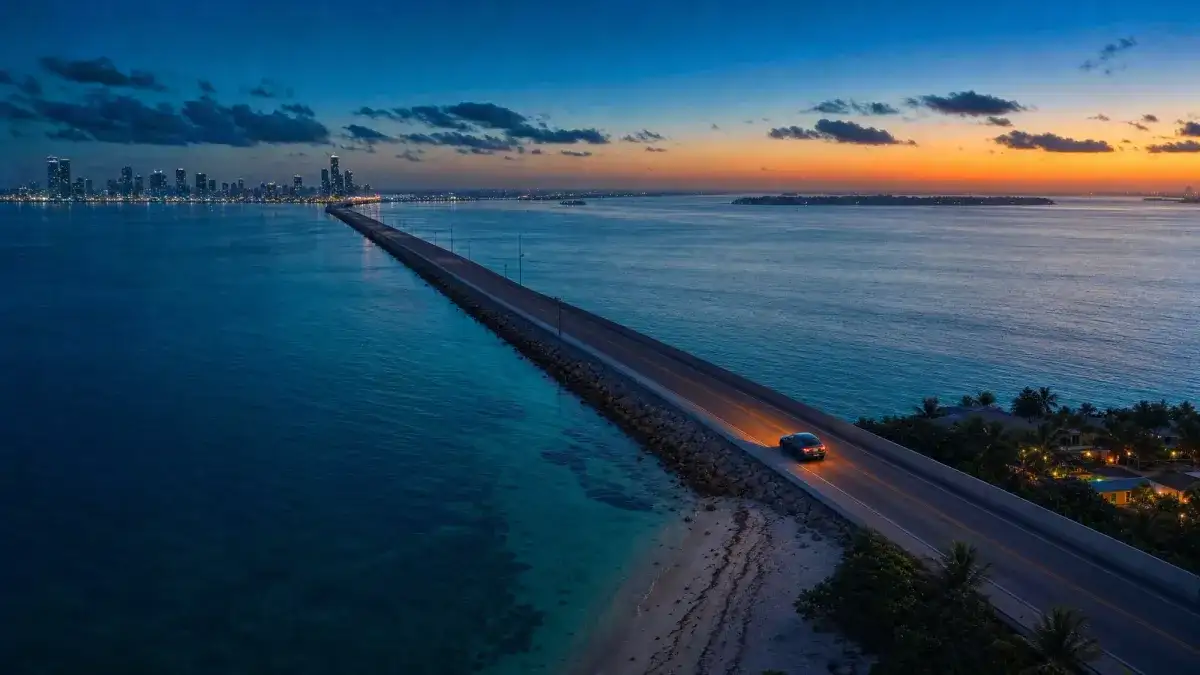
Miami's transient infrastructure generates its own stranding calendar. Cruise weekends return thousands of cars to the port garages, a predictable fraction of them EVs that spent a week losing charge to heat and electronics. MIA's lots and the rental center run the same story on a daily cycle. And the causeways, MacArthur, Tuttle, Rickenbacker, are the city's signature gamble: beautiful, exposed miles where beach traffic meets a battery that should have charged before the bridge. Dispatch treats all of it as standing geography: terminal letters, garage sections, exit numbers, the language of a city built around arrivals.
Event nights and the surge map
Then there are the nights the whole map lights up at once. An arena crowd, a festival weekend, an art fair, and tens of thousands of extra cars converge on a public-charging inventory that was tight on an ordinary Tuesday. Event-night demand does not distribute; it stacks, in the exact districts where parking already costs more than patience. Dispatch reads those nights like a tide chart: trucks staged against the surge zones, ETAs quoted with traffic honesty, and callers coached to phone at the first single digit rather than the last. The city's event calendar is public; the trick is treating it as charging weather, which is what the dispatch board does.
The highway layer
I-95 through the core, the 836 to the airport, the Palmetto's endless interchange ballet: Miami's highways strand more EVs than any surface street, usually at the exact margin where the driver was sure they could make one more exit. The protocol is unglamorous and works: shoulder, hazards, direction, exit number, and a truck that knows the corridor. The county-wide version of that playbook, including what to do in the minutes before the truck arrives, is in our Miami-Dade out-of-charge post.
The rideshare fleet lives on these corridors and deserves its own line: full-time EVs running airport loops and downtown nights on margins where every charging detour is unpaid time. Their calls are precise, the exit, the lane, the percentage, and their fix is sized to the shift: enough range to finish the night and charge properly after. The dispatch board treats a working car's deadline as exactly that.
How does mobile charging compare citywide?
Every alternative in Miami pays a Miami tax. The tow pays it in time and traffic. The drive-to-charge pays it in range spent hunting stalls that event nights and lunch rushes routinely erase. Our emergency charging service pays it once, in the truck's drive, and refunds it at the car: NACS for Tesla, CCS-1 for the rest of the modern fleet, J-1772 for the holdouts, 15 to 45 minutes to a margin that ends the emergency. In a city whose distances are measured in traffic rather than miles, moving the energy beats moving the car, every time.
If your EV is dark on a tower deck, empty at a Calle Ocho curb, stranded at a port terminal, or down to 4 percent on I-95, call Rapid Charge EV at (954) 278-4454 or email support@myrapidchargeev.com. We dispatch across Broward, Miami-Dade, and Palm Beach 24/7.
Frequently Asked Questions
Do you cover all of Miami or just downtown?
All of it: the urban core, the neighborhoods from the Upper Eastside to the Grove, the port and airport, and the highway corridors that stitch them together. The dispatcher routes from your exact location, not from a neighborhood list.
Can you reach me on I-95, the Dolphin, or the Palmetto?
Yes. Get safely onto the shoulder or off at the nearest exit, then share your direction, the closest exit number, and a landmark. Highway response is a core dispatch category, day and night.
What about cruise passengers returning to the port at low charge?
A weekly classic. Give the terminal letter and the lot or garage section, and a session meets the car before the drive home starts.
Can you charge my EV in a Little Havana or Grove neighborhood with no driveway?
Yes. Curbside sessions work anywhere the truck can stand beside the car for half an hour; older neighborhoods without home charging are a daily part of the route.
Miami-Dade has Supercharger queues downtown and forty empty miles to the south. The county's charging deserts are real, specific, and survivable with the right plan. Call (954) 278-4454.
Miami's rental towers advertise EV charging more than they deliver it. Here is where charger-equipped apartments actually cluster by neighborhood, what the amenity really looks like, and the option that works at any address. Call (954) 278-4454.
Miami-Dade's EVs live in towers, cross water daily, and park with valets. The county's mobile charging patterns are unlike anywhere else in Florida. The local operating guide. Call (954) 278-4454.