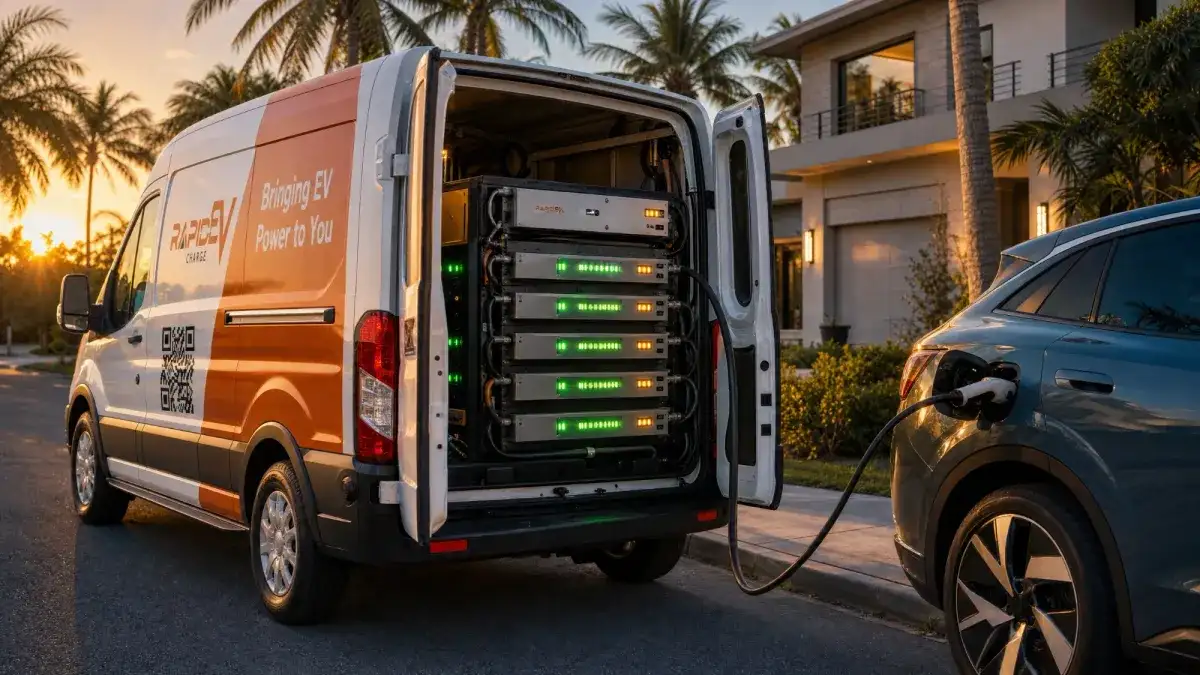
Mobile EV Charging Pembroke Pines: Rescue on Pines Blvd
Pembroke Pines was built for cars and retrofitted for EVs, and the seams show at 4 percent. The delivered answer for a city that lives on one long boulevard.
Tuesday, 5:47 PM, Pines Boulevard between Flamingo and University: the dashboard says 4 percent, the mall's chargers are full, and the next option the app offers is ten minutes of rush-hour boulevard away. Pembroke Pines is one of the largest cities in Broward and one of the hardest to charge in, not for lack of EVs but for the shape of the place, a city hung on one long boulevard, with its public charging clustered at a handful of retail anchors. Who provides mobile EV charging in Pembroke Pines when the anchors fail you? Rapid Charge EV does, the length of the boulevard and the depth of the gates, 24 hours a day.
The operational footprint lives on our Pembroke Pines service page. This post is the local answer in full: how dispatch reads a boulevard city, where the calls actually cluster, and why the ten-minute gap between anchors is the whole story. If you only take one thing from it, take the number; the boulevard is long and the gap is real.
The boulevard problem
Almost everything in Pembroke Pines hangs off Pines Boulevard, and so does its charging. The serious public options concentrate at the retail anchors, the Pembroke Lakes Mall vicinity, the Shops at Pembroke Gardens, the big-box centers at the major intersections, and the spaces between them are long, fast, and plug-free. When the anchors are full, out of service, or simply behind you, the backup is never nearby. That ten-plus-minute gap is survivable at 40 percent and ugly at 4. West of I-75 the pattern shifts from retail to residential, but the distances stay long and the plugs stay private.
Pines Boulevard between Flamingo and Hiatus: the highest-density call zone, especially around the mall.
I-75 at the Pines interchange: Miami-bound drivers who did not make the next charger.
The Turnpike's Pines and Hollywood Boulevard exits: central Broward's through-traffic squeeze.
Pembroke Falls, SilverLakes, Chapel Trail, Grand Palms: gated communities mid-rollout on home charging.
Walter C. Young, Spring Valley, Walnut Creek: older neighborhoods with fewer driveway chargers.
Memorial Hospital West and the school pickup zones: the everyday-logistics layer.
The anchor-retail math
The retail-anchor model works on an ordinary weekday and fails on schedule: weekend afternoons, holiday seasons, back-to-school weeks, any moment the same handful of stalls serves a city of this size at once. Drivers arrive at 15 percent planning to charge while they shop, find every pedestal taken, and exit two hours later with the same 15 percent and a longer evening. The Supercharger version of that queue, and why it builds exactly when you need it not to, is the subject of our Supercharger wait post. The truck's answer is to break the dependency: a session at your parking spot while the errand finishes, no stall required.
The geography compounds the queue problem with a distance problem. Pines is long, the anchors sit miles apart, and a failed plan at one does not leave range for an experiment at the next. The drivers who handle this best treat the boulevard like the highway it functionally is: margin first, errands second, and the experiment skipped entirely. It is the least intuitive lesson of boulevard-scale suburbia, and the one the dashboard teaches rudely.
Commuting against two counties
Pines commutes hard: thousands of daily round trips to Miami-Dade, downtown Fort Lauderdale, and the FLL corridor, many of them long enough to spend most of a charge each way. The pattern that strands people is the errand stacked onto the commute, the after-work detour that turns a comfortable margin into a coin flip on the boulevard. New owners feel it most; the city's growth means a large share of its EVs are in their first year, when the gap between rated range and August range is still a surprise. The preventive version of this paragraph is the pre-10-percent checklist; it reads differently before and after your first 4-percent Tuesday, and the checklist reads differently at 40 percent than at 4. Rideshare drivers running the Pines-to-Miami corridor compress the whole pattern into a single shift, and their calls get the deadline treatment a paycheck deserves.
If you are mid-emergency rather than mid-research, skip to the part that matters: call Rapid Charge EV at (954) 278-4454 with your stretch of the boulevard, your community gate, or your exit number, and a truck starts moving while you finish the sentence. East end or west end matters to the routing, so lead with the cross street.
The gated west and the pre-EV east
The city's housing splits its calls. West of I-75, the master-planned communities, Pembroke Falls, SilverLakes, Chapel Trail, Grand Palms, have the garages and the panels, and their calls are interruptions: a failed wall unit, a tripped breaker, a second EV that outpaced the second circuit. East of University, the older neighborhoods around Walter C. Young and Spring Valley were built before residential charging was a concept, and their drivers run the public-stall routine with all its exposure. Different failure modes, same fix: a session at the address, through the gate or at the curb, usually inside 45 minutes. Both halves call at dinner time; the difference is which side of the gate the truck parks on.
Weekend mornings bring the sports-complex version: tournament parking at the city's fields, families three games deep, and a return to a car that spent four hours baking. The afternoon resolves the same way the school run does, a session at the lot, sized to the rest of the day.
Hospitals, pickups, and the everyday layer
Beneath the commuter drama runs the city's everyday logistics: visitors at Memorial Hospital West discovering a long visit drained more than the meter, parents in the Flanagan and West Broward pickup lines watching single digits with errands still stacked, rideshare drivers working the Pines-to-Miami corridor on margins a gas car never met. None of these are exotic. All of them are time-boxed, which is exactly the shape the dispatch is built for: precise location, honest percentage, realistic ETA, and a session that hands the schedule back. All three groups call the same number and get the same triage.
Is the truck worth more than the ten-minute gamble?
Every alternative in Pembroke Pines is a bet on the gap. The drive to the next anchor bets remaining range against boulevard traffic. The tow concedes the car to reach infrastructure that may be busy. Our emergency charging service refuses the bet: NACS for the Tesla majority, CCS for the Mach-E-to-Ioniq spectrum, J-1772 for the older fleet, 15 to 45 minutes to a working margin, delivered to the lot, the gate, or the shoulder. The car leaves under its own power, which was the entire point. The boulevard's rush hour makes the arithmetic worse exactly when the margin is thinnest, which is why the decision deserves to be made early.
If your EV is at 4 percent outside the mall, behind a SilverLakes gate, or on the I-75 shoulder, call Rapid Charge EV at (954) 278-4454 or email support@myrapidchargeev.com. We dispatch across Broward, Miami-Dade, and Palm Beach 24/7.
Frequently Asked Questions
How fast can you reach me on Pines Boulevard?
It is one of the highest-frequency corridors in the county, so trucks stage against it. East-end and west-end calls dispatch differently; the dispatcher quotes a realistic ETA for your stretch on the call.
Do you come into Pembroke Falls, SilverLakes, Chapel Trail, or Grand Palms?
Yes, all of them. Provide the gate code or have the dispatcher coordinate with security while the truck is en route.
Can you charge me at Pembroke Lakes Mall or the Shops at Pembroke Gardens?
Yes. Both are routine dispatch points when the on-site chargers are full or down. Tell us which entrance or anchor store you parked near.
Do you respond on I-75 and the Turnpike near Pines?
Yes. The I-75 interchange and the Turnpike's Pines and Hollywood Boulevard exits are standing response zones. Shoulder, hazards, direction of travel, and the truck rolls.
Pembroke Pines is HOA country with an EV in every third driveway. Here is the honest home-charging option map for the city's housing mix, installs, approvals, and the service that skips both. Call (954) 278-4454.
No downtown, no retail strip, no public charger, and that is how the neighborhood likes it. Here is how Hillsboro Pines gets 24/7 charging coverage without any infrastructure of its own. Call (954) 278-4454.
Drivers in the Pembroke Park and Hollywood corridor search for fast charging daily and find a sparse, hard-working map. Here is the honest layout, the gap zones, and the alternative that skips the hunt. Call (954) 278-4454.