Under the Flight Path, Virginia Gardens Stays Charged
The airport surrounds the village on the map and employs half of it in practice. The delivered answer for the smallest town on the flight path.
Virginia Gardens is the village the airport grew around: a few hundred homes on a handful of shaded blocks, holding their small-town line while MIA's runways roar a few hundred yards away. The jets overhead set the soundtrack and, for many households, the paycheck; the village itself keeps to its scale, a town hall, a park, streets where everyone waves. Nothing about that scale ever attracted a charging network. Who provides mobile EV charging in Virginia Gardens, the smallest town on the flight path? Rapid Charge EV does, block by block, 24 hours a day.
The village's dispatch runs through the Miami-Dade coverage hub, the county map that treats a few hundred homes as addresses worth reaching. This post is the village-sized answer: how EV life works in a town the infrastructure maps skip, and why the airport next door shapes every call.
A village on the airport's payroll
The village's relationship with MIA is the key to its charging life. Residents work ramp shifts, terminal jobs, and airline schedules that start at 4 AM and end at midnight, and their cars, increasingly electric on commuter math, have to be ready on the airport's clock. Home charging here is improvised the way it is in every modest older neighborhood: a garage outlet doing slow overnight duty, a retrofit circuit where an electrician's visit fit the budget, and nothing public for blocks in any direction. The routine works until a shift change, a tripped breaker, or a borrowed car breaks it, and the airport's clock does not wait for repairs.
The village blocks off NW 36th Street: curb and driveway sessions between the flight waves.
The park and town hall loop: the village's quiet core, served like any boulevard.
The NW 36th Street frontage: hotel-row adjacency and the commuter edge.
The 4 AM dispatch
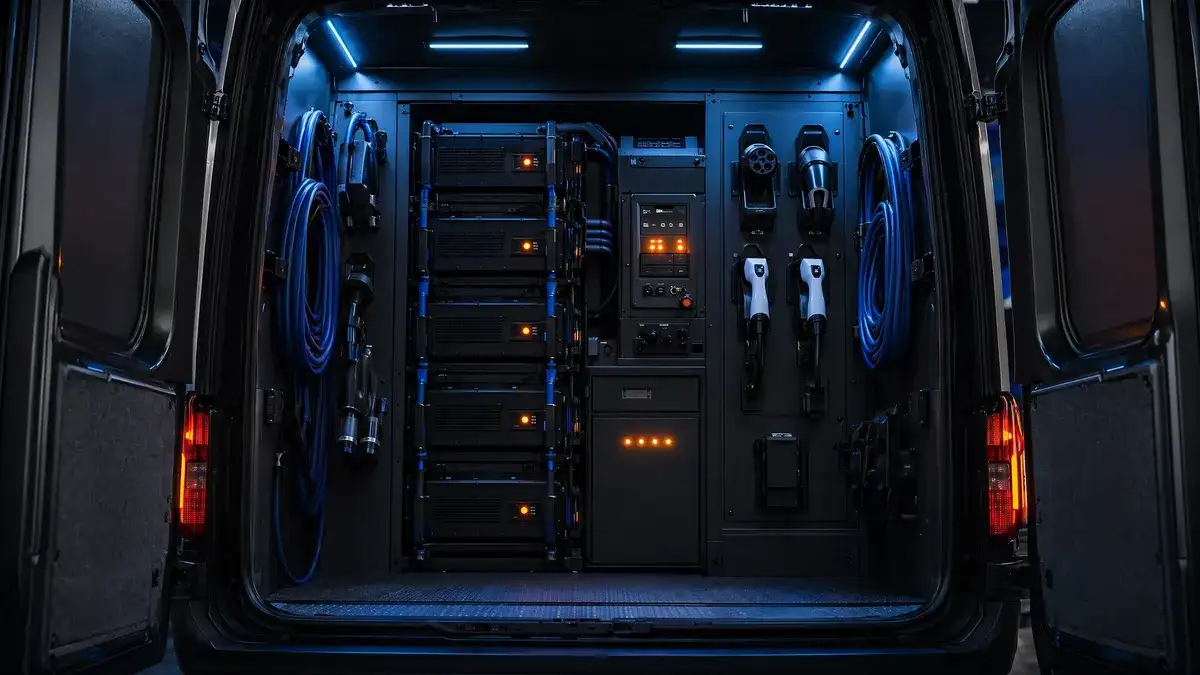
The village's defining call happens before the first departure bank: a ramp worker's EV at 9 percent, a shift starting in ninety minutes, and every theoretical charging option dark or distant. The dispatch answer is built for exactly that hour, a curb session run while the street sleeps, finished before the carpool would have been an option. The county's case for round-the-clock coverage is made in our Miami-Dade out-of-charge post; Virginia Gardens makes it nightly, in miniature. The truck carries every connector family, which covers the village's sensible mix of older commuters and the occasional new lease.
The daytime version is gentler: a household car run low by a week of double shifts, topped up in the driveway between errands; a visiting relative's EV revived before the drive back across the county. Small-town calls, airport tempo.
The hotel row on the village's edge adds a traveler genre to a residential town: rental EVs parked overnight by guests who have never charged one, airline crews on layovers with early reports, the occasional family discovering at breakfast that the rental reads 12 percent and the day's plans run south. The front-desk-coordinated session handles all of it overnight, and the village's location, minutes from the rental returns, makes the timing forgiving.
Why the village never got hardware
Charging networks build for traffic counts and retail anchors, and the village has neither, just homes, a park, and the airport's fence line. No commercial strip means no host sites, and no host sites means the map stays empty no matter how many residents go electric. It is the same story as every small town in the county's gaps, with a louder sky. The practical answer was never going to be construction; it was always going to be delivery.
What the village does have is fabric: neighbors who notice, a town hall that knows everyone, blocks short enough that a service truck gets recognized by its second visit. Small-town fabric turns out to be operationally useful. Calls come with precise details because callers know their streets, access is never a mystery because nothing is gated, and the recurring arrangements that carry households between electrical upgrades get scheduled around real routines: the early shift, the school run, the Sunday reset. The infrastructure maps will keep skipping the village; the village, characteristically, has stopped waiting.
Alternatives, against a shift clock
Crossing NW 36th Street's traffic to hunt a stall costs the exact minutes the shift cannot spare. The tow is an hour's wait to miss the clock-in anyway. Emergency mobile charging keeps the village's bargain with the airport: the car is ready when the shift starts, and nobody's morning depended on infrastructure that was never coming.
If your EV is low before a ramp shift, dark in a village driveway, or thin after a week of doubles, call Rapid Charge EV at (954) 278-4454 or email support@myrapidchargeev.com. We dispatch across Broward, Miami-Dade, and Palm Beach 24/7.
Frequently Asked Questions
Virginia Gardens has no city page on your site. Is it really covered?
Fully. The village dispatches from the same airport-belt zone as Miami Springs and Doral; the truck comes to your block regardless of which page describes the area.
Can sessions run before airport shifts, even very early?
Yes. Pre-dawn curb sessions before a ramp or terminal shift are normal dispatch business in the airport belt.
Where would I charge publicly otherwise?
Realistically, across NW 36th Street's traffic or down in Doral, both trips that cost time a shift schedule does not have. The delivered session removes the trip.
A city that runs on shift clocks and warehouse schedules has EVs now, and almost nowhere public to plug them in. Here is who dispatches charging on the workday's actual timetable. Call (954) 278-4454.
North Dade's largest city hosts the county's biggest event surges and lives a working-suburban life between them. Here is who charges both versions of Miami Gardens. Call (954) 278-4454.
The charging map shows nothing between Oakland Park and Sunrise Boulevards, but the dispatch log disagrees. Here is how Roosevelt Gardens gets its EVs charged at the curb. Call (954) 278-4454.