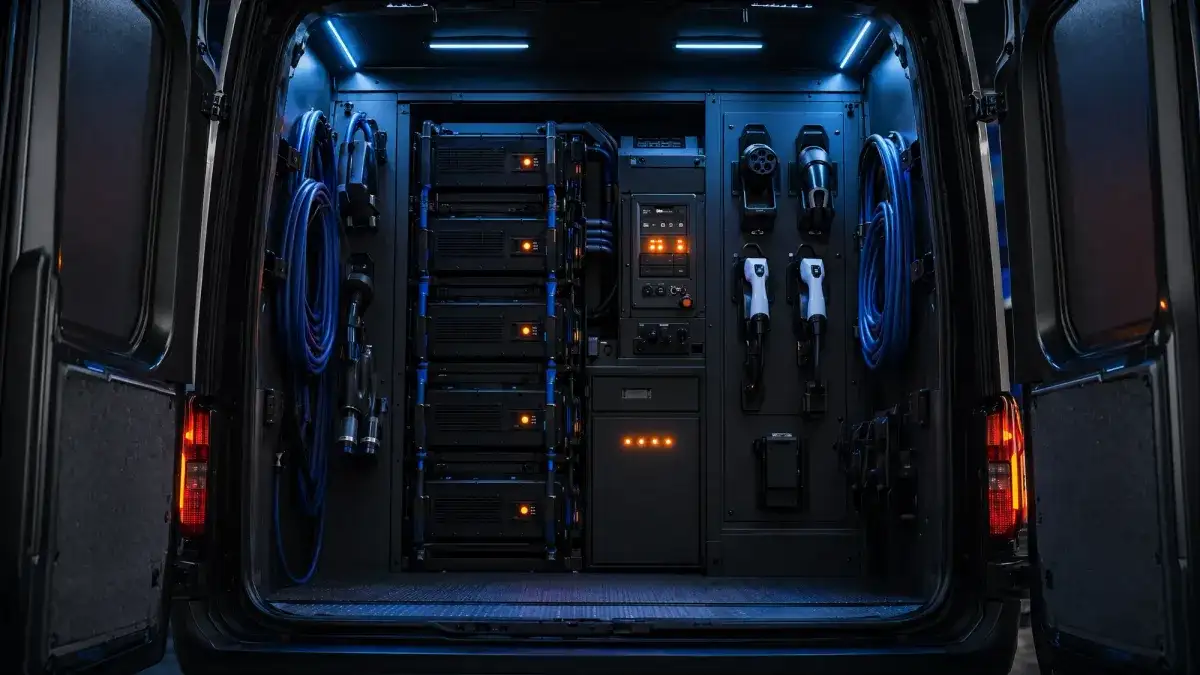
In a city this size, response time is geography. This post breaks down the real Jacksonville response bands, what commercial Level 3 equipment delivers at the curb, and the local variables, bridges, game days, drawbridge openings, that move the number.
When Jacksonville drivers ask how fast mobile charging is, they are really asking two questions: how long until the truck arrives, and how long until the car can drive. Both deserve straight answers, because this is the largest city by land area in the contiguous United States and any service that quotes one flat number is not being honest with you.
Part One: How Fast the Truck Reaches You
Response time tracks the map on the Jacksonville hub. The urban core and the Southside sit closest to the middle of the zone, so San Marco, Riverside, Downtown, and the Town Center corridor land in the 30 to 50 minute band. The Beaches and Arlington add a bridge crossing. The Northside adds distance. St. Augustine adds both.
Two Jacksonville-specific variables matter more than anything else. First, the bridges: a stall on the Buckman or an opening of the Main Street drawbridge reroutes everything near it. Second, events: when EverBank Stadium lets out, the sports complex grid and the Arlington Expressway approaches crawl for an hour. Dispatch accounts for both when quoting your ETA, which is why the quote is live rather than a printed promise.
Part Two: How Fast the Charge Flows
Once on-site, the session behaves like a fast-charging stall that came to you. The equipment negotiates with your car's battery management system, which sets the rate it will accept based on state of charge and temperature. In practice a Jacksonville emergency session delivers 15 to 50 miles of range in 15 to 45 minutes, enough to reach the Town Center Superchargers, a home charger in St. Johns, or wherever you were headed.
What is the total-time math most drivers miss?
Compare the alternatives from, say, a dead battery on Merrill Road in Arlington. A tow means waiting for the flatbed, riding to a fast charger on the Southside, hoping a stall is open and working, then charging. Limping to a charger you might not reach risks a shutdown on a bridge approach. The truck coming to you turns all of that into one wait, and the emergency service runs 24/7, so the math holds at 2 AM exactly as it does at noon.
Low on charge anywhere in the Jacksonville area right now? Call Rapid Charge EV at (954) 278-4454 or email support@myrapidchargeev.com. We dispatch across the Jacksonville metro 24/7.
Frequently Asked Questions
How fast does a mobile charging truck reach Jacksonville locations?
Typical bands: 30 to 50 minutes for the urban core, San Marco, Riverside, the Southside, and Mandarin; 30 to 55 for Arlington, the Beaches, and Argyle Forest; 35 to 60 for the Northside, JIA, Orange Park, Fleming Island, and St. Johns; 40 to 65 for Nocatee; 45 to 75 for St. Augustine.
How many miles of range does one session add?
A standard emergency session delivers 15 to 50 miles in roughly 15 to 45 minutes, negotiated between the equipment and your car's battery management system. That is a bridge charge by design: enough to reach a fast station or home, not a full pack.
What slows response down in Jacksonville specifically?
Bridge traffic is the big one: the Buckman, Mathews, and Dames Point approaches at rush hour, plus the Main Street drawbridge when it opens for river traffic. Game and event days at the sports complex, beach-weekend traffic on JTB and Atlantic, and the sheer distance to the rural Northside and Baldwin round out the list. Dispatch quotes the honest number for the moment you call.
Is on-site charging as fast as a public fast charger?
The truck carries commercial Level 2 and Level 3 equipment. Session speed depends on what your vehicle accepts, but the practical difference is small for a bridge charge, and the truck wins on total time because you skip the drive, the queue, and the possibility of a broken stall.
Searching for EV chargers near you usually happens at the worst moment. Here is the fastest honest path to a working stall anywhere in South Florida, and the backup when near is not near enough. Call (954) 278-4454.
Southbank towers, Brooklyn mid-rises, San Marco condos: thousands of Jacksonville EVs live in buildings that were never wired for them. Here is how delivered charging solves it without an HOA construction fight. Call (954) 278-4454.
Jacksonville commutes are long because Jacksonville is enormous. Here is the honest range math for the metro's classic drives, and the buffer rules that make the anxiety optional. Call (954) 278-4454.