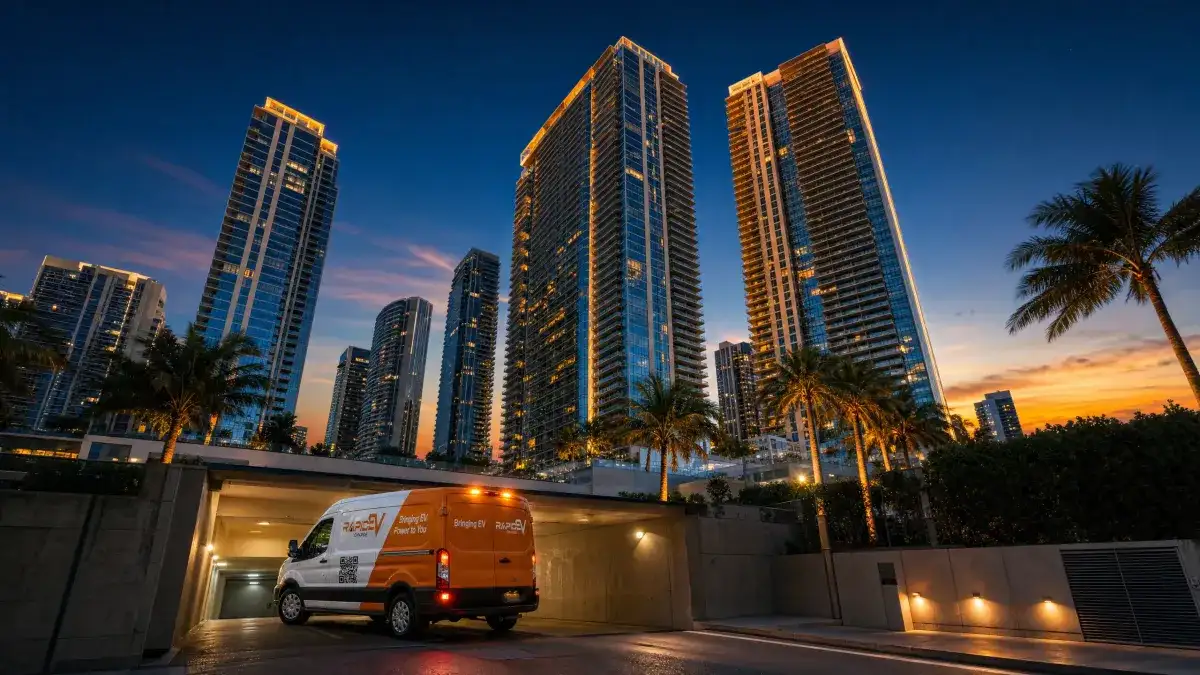
EV Charging for Jacksonville Condos and High-Rises
The Southbank skyline keeps growing and Riverside Avenue keeps filling in, but deck parking with a power run to every space is still rare. This is the practical guide for Jacksonville tower and condo residents: what buildings actually have, what installs really involve, and how mobile charging fills the gap starting this week.
Jacksonville's vertical living has a horizontal problem. The Southbank towers stack hundreds of residences above decks built decades before anyone asked about kilowatts. Brooklyn and Riverside Avenue filled with mid-rises whose garages offer a handful of shared plugs at best. The EVs arrived anyway. Now every board meeting from San Marco to the Beaches has the same agenda item.
The Building Wiring Reality
A parking deck is mostly concrete and distance. Running power to individual spaces means conduit across common elements, panel capacity that many older buildings do not have to spare, metering so neighbors do not subsidize your commute, and an assessment conversation nobody enjoys. Buildings do get there, and the good installs are worth celebrating. The timeline is the problem: EV owners need to charge this week, not after next year's annual meeting.
How Delivered Charging Works in a Tower
One setup conversation with the building: access procedure, insurance certificates, approved hours.
You book a window, scheduled weekly or on demand after a heavy week.
The truck badges in, charges the car at its space, and logs out. No cords across walkways, no equipment left behind.
The battery is ready in the morning, which is the entire point.
Where It Is Already Routine
The pattern concentrates exactly where you would guess: the Southbank riverfront, Riverside and Brooklyn, San Marco's condo pockets, and the oceanfront buildings along Jacksonville Beach. Hospital staff at the Southbank medical campus book night-shift sessions; snowbird owners reactivate service each fall when the winter apartment reopens.
For Boards: Bridge or Alternative, Honestly
If your building is pursuing an install, delivered charging keeps resident demand satisfied during the approval and construction year, and the usage data helps size the eventual system honestly. If the install math never closes for your deck, the scheduled service simply becomes the building's EV answer, at zero capital cost. Either way, no resident needs to sell the car.
Low on charge anywhere in the Jacksonville area right now? Call Rapid Charge EV at (954) 278-4454 or email support@myrapidchargeev.com. We dispatch across the Jacksonville metro 24/7.
Frequently Asked Questions
Can I get my EV charged at a Jacksonville high-rise without building chargers?
Yes. Mobile charging trucks service tower and condo decks across the Southbank, Downtown, Riverside, and San Marco. Access is coordinated with the front desk or valet once, then sessions happen at your space on your schedule or on demand. Call 954-278-4454 to set it up.
Why is installing chargers so hard in condo buildings?
Because it is common-element electrical work: board approval, engineering review, panel capacity questions, metering decisions, and cost allocation across owners. Worthwhile buildings do it, and it routinely takes a year or more. Delivered charging needs none of that, which is why residents use it either as the permanent answer or as the bridge while the board deliberates.
Which Jacksonville buildings and areas see the most demand?
The Southbank riverfront towers, the Brooklyn and Riverside Avenue apartment mid-rises, San Marco condos, Downtown decks near the sports complex, and the oceanfront buildings in Jacksonville Beach. Anywhere the parking predates the EV era.
What does a deck session look like in practice?
The truck arrives during your booked window, staff or valet badge it in per the standing arrangement, the technician charges the car at its assigned space with the right connector, NACS, CCS-1, or J-1772, and leaves the space exactly as found. Residents usually are not even present.
Miami's tower stock wasn't built for EVs. But Miami EV owners are charging anyway, every day, in towers from Brickell to Sunny Isles. Here are the four ways they do it. Call (954) 278-4454.
Fort Lauderdale rents and stacks: Flagler Village apartments, Las Olas towers, beach condos. Here is where EV charging actually exists in that stock, and the fix when your building offers nothing. Call (954) 278-4454.
Speed has two parts: how fast the truck reaches you across 875 square miles, and how fast the charge flows once it arrives. Here are the honest Jacksonville numbers for both. Call (954) 278-4454.