
The Pillar Guide
The Complete Guide to Mobile EV Charging in South Florida
Everything you need to decide whether delivered charging belongs in your EV life: what mobile charging actually is, how it works, who it fits, what it costs, and how it compares to public stations and a home charger. Written for the researcher, not the stranded, though if you are stranded right now, skip the reading and call (954) 278-4454.
- 24/7 Across the Tri-County Area
- Tesla NACS + CCS + J-1772
- We Come to You
What Is Mobile EV Charging?
Mobile EV charging inverts the oldest assumption in electric driving: that the car must travel to the electricity. A mobile charging service carries the electricity to the car. A service truck equipped with commercial-grade Level 2 and Level 3 charging systems meets your vehicle wherever it happens to be parked, plugs in with the connector your car uses, and delivers real charge on the spot. No stall, no queue, no detour.
The idea matters more in South Florida than almost anywhere else. The region adopted EVs faster than its buildings adopted chargers: most residents live in condos, apartments, and HOA communities where installing a personal charger ranges from slow to impossible, and public fast chargers cluster around a handful of retail centers. Mobile charging fills the gap between how South Florida actually parks and how EVs actually charge.
Three service shapes cover nearly every situation: emergency roadside charging when a battery runs out mid-journey, scheduled residential charging for drivers whose buildings offer no plug, and fleet charging for businesses running electric vehicles without depot infrastructure. The same trucks, the same equipment, three different rhythms.
It also helps to say what mobile charging is not. It is not a tow: your car never leaves the spot you parked it in, and you never ride anywhere. It is not a trickle from a household cord: the equipment on a professional truck is the same commercial class of hardware you find at fixed fast-charging sites. And it is not a novelty for edge cases: in a region where hurricanes interrupt grid power, snowbird season doubles the traffic, and most parking spaces have no outlet within a hundred feet, charging that travels is simply the missing piece of the infrastructure.
How Mobile EV Charging Works
The short version is three steps: you book by phone or online, a certified technician drives to your exact location, and the truck charges your car where it sits. Booking takes about two minutes, because dispatch needs only three facts: where the car is, what the car is, and the current battery percentage.
On arrival, the technician stages the truck, selects the connector your vehicle uses, NACS for Tesla, CCS for most other modern EVs, J-1772 for Level 2, and starts the session. The charging equipment negotiates directly with your car's battery management system, which sets the rate it will accept and enforces every manufacturer safety limit, exactly as a fixed station would. An emergency session typically delivers 15 to 50 miles of range in 15 to 45 minutes.
Location changes the choreography, not the outcome. In a condo garage, access is coordinated with the front desk or valet and the session happens at your assigned space, often without you present. On a highway shoulder, the truck stages with full lighting and safety protocol before anyone touches a cable, and dispatch will coach you on where to wait. In a driveway, it is as uneventful as a grocery delivery. The one constant across all of them is the honest ETA: dispatch quotes the real number for your location and the traffic between you and the truck, not a marketing average.
What to have ready when you book:
- Your exact location: an address, a garage level and space, or on a highway, your direction and the nearest exit. Precision here is what turns an ETA from a guess into a promise.
- The vehicle's make and model, which tells the technician the connector and the charging curve before the truck rolls.
- The honest battery percentage. Two percent and twelve percent are different calls, and dispatch plans differently for each.
- For gated communities and towers: the gate or front-desk procedure, coordinated once on the call so nobody waits at an entrance.
Every stage of the process, the equipment on the trucks, and the location-by-location choreography are covered in depth on the full how-it-works page, and the behind-the-scenes walkthrough of a real rescue shows what the whole experience looks like from the driver's seat, so there is no need to repeat it all here.
Who Mobile EV Charging Is For
Four groups get the most out of delivered charging, and between them they describe most of South Florida.
Condo and High-Rise Residents
The region's tower dwellers face the same math everywhere: hundreds of parking spaces, a handful of shared chargers, and a board approval process measured in months for anything new. Mobile charging services the car at its assigned space with nothing installed and nothing for the association to approve beyond garage access. Our condo and high-rise charging guide covers the vertical-living version in detail, and the South Florida renter's guide maps which buildings offer charging at all.
Fleets and Businesses
Delivery vans, service fleets, dealerships, and rideshare operators electrify faster than their yards can be trenched and permitted. Overnight yard visits bring an entire fleet to target charge before morning rollout, and route-based top-ups meet vehicles where they stage during the day, all without a construction project or a landlord negotiation. For a business, the honest comparison is against depot construction: installing your own chargers wins at sustained scale on property you own, and delivered charging wins on leased yards, during the months-long install gap, for seasonal fleets, and as overflow when the depot stalls are outnumbered. Many operators run both, and the ones that do usually started with a delivered pilot to learn their real energy pattern before pouring concrete.
Emergency Roadside
The reason most drivers first hear about mobile charging: the battery ran out somewhere between here and there. South Florida manufactures this moment reliably, the I-95 crawl that outlasted the percentage, the Turnpike stretch with the broken station, the A1A beach day where sentry mode stood guard all afternoon on your dime, the airport garage discovery after two weeks away. A 24/7 dispatch reaches stranded EVs on highway shoulders, in mall garages, and at beach lots across the tri-county area, delivering enough range to finish the journey rather than relocating the problem the way a tow does. The Fort Lauderdale emergency charging breakdown shows how dispatch reads one city street by street.
Scheduled Residential
For drivers with no home charger, a weekly or bi-weekly visit replaces the public-station routine entirely: the car charges at its own parking space while you do anything else. The math that convinces most people is time, not money. A public-charging routine honestly costs one to three hours a week in detours, sessions, and the occasional queue; a scheduled visit costs zero of your hours, because it happens while you are upstairs living your life. It also serves homeowners bridging an installer backlog and two-EV households sharing one garage charger, where the standing visit becomes the second plug nobody had to wire.
If none of those four describe you exactly, the pattern probably still does: mobile charging fits wherever the car's parking spot and the region's charging map disagree. Snowbirds reopening a winter home, hosts with a guest who arrived on empty, event organizers with a fleet of shuttles, all of them are variations on the same theme.
Mobile Charging vs Public Stations vs Home Installation
These three options are not rivals so much as tools for different situations, and an honest guide says plainly when each one wins.
A home charger wins when you own your home, have a garage or driveway with panel capacity, and plan to stay. Overnight Level 2 charging at home is the cheapest per-mile electricity you will ever buy, and we tell every homeowner who asks that installation is the right long-term answer. Our comparison of mobile service and home installation runs the full decision honestly, including the weeks-long installer gap that mobile visits bridge.
Public stations win for road trips and for topping up while you were going to the mall anyway. Their weaknesses are the ones every South Florida EV owner learns by experience: stalls cluster around a few retail centers, weekend queues are real, broken units stay broken, and none of it helps the driver whose battery died six miles from the nearest working plug.
Mobile charging wins everywhere the other two cannot go: renters and condo residents with no install rights, buildings whose boards are still deliberating, fleets without depots, emergencies anywhere, and every driver whose time is worth more than a charging-station queue. It is the only one of the three that adapts to where your car already is.
The thirty-second decision checklist:
- Own your home with a garage and panel capacity, staying five plus years? Install a charger, and use mobile visits as the bridge and the backup.
- Rent, or park in a shared garage or lot? Delivered charging is your home charger, on wheels.
- Run a business fleet on a leased yard, or mid-electrification? Start with delivered service, build the depot when the scale proves out.
- Just want insurance against the stranded day? Save the number and read on: the emergency service exists precisely for you.
What Mobile EV Charging Costs
Pricing follows three variables: where the car sits relative to the dispatch zone, how much energy you need delivered, and whether the visit is an emergency or part of a recurring plan. Emergency sessions carry the premium of urgency and 24/7 readiness; scheduled residential and fleet visits price as routines and land considerably friendlier per session.
Context makes any number meaningful, so here is the honest frame. A metro tow to a charging station commonly runs into three figures before you count the wait, the ride, and the public charger you still pay at the far end. A public fast-charging session typically costs about what a casual restaurant meal does, when a working stall is available, which is the part a stranded car cannot verify. Against those, a delivered charge that ends with you driving away from the exact spot you stopped in is usually the best total-cost answer the moment your situation involves any urgency at all, and the scheduled version amortizes into a routine most drivers compare to a car wash habit rather than a repair bill.
Two promises hold across every service: the exact all-in price is quoted before a truck rolls, and there is no surge pricing, not at 2 AM, not on holidays, not during hurricane recovery. Ranges and the full structure live on the pricing page and in our honest breakdown of Florida mobile charging costs, and the fastest path to a real number is two minutes on the phone at (954) 278-4454 with your location and vehicle.
Where We Serve
Coverage spans the South Florida tri-county area end to end, from Jupiter down to Homestead, with dedicated dispatch zones in Broward County, Miami-Dade County, and Palm Beach County, plus the Jacksonville metro. Every covered community is listed on the full service areas index. The flagship city pages below carry the street-level detail:
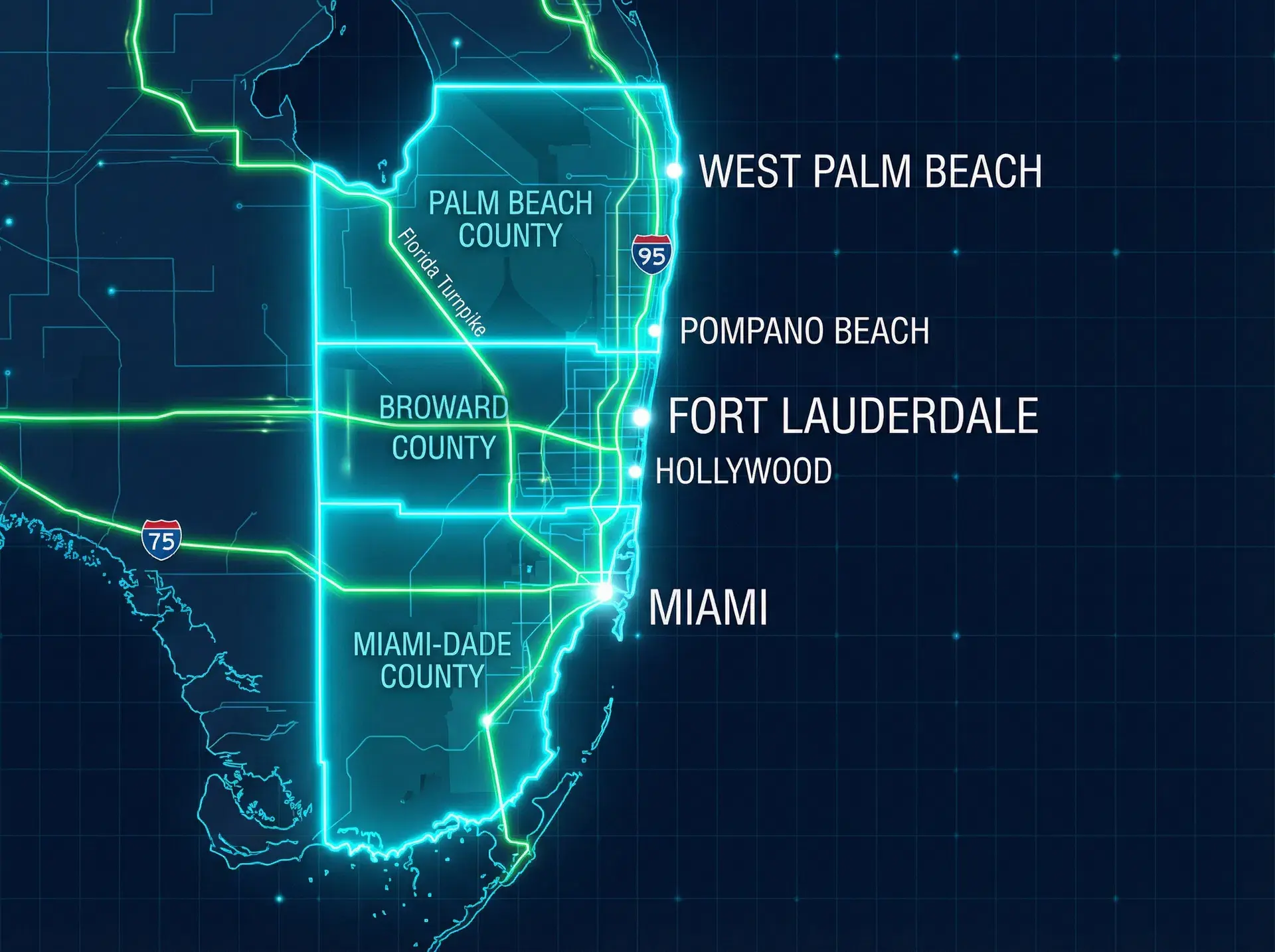
Each county gets its own dispatch logic because each county strands drivers differently. Broward is corridor country: I-95, I-595, and the Sawgrass moving commuters past retail charging that empties into suburbs with none. Miami-Dade is vertical: the densest tower-living market in Florida, where the distance between your parking space and a plug is measured in board meetings, plus the airport, the port, and Homestead's long southern reach. Palm Beach spreads the same demand across gated communities, barrier islands, and the widest geography of the three. The county pages linked above carry the response-time tables, landmark coverage, and ZIP-level detail for each.
Mobile EV Charging FAQ
The questions every researcher asks before their first delivered charge, answered plainly. Anything this page did not cover, the dispatcher will, and the wider question library lives on the full FAQ page.
- What exactly is mobile EV charging?
- Mobile EV charging is charging delivered to your vehicle instead of the other way around. A service truck carrying commercial-grade Level 2 and Level 3 equipment meets your EV wherever it is parked, a driveway, a parking garage, a roadside shoulder, and charges it on the spot using the correct connector for your car.
- Does mobile charging work for every EV brand?
- Yes. The trucks carry NACS for Tesla, CCS for most other modern EVs, and J-1772 for Level 2 charging, so Tesla, Rivian, Ford, BMW, Hyundai, Kia, Lucid, and the rest of the mainstream fleet are all routine. The session is negotiated with your car's own battery management system, exactly as a fixed station would.
- How much range does one mobile charging session deliver?
- A typical emergency session delivers 15 to 50 miles of range in roughly 15 to 45 minutes, enough to reach home, a fast charger, or your destination. Scheduled sessions at homes and buildings can deliver more because time pressure is off.
- Is mobile EV charging safe for my battery?
- Yes. The equipment communicates with your vehicle's battery management system, which controls the charging rate, monitors temperature, and enforces the manufacturer's limits, the same protections that apply at any public station.
- How fast can a truck reach me in South Florida?
- Typical emergency response runs 30 to 60 minutes depending on where you are in the tri-county area, with the exact ETA quoted honestly when you call 954-278-4454. Scheduled visits are booked for the window you choose.
- Do I need mobile charging if I have a home charger?
- It becomes your backup rather than your routine: the safety net for the day the charger fails, the breaker trips, a guest arrives on empty, or the commute math misses. Households with two EVs and one charger also use scheduled visits as the overflow plug.
- What does mobile EV charging cost?
- Emergency sessions are priced by location, energy delivered, and urgency, with the exact all-in number quoted before dispatch and no surge pricing at night or during storms. Scheduled and fleet service price as recurring plans. Call (954) 278-4454 for a quote on your exact situation.
- Does Rapid Charge EV serve areas outside South Florida?
- Yes. Beyond the Broward, Miami-Dade, and Palm Beach tri-county area, a local operator runs the same services across the Jacksonville metro, from the Beaches to Orange Park and down to St. Augustine, with its own hub page and city coverage.
Ready to Try Delivered Charging?
Whether you are researching for your building, your fleet, or just your own driveway, the fastest answer is a two-minute conversation with dispatch.