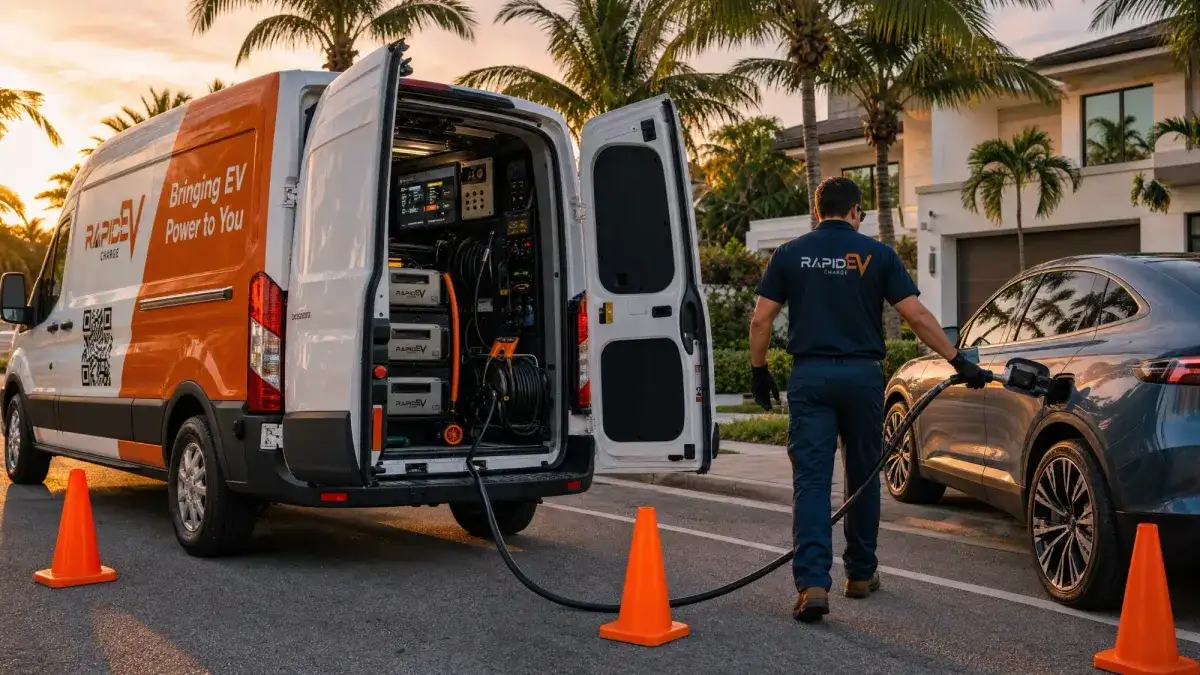
When an EV driver calls for emergency mobile charging, most of them just want one thing: to get back on the road as fast as possible. But behind that simple outcome is a well-organized process backed by commercial-grade equipment designed to deliver power to any vehicle, at any location, in minutes.
Here is an honest, behind-the-scenes look at exactly how Rapid Charge EV rescues a stranded EV from the moment you call to the moment you drive away. If you are stranded right now, see how our emergency charging service works or contact us for immediate help.
Step 1: The Call and Dispatch
The moment you call, the process begins immediately. Our team collects three key pieces of information:
Your exact location, including a street address, highway exit number, parking garage level, or nearby landmark.
Your vehicle make and model, so the technician arrives with the correct connector type.
Your current state of charge, so the technician knows how much energy to deliver and how long the session will likely take.
Once that information is confirmed, a technician is dispatched from the nearest available unit. Real-time routing ensures the fastest possible response based on your location across Broward, Miami-Dade, and Palm Beach counties.
No waiting on hold. No being transferred between departments. One call, one dispatch, help on the way.
Step 2: The Mobile Charging Unit
This is where the real difference between calling a tow truck and calling a mobile charging service becomes clear.
Our mobile charging units are purpose-built service vehicles equipped with self-contained DC fast charging systems. Unlike a standard tow truck, which brings nothing but hooks and chains, our mobile units arrive carrying everything needed to charge your battery on the spot with no grid connection required.
The core of the system is a high-capacity battery energy storage pack paired with DC fast charging output hardware. Here is what that looks like in real terms:
Output power: Commercial-grade mobile DC fast chargers typically operate between 25 kW and 120 kW of output.
Connector compatibility: CCS (used by most non-Tesla EVs), NACS (Tesla), and CHAdeMO (used by Nissan Leaf and some older models).
Voltage range: Output voltage up to 1000V, covering everything from compact EVs to larger SUVs and crossovers.
Energy delivery speed: Depending on the vehicle and battery condition, most sessions deliver 15 to 50 miles of usable range in 15 to 45 minutes.
The units are designed to operate in all conditions, including Florida's heat, humidity, and summer rainstorms.
Step 3: On-Site Safety Assessment
When the technician arrives, the first priority is not plugging in. It is making sure the area is safe for both the driver and the technician.
This means:
Confirming the vehicle is fully off the roadway or in a stable position.
Checking for any hazards like standing water, traffic exposure, or unstable ground.
Verifying the vehicle is powered down and ready to accept a charge.
Checking the 12-volt auxiliary battery, which is a step many drivers do not expect.
Many EV owners are surprised to learn that a dead 12-volt auxiliary battery can prevent the main traction battery from accepting a charge at all. This small battery powers the vehicle's onboard computer, which must authorize any charging session. If the 12-volt battery is dead, no charger will work until it is addressed. Our technicians carry the equipment to handle this issue on-site, so a dead auxiliary battery does not end the service call before it starts.
Step 4: Connecting and Charging
Once safety checks are complete and the vehicle is confirmed ready, the technician connects the appropriate cable to the vehicle's charge port.
Here is what happens inside the charger during a DC fast charge session:
The charging unit and the vehicle's battery management system communicate to confirm what the vehicle can safely accept.
The charger begins delivering DC power directly to the battery, bypassing the car's internal onboard charger, which is what makes DC fast charging so much quicker than Level 2.
Power output adjusts automatically throughout the session based on battery temperature, current state of charge, and the vehicle's own safety limits.
The session continues until the target range is delivered or the driver chooses to stop.
Because this process is managed by both the charger and the vehicle's built-in battery management system, it is safe for the battery and designed to avoid overheating or overcharging.
Step 5: Range Delivery and Route Guidance
Most emergency mobile charging sessions are designed to deliver enough range to safely reach the nearest full charging station, not to fully charge the vehicle on the spot.
This approach makes sense for several reasons:
It gets you back on the road faster.
It reduces the amount of time you spend on the side of the road.
It protects the battery by avoiding repeated deep charges at a partial state.
Once charging is complete, the technician can help confirm the nearest available charging station based on your vehicle's connector type and your destination. Whether you need a Tesla Supercharger, a ChargePoint station, an Electrify America fast charger, or a simple Level 2 location, the technician can point you in the right direction before you pull away.
Any Location, Any Scenario
One of the most important things to understand about commercial-grade mobile EV charging is that it is not limited to highway breakdowns. We respond to stranded vehicles in all kinds of situations:
Highway shoulders on I-95, the Turnpike, I-595, and US-1.
Parking garages and surface lots at shopping centers, airports, and stadiums.
Residential streets and condo complexes without on-site charging.
Remote roads near the Everglades, state parks, and rural Broward and Miami-Dade corridors.
Event venues and tourist areas where public chargers are occupied or offline.
If there is road access to reach your vehicle, we can reach you.
Why Commercial-Grade Equipment Matters
There is a difference between a consumer-grade portable charger and the kind of commercial equipment we deploy for emergency response. Consumer products are designed for convenience. Commercial-grade mobile units are designed for reliability under pressure.
That means:
Faster charge delivery
Broader connector compatibility
Safer operation in outdoor conditions
The ability to handle any EV on the market today, including sedans, SUVs, crossovers, trucks, and vans
When you are stranded on the side of the road at night or in a storm, that difference matters.
The Bottom Line
Mobile EV charging is not complicated, but the process behind it requires the right equipment, the right training, and a reliable dispatch system to work properly every time.
Every response is handled by a trained technician with commercial-grade equipment, ready to deliver power to your vehicle wherever you are in South Florida.
If you are stranded with a dead EV battery, or you just want a plan before you ever need one, call Rapid Charge EV at (954) 278-4454 or email support@myrapidchargeev.com. We dispatch across Broward, Miami-Dade, and Palm Beach 24/7.
Frequently Asked Questions
How long does a mobile EV charging session take?
Most emergency sessions deliver 15 to 50 miles of usable range, enough to reach a full charging station or get home. Treat that as an average rather than a limit: every vehicle accepts a charge differently, and the technician can deliver more when the situation calls for it. The goal of a roadside session is a bridge charge, not a full battery.
Which EV connectors do the mobile units carry?
CCS (most non-Tesla EVs), NACS (Tesla), and CHAdeMO (Nissan Leaf and some older models), with output voltage coverage for everything from compact EVs to trucks and SUVs. Every truck carries all of them.
Is roadside DC fast charging safe for my battery?
Yes. The session is negotiated between the charger and your vehicle's battery management system, which controls the rate, monitors temperature, and enforces the vehicle's own safety limits, exactly as it would at a fixed DC fast station.
What if my 12-volt battery is dead too?
A dead 12-volt auxiliary battery can prevent the main pack from accepting any charge, because it powers the onboard computer that authorizes the session. Technicians carry the equipment to handle this on-site, so a dead 12-volt does not end the service call.
Palm Beach County is long, spread out, and seasonal. A dead EV in Jupiter is a different event from one in Wellington. Here's who to call and how the county's geography shapes the answer. Call (954) 278-4454.
The Turnpike is the hardest road in South Florida to run out of charge on. Long exit spacing, toll logistics, and thin charging. Here's the playbook, written for this specific road. Call (954) 278-4454.
Thousands of Florida drivers search for an EV emergency mobile charger every month. Here is what the term actually covers, what a trunk unit can and cannot do, and the honest buy-versus-call math. Call (954) 278-4454.