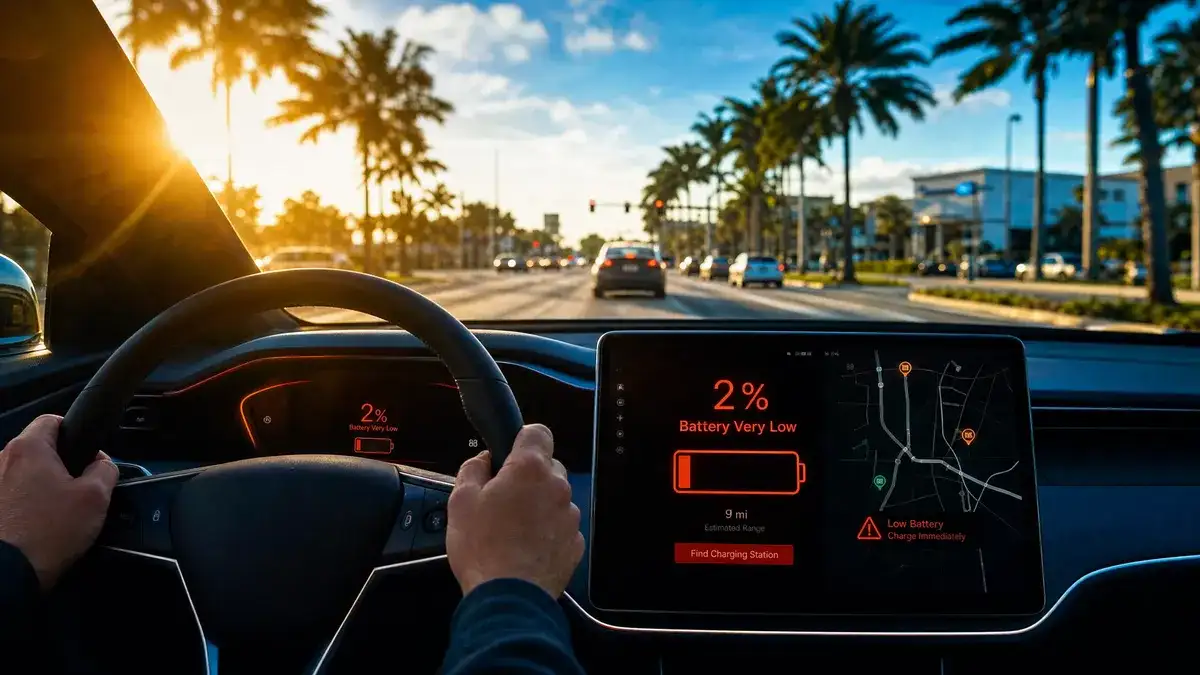
Leaving Your EV Parked at a Florida Airport: Battery Guide
Every EV traveler runs the same mental math at the departure curb: will it have enough when I get back? This guide answers it properly, drain by trip length, the settings that multiply it, why the plugged-in-all-week fantasy does not exist, and the one-call safety net at every Florida airport we cover.
This is the question every EV owner asks before their first flight and stops asking after their first mistake: what happens to the battery while the car sits? The physics are friendly, the features are not, and Florida adds its own tax. Here are the real numbers, by trip length, and the checklist that makes them irrelevant.
The Drain, By Trip Length
A long weekend (3 days): with features quieted, expect low single digits of loss. This trip length forgives almost any starting percentage above the drive home.
A week: a few percent quiet, potentially two to three times that with sentry active in a busy garage plus summer heat. Still easy with a real buffer.
Two weeks: this is where travelers get surprised. The multipliers compound, and a car parked at 60 percent with sentry on in July can greet you far lower. Board high, features off, or accept the risk knowingly.
What Actually Spends the Charge
Idle chemistry is nearly free; features are not. Security camera modes hold the car's computers awake continuously, the single biggest parked drain. Cabin overheat protection cycles climate hardware against the Florida sun. Connected-app checks wake the whole stack for a status you cannot act on from Cancun. And summer garage heat keeps battery thermal management honest all day. Every one of these is a choice; make them at the curb, not by default.
How much does the season change it?
Enough that the same trip taken twice a year gives you two different answers. A car parked through a Florida August sits in heat that never really releases overnight, so thermal management keeps working and cabin protection features cycle far more than they would in January. The same week, the same settings, and the same starting percentage can leave you meaningfully lower in summer than in winter.
Summer, roughly May through October: assume the higher end of any drain estimate, and treat cabin overheat protection as the expensive setting it is.
Winter, roughly November through April: the friendliest parking conditions Florida offers, and the season when a modest buffer genuinely suffices.
Covered or interior levels beat open upper decks in any season, and the difference is free.
Rapid Charge EV sees the summer version of this call far more often than the winter one, which is the pattern in a sentence.
The ten minutes at the curb
Do these before you walk into the terminal, in this order, and the return-day question answers itself.
Note the garage, level, and section. Photograph the pillar marking if there is one.
Set whatever long-idle, trip, or deep-sleep mode your manual describes.
Decide about security camera and cabin protection features deliberately rather than leaving whatever was on.
Check the number on the dash against your drive home plus a real buffer, while you still have the option to do something about it.
Save the dispatch number in your phone so return-day you does not have to look it up one-handed with luggage.
Return day, in order
Check the battery before you leave the terminal, not after you reach the car, because that is when you still have easy options. If the number covers your drive home with margin, go. If it is close, decide in the garage rather than on the road: a session where the car sits beats discovering the problem on an expressway. And if the car will not wake at all, that is a routine call rather than an emergency, and it is covered below. A pack that has sat at a very low state of charge takes a few minutes to accept power and bring the vehicle systems back, so the first miles arrive slowly before the rate climbs. That is normal behaviour rather than a fault, and worth knowing before it happens to you at midnight.
Why Staying Plugged In Is Not a Plan
Shared airport chargers complete a session in hours and stop; they do not trickle-maintain your car for a week, and camping a stall violates posted policy everywhere plus the basic etiquette of shared infrastructure. The airport-specific realities are covered garage by garage in the FLL guide, the MIA guide, and the Jacksonville version. The plan that works is identical at all three: buffer in, features off, fly.
The Safety Net at Every Gate
When the plan fails anyway, mobile charging is the airport traveler's insurance policy: emergency dispatch meets cars in the FLL, MIA, and JAX garages routinely, at any hour a delayed flight can land, delivering 15 to 50 miles while you handle the luggage carousel. Pricing is quoted before the truck rolls, red-eye or not. Save 954-278-4454 before you fly; it converts the whole topic from anxiety to trivia.
Landing to a battery that will not get you home? Call Rapid Charge EV at (954) 278-4454 or email support@myrapidchargeev.com. We dispatch across Broward, Miami-Dade, and Palm Beach 24/7.
Frequently Asked Questions
How much charge does an EV lose parked for a week at the airport?
A healthy modern EV parked with high-drain features off typically loses a few percent per week. With sentry or camera security features active in a busy garage, that can multiply severalfold, and Florida summer heat adds thermal-management cycles on top. Budget conservatively: assume several percent for a quiet week and meaningfully more with sentry on in summer.
Can I leave my EV plugged in at the airport while I travel?
No, at any Florida airport: shared chargers are for active sessions, completed sessions stop delivering anyway, and week-parking a shared stall violates every etiquette rule and posted policy. The plan is a buffer in the pack, not a cord in the port.
What settings should I change before airport parking?
Consult your manual for a trip or deep-sleep mode and use it; decide consciously about sentry and cabin-protection features, they are the biggest drains; and resist checking the app daily, since each wake-up spends charge. Ten minutes at the curb buys percentage on return day.
What if my battery is too low when I land?
One call: 954-278-4454. Mobile charging trucks meet cars at FLL, MIA, and JAX garages routinely, deliver 15 to 50 miles while you collect luggage, and run on quoted, surge-free pricing at every hour a red-eye can land.
Dead EV battery on I-95 in Broward County? Learn exactly what to do, how mobile EV charging works, and how to get fast roadside rescue from Rapid Charge EV. Call (954) 278-4454.
Five percent is not an emergency yet, but it is the last moment you get to choose calmly. Here is the decision tree South Florida Tesla drivers should run before the number becomes a story. Call (954) 278-4454.
Neptune Beach is small on purpose, which is why it has no charging infrastructure. Here is who brings the charge to the Town Center, Penman Road, and every beach-access block. Call (954) 278-4454.