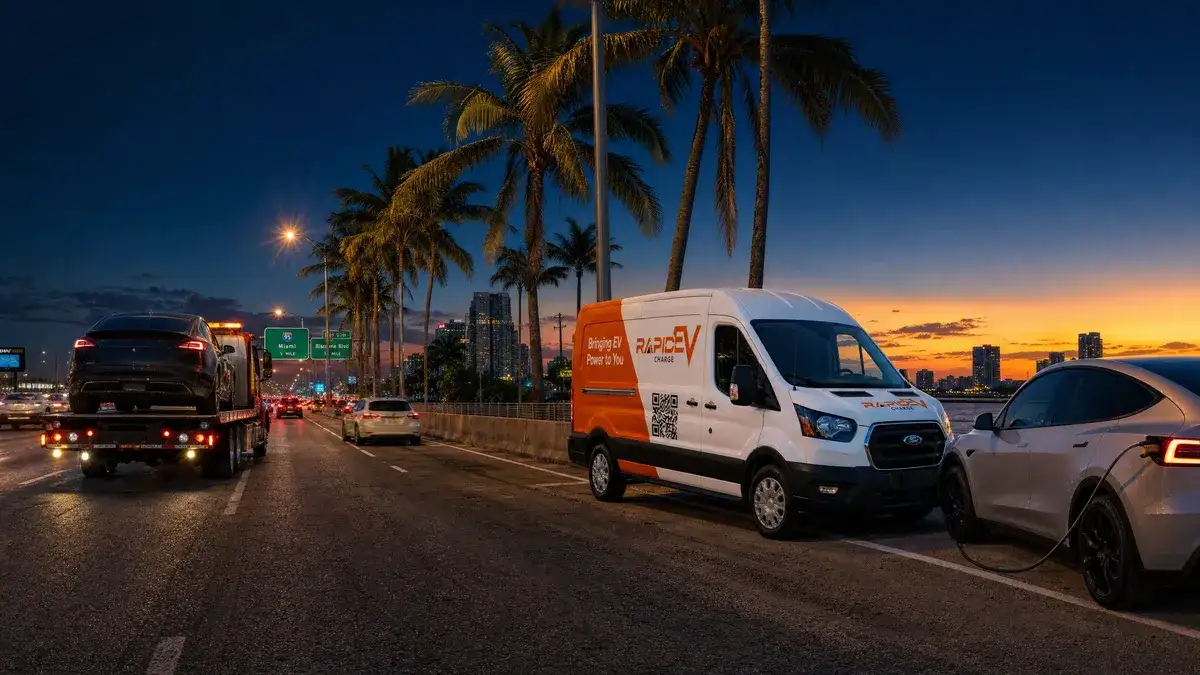
Nobody publishes a straight answer to this question, so here it is: what actually determines the price of a mobile charging visit in Florida, how emergency differs from scheduled and fleet service, what the alternatives really cost once you count everything, and why we quote the exact number before a truck ever rolls.
The mobile EV charging industry has a pricing honesty problem. Search the question and you will find vague promises, gated quote forms, and competitors who will not put a structure in writing. That vagueness is why 'how much does mobile EV charging cost' became one of the most-asked EV questions in Florida, and why this page exists. We will not play coy: here is exactly how the pricing works, what moves the number, and what the alternatives really cost.
The Three Factors That Set Your Price
Location: distance from the active dispatch zone to your car. A driveway in Pembroke Pines and a shoulder at the far end of Alligator Alley are different trips, and the quote reflects the real drive, not a flat fantasy.
Energy delivered: a bridge charge that gets you 20 miles to your home charger costs less than a full 80-mile rescue session. You choose the size of the fix.
Service type: a one-time emergency dispatch, a standing weekly visit at your building, and an overnight fleet yard cycle are three different products with three different structures.
What We Promise About the Number
You get the exact price on the phone, before dispatch, every time. No surge multiplier because it is 2 AM, no storm-season opportunism, no surprise mileage line items when the technician arrives. If the quote does not work for you, you have lost two minutes on the phone. The pricing page describes the structure, and 954-278-4454 turns it into your exact number.
The Comparison Everyone Should Run
Price only means something against the alternatives, and the honest comparison counts everything rather than one line item. A metro-area tow in South Florida generally starts around 250 dollars and rises with distance, and that number buys transport only: the car arrives at a station where you still pay for the session, still wait for it, and still hope a working stall is free. Public fast charging is the cheapest option on paper and only on paper, because it assumes a stall that is open, working, compatible, and reachable on the range you have left, which is exactly what a stranded car cannot verify. The towing versus mobile charging breakdown runs this in detail, and the short version is that delivered charging usually wins the moment your situation involves the word 'stranded'.
Why will nobody publish a flat rate?
Because a flat rate would be a lie in one direction or the other. The dominant variable is geography, and South Florida geography is not uniform: a driveway ten minutes from an active truck and a shoulder at the far western edge of the county are genuinely different jobs. An operator advertising one number for both is either overcharging the near call to subsidise the far one, or planning to add fees once the technician arrives.
The honest version is a structure you can understand plus a firm number before anything moves. That is why the quote happens on the phone rather than after the truck is dispatched, and why the figure you hear is the figure you pay.
What should you ask any provider?
Useful whoever you call, including if you are comparing. Six questions separate a real quote from a number that will grow.
Is that the all-in price, or does mileage get added when the technician arrives?
Does the rate change at night, on weekends, or during storm recovery?
How many miles of range does that deliver, and what happens if I need more once you are here?
What is the realistic arrival window, not the best case?
Is there a minimum charge or a callout fee if the car turns out to need something else?
What happens if the session cannot fix it, for instance a dead 12-volt or a fault rather than an empty pack?
Rapid Charge EV answers all six on the phone before dispatch, and any operator worth calling should be willing to do the same.
Where the Money Goes
A fair question deserves a fair answer: you are paying for a commercial-grade Level 2 and Level 3 charging system on wheels, a trained technician, insurance appropriate to working live equipment on road shoulders, and availability at 3 AM on a holiday. The how it works walkthrough shows the equipment and process behind the number.
What can change the number once we are there?
Very little, by design, but honesty means naming the cases. If you ask for more range than you originally quoted, the session gets longer and the quote adjusts, and you decide that before it happens rather than after. If the car turns out to have a fault rather than an empty pack, a dead 12-volt being the common one, that is a different job and the dispatcher will say so on the phone rather than sending a truck that cannot help.
Access is the other variable worth flagging when you call. A gated community, a garage with a height limit, a valet-held key, or a space with no room beside it can all affect how a visit runs. Mentioning it up front costs you nothing and prevents the version of this where a truck arrives and cannot reach the car.
Scheduled and Fleet: Where Per-Visit Cost Drops
Emergency pricing covers urgency. If your building has no charger and you need power weekly, scheduled service prices as a routine, not a rescue, and multi-vehicle fleet service adds volume economics on top. The pattern across Florida operators, ours included, is simple: the more predictable the visit, the friendlier the per-session number.
Need a charge where your car sits right now? Call Rapid Charge EV at (954) 278-4454 or email support@myrapidchargeev.com. We dispatch across Broward, Miami-Dade, and Palm Beach 24/7.
Frequently Asked Questions
How much does emergency mobile EV charging cost in Florida?
The price depends on three things: where the car sits relative to the dispatch zone, how many miles of range you need delivered, and the service type. Rapid Charge EV quotes the exact all-in number on the phone before dispatch, with no surge pricing at night, on weekends, or during storm recovery. Call 954-278-4454 and you will have the real figure in about two minutes.
Is mobile charging cheaper than towing to a charger?
Usually, once you count the full trip. A metro-area tow in South Florida generally starts around 250 dollars and climbs from there with distance, and that fee only moves the car: it arrives at a charging station you still have to pay for and wait at, and it costs you the hour of riding along. Delivered charging puts the miles into the car where it already sits and you drive on. A tow is still the right call for a mechanical fault or damage, where no amount of charge helps.
Does the price go up at 2 AM or during hurricanes?
No. The quote structure is the same at 2 PM and 2 AM, weekdays and holidays, calm and storm recovery. Surge pricing on stranded drivers is exactly the practice this company was built against.
How is scheduled or fleet charging priced differently?
Recurring service trades urgency for predictability: standing weekly or bi-weekly visits at your home, building, or yard are priced as a plan rather than per emergency, and fleet work adds volume pricing across vehicles. The fleet and scheduled pages explain the structures, and the dispatcher prices your exact situation on one call.
Installing a home charger in Fort Lauderdale is the right call for many homeowners, and impossible for many renters and condo dwellers. Here is the honest local guide to both halves. Call (954) 278-4454.
A composite dispatch story from one of those calls. The kind of thing you do not see in a marketing brochure, the actual texture of how late-night mobile EV charging works in South Florida. Call (954) 278-4454.
Charge to 80%, run down to 20%, repeat. The rule is real, the science is real, and it works. The South Florida version has wrinkles generic guides miss. Call (954) 278-4454.