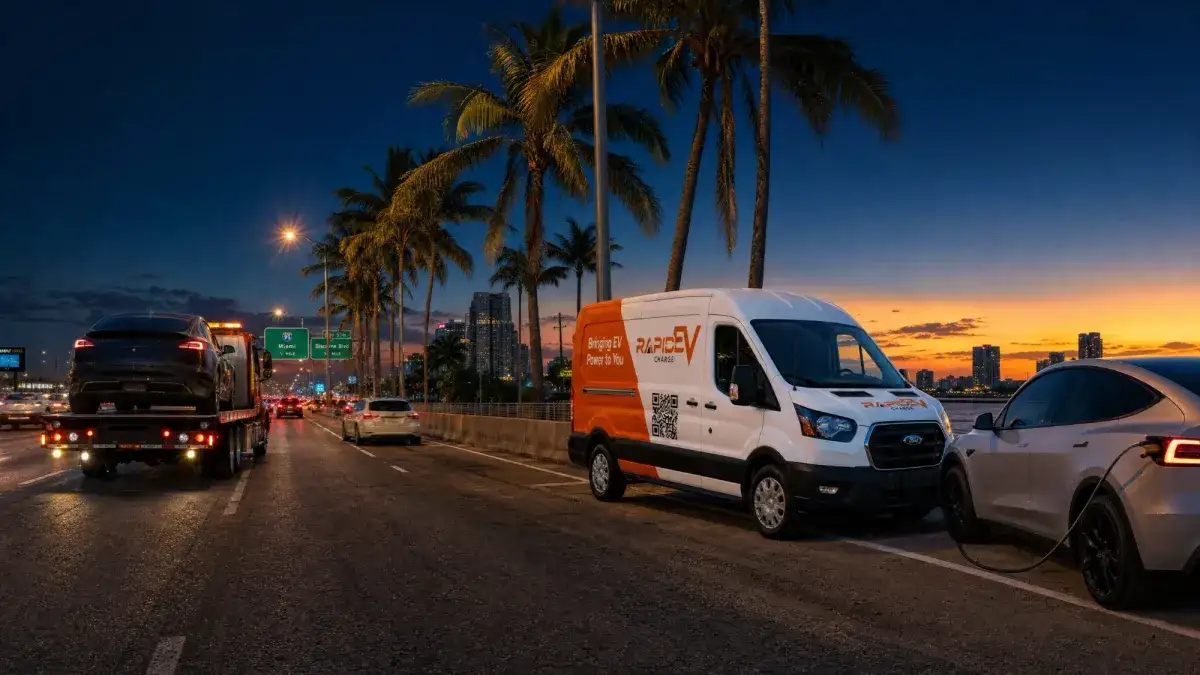
Stranded on the Florida Turnpike at 0%? What to Do
Running out of charge on the Florida Turnpike is a different problem from running out on I-95. Exits are farther apart, leaving the toll system to find a charger costs time and money, and several stretches have minimal shoulder. This is the Turnpike-specific playbook for Broward, Miami-Dade, and Palm Beach drivers.
Running out of charge on the Florida Turnpike is its own category of stranded. Rapid Charge EV dispatchers handle Turnpike calls every week, and the pattern is consistent: drivers who would have been fine on I-95, where exits come every mile or two, get caught out by the Turnpike's long gaps, toll logistics, and thin charging options. This guide is the playbook for this specific road.
Why the Turnpike is harder than I-95
Three structural differences make the Turnpike the most committing road in South Florida for a low EV battery.
Exit spacing. Between Miramar and West Palm Beach, exits can be five or more miles apart. On I-95 you are rarely more than two miles from an off-ramp; on the Turnpike, a low battery has fewer escape hatches.
Toll-system logistics. Leaving the Turnpike to find a charger means exiting the toll system, charging somewhere off the corridor, and re-entering. With SunPass that is a cost and time detour; without it, it is also a toll-by-plate hassle. Drivers postpone exiting for exactly this reason, and that postponement is how 8% becomes 0%.
Thin charging on the corridor itself. The mainline service plazas were built around fuel and food, not DC fast charging. Public charging near Turnpike exits exists but usually sits a mile or more off the ramp at retail anchors, which matters a lot when you are counting single digits of range.
Add the no-shoulder stretches, several segments through Broward run construction barrels or narrow concrete-barrier shoulders, and the margin for error is genuinely smaller than on any other road in our service area.
First moves when the battery hits zero
Safety first, charging second. If the vehicle is still rolling, use the remaining momentum deliberately: signal right, get to the shoulder or, if one is within reach, a service plaza or exit ramp. EVs coast farther than gas cars when power fails; aim that glide somewhere useful.
Hazard lights on immediately, before you finish stopping.
Stay in the vehicle with seat belts on if traffic is moving fast past you. The Turnpike's travel speeds are among the highest in South Florida.
If you must exit, do it on the passenger side and move behind the guardrail or barrier.
If you are stopped in a travel lane or a no-shoulder stretch, call 911 first so FHP can position traffic control. Charging comes after safety.
Pinpointing your location for dispatch
The Turnpike is long and the landmarks repeat, so precision matters. When you call, give dispatch three things: your direction of travel (northbound or southbound), the last exit you passed, and any mile marker post you can see from where you stopped. The small green mile marker posts on the shoulder are the fastest way for us to find you.
Useful reference points in our service area, south to north: the Homestead Extension through Kendall and Cutler Bay, the Dolphin Expressway interchange, the Hollywood/Pines Boulevard exit, Griffin Road, Sunrise Boulevard, the Pompano Beach Service Plaza, Glades Road in Boca Raton, and Okeechobee Boulevard in West Palm Beach. Name the nearest one and we can route before you finish the call. If you are in this situation right now, call (954) 278-4454 and we will take it from there.
Mobile charging vs towing, the Turnpike version
We have a full decision framework comparing mobile charging and towing in general. The Turnpike-specific version is shorter, because the road itself changes the math.
A tow from the Turnpike has to take you somewhere, and the somewhere is the problem. The nearest charger to your breakdown point may be miles off the toll road, and tow billing is distance-based. You also wait for a flatbed, EVs should not be towed on hook-and-chain or wheel-lift rigs, and flatbed availability on the Turnpike during rush hour is unpredictable.
Mobile charging skips the relocation entirely. The truck comes to your shoulder or plaza position, delivering enough range to get you off the toll road and to a proper station or home, and you drive away under your own power. For a pure out-of-charge scenario with no mechanical fault, it is usually the faster and simpler path. When a tow is genuinely the right answer, a fault warning, an unsafe position, suspected flood damage, we say so on the phone and help coordinate it.
Service plazas and the charging landscape
Two mainline service plazas anchor the South Florida stretch: Pompano Beach in central Broward and West Palm Beach at the northern end of our coverage. Both have parking, lighting, food, and restrooms, which makes them the best places on the road to wait for a truck. If your battery is low but not empty and a plaza is reachable, head there and call from a parked spot rather than the shoulder.
Public DC fast charging directly on the Turnpike corridor remains thin. Most options cluster at retail centers near the bigger interchanges, Miramar and Pembroke Pines off the southern exits, Sunrise and Tamarac mid-county, Boca Raton at Glades Road. Treat those as planning waypoints, not rescue options; by the time you are at 3%, a charger a mile and a half off the ramp may as well be in another county.
Prevention for regular Turnpike drivers
If the Turnpike is part of your routine, Miami to Boca commutes, airport runs on the Homestead Extension, weekend trips to West Palm, three habits eliminate most of the risk.
Board the Turnpike at 50% or better for any run longer than 20 miles. The road punishes thin margins more than I-95 does.
Know your bail-out exits in advance. Pick two interchanges along your usual run where you know charging exists nearby, and treat them as decision points.
Account for South Florida heat. Summer A/C load plus 70+ mph travel speeds burn range faster than the dashboard estimate assumes. Plan on arriving with 15-20% more margin than the trip computer suggests.
Bottom line
The Turnpike's long exit spacing, toll logistics, and thin corridor charging make it the easiest road in South Florida to get stranded on and the most annoying one to get towed off of. If you are stopped with an empty battery and no other faults, mobile charging solves the problem where you stand.
If you are stranded on the Turnpike anywhere between Florida City and West Palm Beach, call Rapid Charge EV at (954) 278-4454 or email support@myrapidchargeev.com. We dispatch across Broward, Miami-Dade, and Palm Beach 24/7.
Frequently Asked Questions
Can a mobile charging truck actually reach me on the Turnpike shoulder?
Yes, where there is a usable shoulder or you can reach a service plaza. Our trucks run the same toll road you are stranded on and position behind your vehicle with cones and high-visibility markers. If you are stopped in a narrow-shoulder stretch, dispatch may coordinate a short reposition to the nearest plaza or exit before charging begins, safety first.
Should I try to make it to a service plaza?
If the vehicle is still moving and a plaza is within your remaining range, yes. The Pompano Beach and West Palm Beach service plazas are the safest places on the Turnpike to wait, parking, lighting, restrooms, food. If the dashboard says zero, do not gamble; take the shoulder while you still have control of where you stop.
Does mobile charging cover the Homestead Extension (HEFT)?
Yes. The Homestead Extension through southern Miami-Dade, Kendall, Cutler Bay, and Florida City is part of our standard dispatch footprint. It is one of the thinnest stretches for public charging in the metro, which is exactly why we cover it.
Why not just call a tow?
Sometimes a tow is right, mechanical faults, unsafe positioning, suspected flood damage. But if the only problem is an empty battery, a tow moves your problem to a charger and bills you for the miles; mobile charging solves it where you stand. Our general mobile charging vs towing guide covers the full decision framework.
Florida City is mile zero: the Turnpike ends, US-1 points at the Keys, and the mainland's charging network quietly signs off. Here is who answers on the last stretch. Call (954) 278-4454.
A composite dispatch story from one of those calls. The kind of thing you do not see in a marketing brochure, the actual texture of how late-night mobile EV charging works in South Florida. Call (954) 278-4454.
Your EV won't drive. You don't know why. Should you call mobile charging or a tow? This is the framework we use when we triage calls, broken down so you can make the right call without guessing. Call (954) 278-4454.