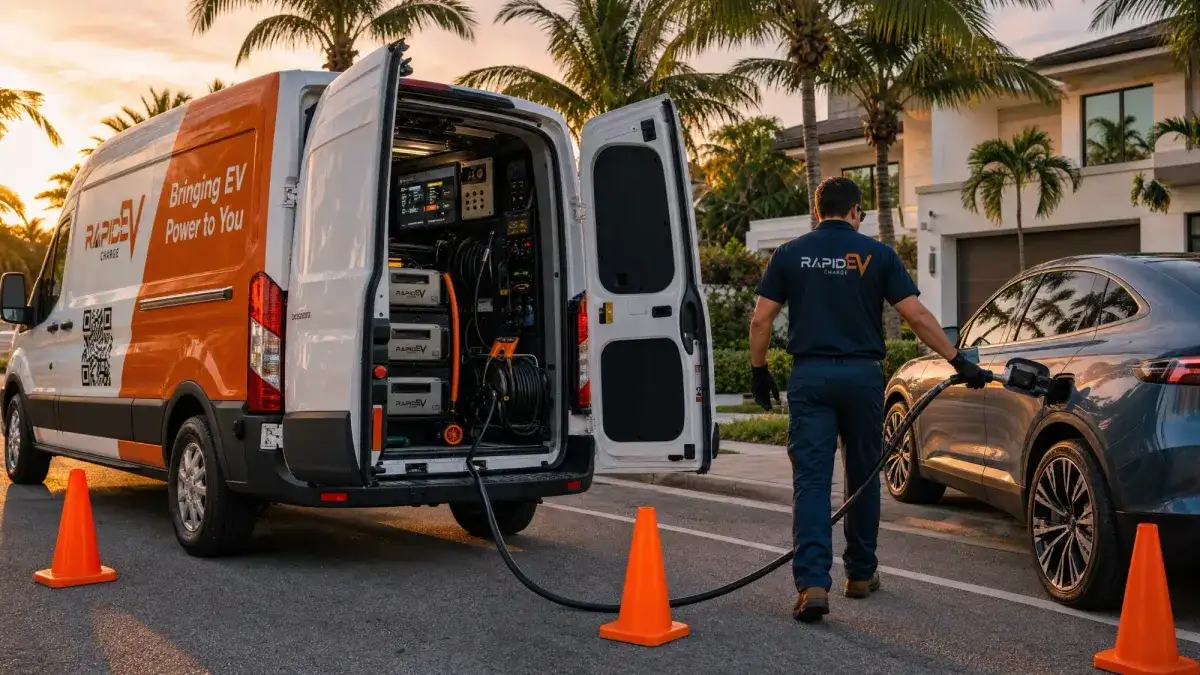
Every southbound battery makes its final decision here. The delivered answer for the gateway town where the mainland's infrastructure runs out.
Florida City is where the mainland makes its last offer. The Turnpike dissolves into US-1, the outlet signs give way to mile markers, and somewhere past the last traffic light the charging network of metropolitan Miami-Dade formally signs off. Every southbound EV makes a decision here, whether its driver realizes it or not: cross toward the Keys with the percentage on the dash, or fix the percentage first. Who provides mobile EV charging in Florida City, on either side of that decision? Rapid Charge EV does, from the terminus to the Card Sound split, 24 hours a day.
The town's entry is our Florida City service page. This post is the gateway version: why mile zero produces strandings out of proportion to its size, how the dispatch reads a town built around through-traffic, and what locals know that vacationers learn the hard way.
Mile zero arithmetic
The northbound math is forgiving: the network thickens with every mile toward Miami. The southbound math is not. Past Florida City, the next reliable fast charging is deep into the Keys, on the far side of a long, hot, shoulderless stretch with water on both sides. Vacationers who planned around their home network discover that the rules changed at the terminus, and the discovery happens at the exact spot where the options have narrowed to one direction. The county's wider thin spots are cataloged in our Miami-Dade charging deserts post; Florida City is the catalog's last page.
The US-1 frontage and the Card Sound split: the decision point for every southbound battery.
The Turnpike terminus: arriving travelers discovering the gap in real time.
The outlet and Walmart lots: errand stops that double as charging triage.
The Krome Avenue edge and the local blocks: resident and worker calls year-round.
The gateway dispatch
Through-traffic calls run on urgency and unfamiliarity: the driver does not know the town, the schedule has a sunset clause, and the car may already be below the comfort line. The dispatcher works with whatever location detail exists, a lot name, a mile marker, the gas station at the split, and the truck arrives with connectors for every EV sold in the US. The session is sized to the mission: enough range to continue to the Keys with margin, or enough to turn back north to the full network, whichever the trip actually requires. It is triage, done in a parking lot, with the AC running.
The local version is quieter. Florida City's own drivers, workers on agricultural schedules, families along the residential blocks, commuters to Homestead and beyond, run EV life at the network's edge year-round, and their calls look like anyone's: a driveway session after a failed charger, a curbside top-up before an early shift. Edge-of-network towns do not get rescued by infrastructure announcements; they get covered by dispatch zones, and this one is.
The motel rows tell the town's story best. Florida City's lodging strip exists for travelers staging a dawn run into the Everglades or an early crossing to the islands, and a growing share of those guests arrive electric, park for the night, and want to leave at six with a full day's range. The overnight session in a motel lot has become a standing genre: booked in the evening, finished before the wake-up call, no detour on either end of it. For a town whose business is sending people onward, charging that happens while they sleep is the version that fits, and front desks here learn the routine fast.
What the last stretch punishes
The southbound mistake is always the same: treating the decision point as just another town. The drive to Key Largo is short on a map and long on a battery, with heat, headwinds, and zero meaningful charging until well past the water. A car that leaves the split at 30 percent is running an experiment with a bad control group. The fix costs half an hour at the outlets; the alternative costs an afternoon on the 18-mile stretch waiting for help that has to come from the mainland anyway.
The alternatives at the edge
There is no tow here that improves the situation: north means conceding the trip, south means towing into the gap. On-demand EV charging is the only option that adds energy where the car already is, which at mile zero is the whole game. Cross with margin or do not cross; the truck makes the first option available on demand.
If your EV is doubting the crossing at the Card Sound split, flat at the Turnpike terminus, or low in an outlet lot with the Keys still ahead, call Rapid Charge EV at (954) 278-4454 or email support@myrapidchargeev.com. We dispatch across Broward, Miami-Dade, and Palm Beach 24/7.
Frequently Asked Questions
I am heading to the Keys and not sure my charge will make it. Should I call before crossing?
Yes, and from the mainland side. A session near the US-1 and Card Sound split costs less of your day than a rescue arranged from the 18-mile stretch, where options narrow fast.
Can you reach the Turnpike terminus and the outlet lots?
Yes. The terminus, the outlet and Walmart lots, and the US-1 frontage are all standing dispatch points; tell us which lot and entrance.
Do you serve Florida City residents, not just travelers?
Absolutely. Local driveway and workplace sessions run on the same dispatch as the highway calls, any hour.
The Turnpike is the hardest road in South Florida to run out of charge on. Long exit spacing, toll logistics, and thin charging. Here's the playbook, written for this specific road. Call (954) 278-4454.
One square mile of oceanfront, a famous shopping destination, and almost no public plugs: the village handles dead batteries the way it handles everything, quietly and through the right channel. Call (954) 278-4454.
In a city of garages, a failed home charger removes the whole charging plan. Here is who dispatches mobile EV charging across Cooper City, from the school pickup line to the Embassy Lakes gate. Call (954) 278-4454.