The district packs a city's worth of visitors into street parking that was an afterthought, with charging that mostly is not there. The delivered answer, on the district's own clock.
Wynwood was built twice: once as a warehouse district with loading docks and dead-end blocks, and again as an arts neighborhood with murals on every wall and crowds to match. Nobody rewired it in between. The district now pulls thousands of EVs into street parking on a good Saturday, offers them a handful of public plugs that fill before sunset, and keeps them out past midnight on gallery openings and brewery sets. Who provides mobile EV charging in Wynwood when the night runs longer than the battery? Rapid Charge EV does, mural blocks to warehouse lots, 24 hours a day.
The district's file is our Wynwood service page. This post is the street-level answer: how dispatch reads a neighborhood with almost no garages, why the calls cluster after dark, and what the district's conversion from warehouses to galleries did to its parking physics.
A district with no garages to hide in
Wynwood's charging problem is structural and honest: the building stock is converted warehouses, and warehouses do not come with parking decks. Visitors park at curbs, in paid surface lots, and in the handful of new garages at the district's edges, and the public charging follows the same scarcity, a few stalls on NW 2nd Avenue and at the food halls, claimed early on any day that matters. The district's new residential towers added EV owners faster than they added plugs, so even the people who live here queue like visitors. Everyone shares the same few electrons, and on event nights the sharing stops working.
The district's businesses live the same scarcity from the other side. Galleries host openings that fill every curb for three blocks. Breweries turn afternoon visitors into midnight regulars. The food halls cycle hundreds of cars through lots sized for dozens. None of them can offer charging without surrendering parking, and in Wynwood parking is the scarcer currency, so the hospitality instinct that defines the district has nowhere to put a pedestal. The gap between what the district wants to offer its visitors and what its electrical reality allows is precisely the gap a delivered session fills.
The NW 2nd Avenue spine: the Walls, the galleries, and the heaviest call volume.
The NW 23rd to 29th Street core: side-street parking where the night's plans outrun the dash.
The brewery and food-hall blocks: long evenings measured in sets and rounds, not hours.
The new residential towers at the edges: more EVs than waitlist slots.
The I-95 and NW 36th Street approaches: the district's connection to everywhere else.
The district's clock runs backward
Most neighborhoods strand drivers at rush hour. Wynwood strands them at midnight. The arc is reliable: arrive at golden hour, park on a side street, walk the Walls, stay for dinner, stay for the set, and return at 1 AM to a car that spent the evening running sentinel cameras in the heat. The percentage that comfortably arrived is not the percentage that leaves, and at that hour the public stalls are either taken or behind a lot gate that closed at midnight. The full anatomy of that night, and how it ends with a truck instead of a tow, is told in our 2 AM stranding story; Wynwood is where that story happens most.
Dispatch is built for the district's hours rather than in spite of them. Night calls are standard, not exceptions, the logic of a county where the strandings never respect business hours, laid out in our 24-hour Miami-Dade post. The late crew knows the district's blocks, its one-ways, and its lot gates, which matters more here than anywhere: a rescue that cannot find the car is not a rescue.
How a street-parking dispatch works
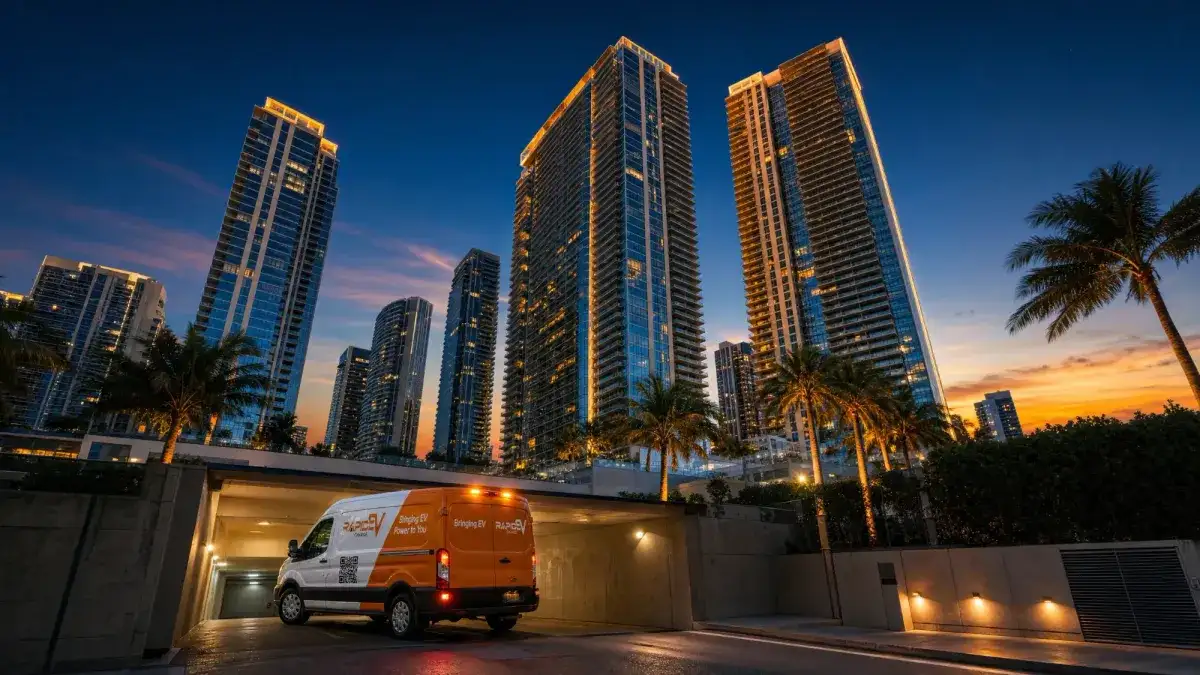
With no tower deck or valet podium to anchor it, the Wynwood call runs on description: the cross streets, the nearest mural or storefront, the car's color and connector. The truck positions beside the car at the curb or in the lot, runs the session off its own power, and finishes in 15 to 45 minutes, roughly one more round inside, which is how more than a few callers actually time it. NACS for the Teslas, CCS for everything from Polestar to Taycan, J-1772 for the older art-school hatchback; the district's badge mix is the county's most eclectic and the truck carries for all of it.
The working layer deserves its line: the rideshare EVs that feed Wynwood its crowds run the district all night on margins where a charging detour is unpaid time. Their calls are brisk and precise, and the fix is sized to the shift: enough range to finish the night strong and charge properly after sunrise.
The district's newest population, actual residents, completes the night math. The towers rising at Wynwood's edges lease to people who chose the neighborhood for its hours, and their EVs face the same waitlisted building plugs as everywhere else in the urban core. The difference is that a Wynwood resident's car can be served on the district's own schedule: an overnight curb session after the galleries close, a deck visit coordinated with a building still learning what EVs need. Residents tend to discover the service the way visitors do, mid-stranding, and keep it the way locals keep everything here: as a routine with a story attached.
Mid-crisis rather than mid-read? Here is the only sentence that matters: call Rapid Charge EV at (954) 278-4454 with your cross streets and your percentage, and the truck starts toward the district while you head back in for the encore.
Event nights and the Basel effect
Art Basel week is the district's annual stress test: every lot full, every curb claimed, every public stall a memory, and a crowd that measures its evenings in galleries rather than miles. The week rewards early calls and exact locations, and the dispatch board treats it like weather, staffed in advance, quoted honestly. The same pattern runs at smaller scale every gallery-walk weekend of the year; Basel just turns the dial to ten. The board's Basel notes read like tide tables, which lots close when, which blocks the installations claim, where a truck can actually stage, and that institutional memory is the real service area.
Against the alternatives, after midnight
The 1 AM alternatives are all bad theater. The tow means an hour of waiting on a dark block to be taken somewhere that is closed. The crawl toward a mainland charger bets single digits against I-95's on-ramps at night, with the district's one-way grid adding insult before the injury. 24/7 roadside charging ends the evening the way it was supposed to end: car charged at its curb, drive home boring, story about the murals instead of the battery. The district made its choice about what hours it keeps; the charging answer simply agreed to keep them too.
If your EV is fading on a mural block, locked behind a lot gate at single digits, or too low to face the highway home, call Rapid Charge EV at (954) 278-4454 or email support@myrapidchargeev.com. We dispatch across Broward, Miami-Dade, and Palm Beach 24/7.
Frequently Asked Questions
Can you find my car on a Wynwood side street?
Yes, with your help: the cross streets, the nearest mural or business, and the car's color and badge. The district's blocks are short, and the technician knows them; precise beats poetic when you describe the spot.
How late do you actually dispatch here?
All night. Wynwood's calls peak between 11 PM and 2 AM, and the district's dispatch is staffed on the district's schedule, not a business calendar.
Do you cover gallery openings and event nights?
Yes. Big nights stretch ETAs, so call at the first single digit. The dispatcher quotes the traffic honestly and the truck works the same blocks all evening.
I live in one of the new Wynwood buildings. Can sessions run on a schedule?
Yes. The new residential towers have more EVs than plugs, and standing visits carry many residents between building waitlist cycles.
No garage, no local pedestal, no problem the apps can see: Franklin Park's charging reality is outlet routines and corridor traffic. Here is who delivers a charge to these blocks. Call (954) 278-4454.
The standard dead-battery advice was written for some other city. Here are Lauderhill's actual options, from the public stall lottery to the charge that comes to your Inverrary lot. Call (954) 278-4454.
Tesla, Ford, Chevy, Rivian, BMW, Lucid, Nissan: every brand is somewhere different in the switch from CCS1 to NACS. Here is the 2026 map of who has which port and what adapter they need. Call (954) 278-4454.