How to Charge an EV at an Apartment With No Charger
Renters ask this question more than any other in the EV world, and most answers online are written by people who have never lived it. This is the complete, honest option list for charging without a home charger, ranked by what each really costs in money and life, with the Florida-specific details that change the math.
You can own an EV in an apartment with zero charging infrastructure. Thousands of South Florida renters do it every day. What you cannot do is wing it: charging without a home plug is a system you design once, and the difference between a good system and a bad one is measured in hours of your week. Here is every option that actually exists, ranked with the honesty the listicles skip.
Option 1: The Public-Charging Routine
Anchor one or two fast-charging sessions to errands you already run: the grocery run, the gym, the Sunday reset. It costs a session fee each time and, honestly, 1 to 3 hours weekly including detours and the occasional queue, worse during Supercharger crunch weeks. It is the default renter answer and it works, right up until the night every stall is taken and you needed to be home an hour ago.
Option 2: Charge Where You Work
If your employer offers workplace charging, it can carry your entire commute cycle free or cheap. Ask facilities; more South Florida office parks added stalls this decade than most employees realize. The catch is the same shared-stall etiquette as everywhere else, and job changes reset the plan.
Option 3: Negotiate With the Landlord
Renters have no Florida right-to-charge (condo owners do; the distinction is covered in the regional apartment guide), but leverage exists at renewal time: a charger is a retention amenity, and some landlords will split installation against a longer lease. Ask in writing, propose the specific space, and get any promise into the lease itself.
Option 4: The Outlet, With Every Caveat
Where a legal, properly rated outlet genuinely serves your parking space, and your building approves its use in writing, Level 1 charging adds 3 to 5 miles per hour, enough to sustain a short commute overnight. That is the entire safe version of this option. The extension-cord-out-the-window version is a fire hazard, a lease violation, and a manufacturer warning label come to life. We list it to be complete and to talk you out of it.
Option 5: The Charging That Comes to You
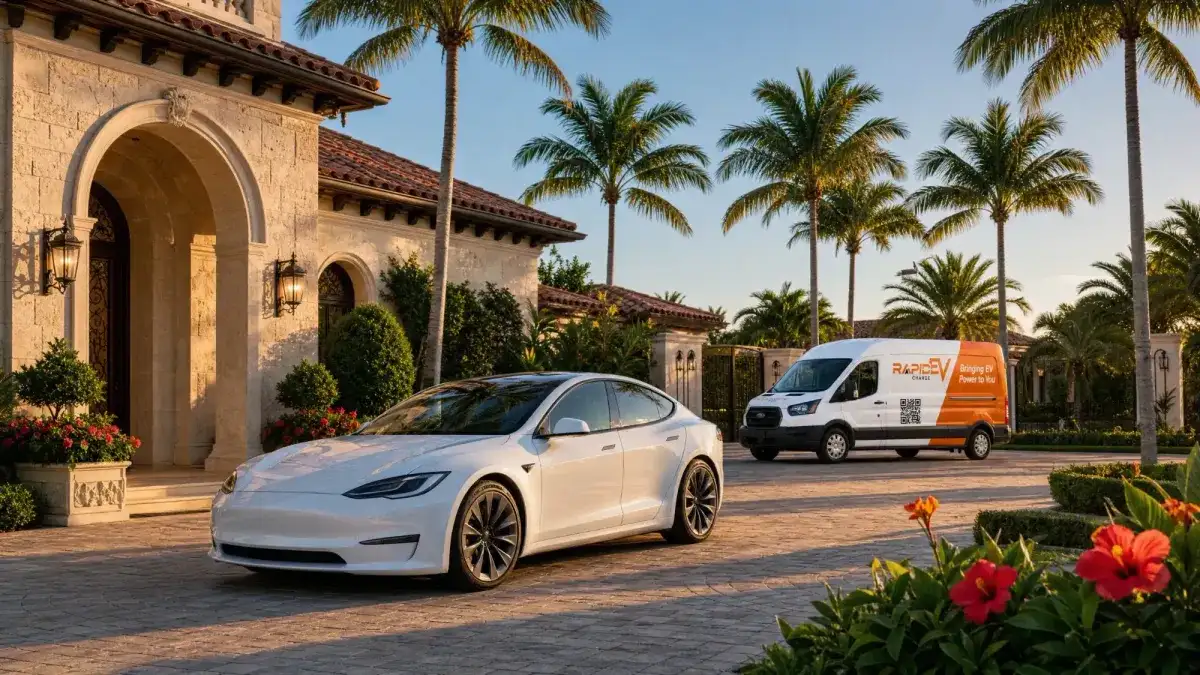
The option the option-lists never include, because it is newer than the articles: scheduled mobile charging from Rapid Charge EV meets your car at its assigned space on a weekly or on-demand cadence. Nothing installed, nothing for the building to approve beyond access, no time cost to you at all; the session happens while you are upstairs living your life. It anchors the charging system for renters across Miami, Fort Lauderdale, and the whole tri-county map, and pairs with any of the options above as the backbone or the backup. Pricing follows the quoted-before-you-commit structure.
How do you pick a primary and a backup?
Start from your weekly mileage, not from which option sounds cheapest. The question is how many times per week you need to add range, because that number decides whether an option is a routine or an ordeal.
Under about 100 miles a week: almost anything works, including a single weekend public session. Pick on convenience.
Roughly 100 to 250 miles a week: you need a dependable primary. Workplace charging or a scheduled delivered visit carries it; public charging alone starts costing real hours.
Over about 250 miles a week: you need a primary that does not depend on stall availability, plus a genuine backup. This is where renters most often give up on public-only and never go back.
Irregular or unpredictable weeks: favour on-demand over fixed schedules, and keep the emergency number saved rather than optimising a routine you will not follow.
What changes in a Florida summer?
Heat is the variable renters underestimate, because a car parked outside in August behaves differently from the same car in a garage. Cabin cooling on the drive to a charger costs range, thermal management keeps working while the car sits, and a pack that has been baking accepts power more slowly at first. Practically, that means summer sessions take a little longer and deliver a little less than the same session in January, so a weekly rhythm that was comfortable in winter can get tight without you noticing why.
It also affects how you should think about state of charge. Drivers with a home plug top up nightly and live in a narrow band. Without one, you are cycling deeper and less often, so leaving the car parked at a very low state of charge for days is worth avoiding, and arriving home with a usable buffer matters more than squeezing the last few miles out of a session.
The System Most Renters Land On
After the experimentation phase, most settle into: a primary (workplace or scheduled delivered charging), a secondary (the public routine, demoted to backup), and the emergency number saved for the nights the system breaks. Design it once, and apartment EV life stops being a compromise.
Need a charge where your car sits right now? Call Rapid Charge EV at (954) 278-4454 or email support@myrapidchargeev.com. We dispatch across Broward, Miami-Dade, and Palm Beach 24/7.
Frequently Asked Questions
How do you charge an EV if your apartment has no charger?
Five realistic paths: build a public-charging routine around your week, charge at work if offered, negotiate installation with your landlord, use a standard outlet where one legally and safely exists near your space (rare and slow), or schedule mobile charging that comes to your parking space. Most renters end up combining two of these; the mix depends on your commute and building.
Can I run an extension cord from my apartment to my car?
Almost always no, and you should not want to: household extension cords are not rated for sustained EV charging loads, fire risk is real, manufacturers warn against it, and buildings prohibit cords crossing walkways for good reason. If a legal, properly rated outlet genuinely reaches your space, Level 1 charging adds roughly 3 to 5 miles per hour, fine for short commutes, but the cord-across-the-sidewalk version is how renters get evicted and cars get damaged.
Is public charging alone practical for an apartment dweller?
It works with discipline and costs you time: one or two DC fast sessions a week, anchored to errands you already run. It fails in the details, occupied stalls, broken units, queue nights, which is why most public-only renters eventually add a backup. The honest weekly time cost is 1 to 3 hours you did not previously spend.
What does mobile charging for apartments cost?
Scheduled visits price as a routine, not an emergency, with the structure explained before you commit and no surge games. Call 954-278-4454 for the number for your building and cadence; the two-minute call beats speculating.
Bartram Park built thousands of new front doors and almost no plugs behind them. Here is who delivers EV charging to the corridor's assigned spaces, Baptist South, and the 9B ramps. Call (954) 278-4454.
No garage, no building charger, and a public stall that everyone shares: Lauderdale Lakes runs EVs on borrowed infrastructure. Here is who delivers the charge to your apartment lot. Call (954) 278-4454.
Searching for EV chargers near you usually happens at the worst moment. Here is the fastest honest path to a working stall anywhere in South Florida, and the backup when near is not near enough. Call (954) 278-4454.