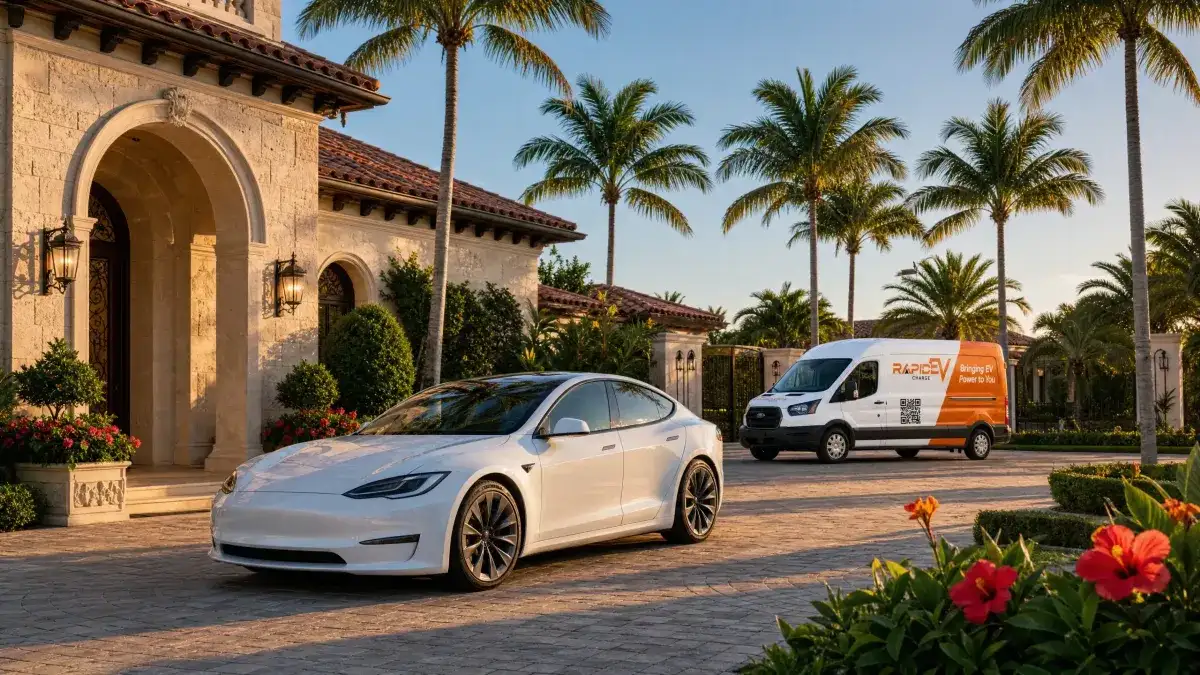
Miami Apartments With Car Charging: Where to Find Them
Miami is America's renter city, its EV adoption keeps climbing, and its apartment charging reality lags both facts. This neighborhood-by-neighborhood guide covers where charging apartments cluster, what 'EV parking available' means once you read the fine print, and how delivered charging turns any Miami building into an EV-ready one.
Miami rents. It rents high-rise, mid-rise, and garden-style, and increasingly it rents to people who drive EVs into buildings designed a decade before anyone asked where the chargers were. The listing sites will tell you a building is 'EV friendly'; this guide tells you what that means neighborhood by neighborhood, and what to do when the honest answer is 'it is not'.
The Neighborhood Map, Honestly Drawn
Brickell and Downtown: the deepest bench of charger-equipped towers in Florida, almost always shared stalls with real evening competition. The valet layer adds its own choreography, covered in our Miami condo and high-rise guide.
Edgewater and Midtown: newer construction means better ratios; some of the best renter odds in the city.
Wynwood: the new rental wave increasingly includes stalls; the older warehouse-adjacent stock does not.
Doral and the western suburbs: post-2018 Class A complexes often ship with stalls; everything older, almost never.
Little Havana, Coral Way, the garden belts: charming, affordable, and almost universally plug-free. These neighborhoods are where delivered charging earns its keep.
Coconut Grove: a genuine split. The newer Grove towers along the bayfront often have stalls; the bungalow conversions and older low-rise stock behind them almost never do.
Allapattah and Little River: rapidly changing, and charging has not caught up with the rents yet. New construction is starting to include it, older converted stock does not.
Key Biscayne: newer buildings have stalls, but the bridge means a missing charger is a bigger problem here than anywhere else in the county.
How do valet garages change the equation?
A large share of Miami's tower stock is valet only, and that single fact reshapes charging more than the stall count does. You do not park your own car, so you cannot plug it in, and whether it ever reaches a charger depends entirely on the valet team's willingness and workload. Rapid Charge EV runs these buildings constantly, and the pattern is consistent: valet operations are cooperative when there is a standing arrangement and unreliable when it is an ad hoc favor.
Ask whether valet will actively move your car to a stall, or only if one happens to be free when you hand over the keys.
Ask whether that service costs extra, and whether it runs overnight or only during staffed hours.
Find out who holds the key overnight, because a delivered charging visit needs the car accessible.
In buildings with a front desk rather than valet, the first visit is coordinated once and later visits follow the established procedure.
Why public charging is harder here than the map suggests
Open a charging app in Miami and the density looks reassuring. Living it is different, because the map does not show causeways, bridge openings, or the difference between three miles and twenty five minutes. A stall in Brickell is not usefully close to an Edgewater apartment on a weekday evening, and a Key Biscayne resident is separated from most of the county's fast charging by a single bridge. Layer on event nights near the arenas and the arts district, when every nearby stall fills at once, and the weekly public routine that looks fine on paper turns into an hour you did not plan to spend.
Reading the Fine Print
'EV parking available' can mean six stalls with app reservations or one broken charger nobody has serviced since installation. Before you sign: how many stalls for how many units, working as of this week, billed how, and what is the wait for a charger-adjacent space? The five-question interrogation from our region-wide apartment guide applies double in Miami, where marketing and infrastructure diverge most confidently, and the pre-lease question list covers what to ask a leasing agent before you sign anything.
One more Miami-specific check: find out whether the stalls are on the resident level or the visitor level of the garage. Towers that put charging on a visitor or retail level often lose it to non-residents during the day and to event traffic at night, and residents discover this only after moving in. Ask which level, then ask who else has access to that level, and whether the building enforces the resident-only rule or simply prints it on a sign nobody reads.
Condo buyers face a different version of the same problem, since the stall you see may belong to a specific unit rather than the building. The Miami condo and high-rise guide covers ownership and the association route in detail.
Does the season change what is available?
More than newcomers expect. Miami's occupancy swings hard from roughly December through April, when seasonal residents return and garages that felt half empty in August run full. Two shared stalls that were reliably free on an October evening become a queue in February, and the buildings with the thinnest ratios are the ones where the change bites hardest.
If you are touring in summer, ask what the garage looks like in season rather than trusting what you can see. If you are touring in season, you are seeing the worst case, which is genuinely useful information. Seasonal residents arriving with an EV face the same math from the other side, covered in the snowbird charging guide.
The Any-Building Answer
Delivered charging makes the building's infrastructure irrelevant: a scheduled session meets your car at its space, weekly or on demand, whether that space is a Brickell garage level or a Coral Way surface lot. Setup is one conversation with management, the truck carries NACS, CCS, and J-1772, and the cadence pauses when you travel. Renters without any plug run the full option set in the no-charger apartment playbook; for stranded-tonight emergencies, 24/7 dispatch covers every Miami neighborhood on the Miami-Dade coverage map.
Need a charge where your car sits right now? Call Rapid Charge EV at (954) 278-4454 or email support@myrapidchargeev.com. We dispatch across Broward, Miami-Dade, and Palm Beach 24/7.
Frequently Asked Questions
Which Miami neighborhoods have the most apartments with EV charging?
Brickell and Downtown lead by sheer tower count, with Edgewater and Midtown close behind on newer construction; Wynwood's newer rentals increasingly include stalls, and Doral's newer complexes lead the suburban side. Older stock in Little Havana, Coral Way, and the garden-apartment belts rarely offers anything.
What does apartment EV charging in Miami actually look like?
Typically a handful of shared Level 2 stalls in the garage, first-come or app-reserved, billed per session or per kWh. Chargers dedicated to your assigned space exist mostly in condo buildings where owners installed under Florida's condo right-to-charge law, not in rentals.
My Miami building has no chargers. What are my options?
Public charging as a routine gets old fast in Miami traffic. The practical alternatives: negotiate installation at renewal, charge at work if your employer offers it, or use scheduled mobile charging at your assigned space, nothing installed, coordinated once with the building. Call 954-278-4454 to set the cadence.
Do Brickell towers allow mobile charging trucks in their garages?
Yes, routinely. Access is coordinated with the front desk or valet the first time, and later visits follow the established procedure. Valet-parked buildings hand the process to the valet entirely.
Brickell, Doral, Aventura, Boca, Palm Beach Gardens, the Tesla Supercharger queues in South Florida hit different. Here's the pattern and the workaround. Call (954) 278-4454.
Fort Lauderdale rents and stacks: Flagler Village apartments, Las Olas towers, beach condos. Here is where EV charging actually exists in that stock, and the fix when your building offers nothing. Call (954) 278-4454.
Miami is a dozen charging problems wearing one skyline: tower decks, bungalow streets, port terminals, and the most unforgiving highway miles in Florida. Here is who answers all of them. Call (954) 278-4454.