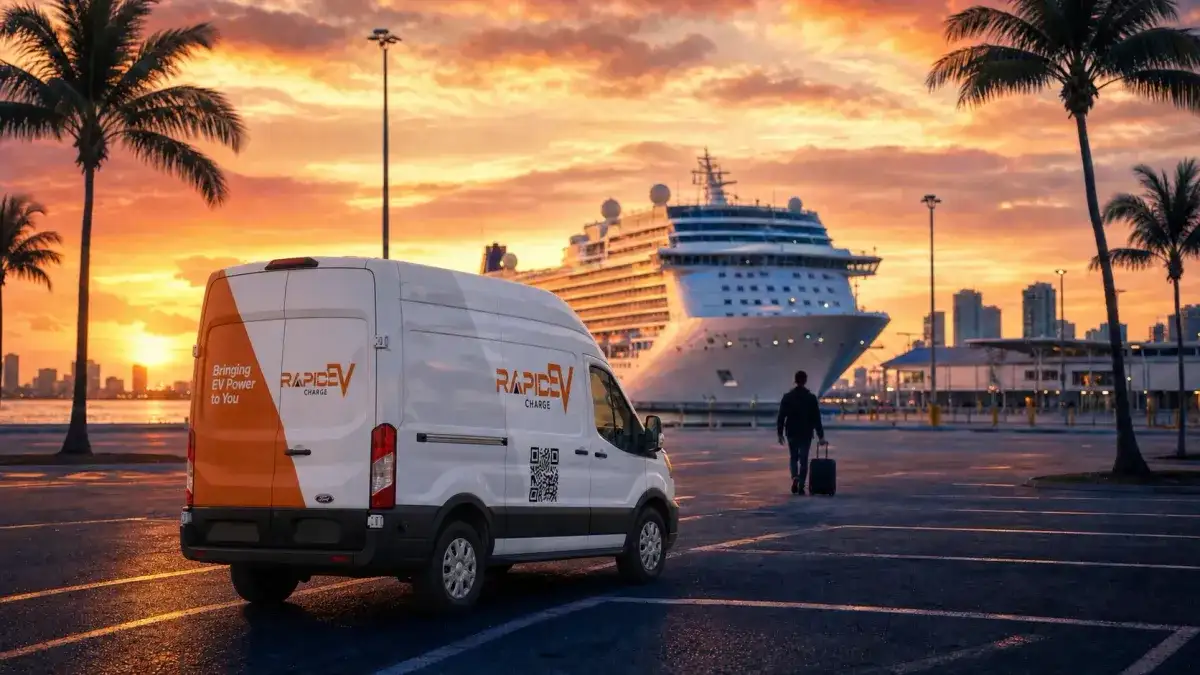
Port Everglades Cruise Parking for EVs: Pre-Sail Checklist
How the numbered cruise terminals and their garages work for an EV, the state of charge to arrive with, what a week of Florida heat does to a parked pack, and the return-day plan when the number on the dash is not enough for the drive home.
Before you sail from Port Everglades in an EV, park with the entire round trip plus a parked-week buffer already in the battery, because the terminal garages will not add any charge worth counting on. That single rule prevents nearly every cruise-parking call Rapid Charge EV takes at the port, and the calls we do take usually come from a car that went in low and spent a week in the heat losing a little more each day. Here is the checklist to run before you hand over the luggage, and the plan for return day if the number on the dash is smaller than you hoped.
How does Port Everglades parking work for an EV?
The port sits at the east end of I-595 between Fort Lauderdale and Hollywood, and cruise passengers park in the garages beside their numbered terminal. The terminal number on your cruise documents is the one to remember, because it decides which garage you enter and which lobby you walk back to a week later. The port's own parking pages are the authority on current rates and garage assignments, and those can change with the sailing schedule, so confirm the day before rather than relying on last year's trip.
For an EV the important fact is what the garages are not. They are not a charging plan. Any Level 2 stalls are shared infrastructure with move-your-car expectations, and no port wants a week-parked vehicle camped on a plug. The Port of Miami cruise guide covers the same problem on the Miami-Dade side, and the answer is identical: arrive charged.
What should be on the pre-sail checklist?
Charge to a comfortable level the night before, not the morning of. Fast chargers near the port fill up on embarkation mornings, and a queue is the last thing you want with a boarding window.
Add the parked-week buffer. Estimate the drive home, then add margin for several days of security systems, cabin overheat protection, and app check-ins in September heat.
Turn off features you do not need while parked, such as constant sentry recording or scheduled climate preconditioning, if your vehicle allows it and you are comfortable doing so.
Photograph the column sign, the level, and the terminal number as you walk to the elevator. Return day is crowded and the memory does not survive a week at sea.
Set the app to notify you if the state of charge drops below a threshold, so you learn about a problem from the ship rather than from the garage.
The pack is fine. The car simply never fully sleeps. Security cameras or alarm systems stay on, the cabin overheat protection runs on hot afternoons in a deck with sun exposure, the car wakes each time you open the app from a port of call, and some vehicles run periodic battery conditioning. Each draw is small. Seven days of them in South Florida heat is not. A car that parked at 25 percent for a drive to Palm Beach County can come back with a number that does not cover the trip, while the same car parked at 60 percent for a Fort Lauderdale address has nothing to worry about.
What is the plan on return day if the car is low?
Do not drive out of the port on a thin margin. Disembarkation traffic on the port loop and the 17th Street approach is slow, the nearest fast chargers are busy with other returning passengers, and a car that stalls in port traffic becomes a much bigger problem than one that waits in a garage. Call from the garage, give the terminal number, the level, and the column marker, and let the truck come to the car. Emergency mobile charging reaches the port garages at every hour, the session runs 15 to 45 minutes while you handle luggage, and you leave with 15 to 50 miles, enough for home across Broward or for a fast charger on the way.
Better still, check the app the day before you dock. If the number is short, book the session for your disembarkation time and the truck meets you at the terminal. That turns a return-day scramble into a scheduled handoff, which is how the Broward County mobile charging guide describes most planned sessions in the county.
What about the drive home from the port?
The port empties onto I-595 westbound, US-1, and the 17th Street corridor, and from there to I-95 and the Turnpike. If you left the garage with a margin rather than a full pack, pick a fast charger on your route rather than the closest one to the port, because the closest one is where every other returning EV is heading. The Fort Lauderdale service page lists the surrounding coverage if the plan changes on the road.
If you are back at Port Everglades and the car will not make the drive home, call Rapid Charge EV at (954) 278-4454 or email support@myrapidchargeev.com. We dispatch across Broward, Miami-Dade, and Palm Beach 24/7.
Frequently Asked Questions
Is there EV charging in the Port Everglades cruise garages?
Treat the answer as no for planning purposes. Any stalls that exist at the port are shared, conventional Level 2 units meant for short stays, not a week-long sailing, and occupied-stall rules apply. Arrive with the charge you need for the whole trip already in the pack and treat any plug you find as a bonus.
How much charge should my EV have when I park for a cruise?
Enough for the drive home plus a buffer for the days parked. A week in an open garage in Florida heat can cost several percent through security systems, cabin protection, and app check-ins, so a car that parks at 60 percent for a Broward address is comfortable, while one that parks at 25 percent for a Palm Beach drive is a gamble.
What if my EV is too low to drive home after the cruise?
Stay at the terminal garage and call for a mobile charge rather than driving toward a station on a thin margin through port traffic. A truck meets the car at its level, adds 15 to 50 miles in 15 to 45 minutes, and you leave with enough range for home or for a fast charger on the way.
Can I schedule a charge to meet me at Port Everglades on disembarkation day?
Yes. Check the car's state of charge in the app the day before you dock, and if it is short, book a session for your arrival time at the terminal. The session runs while you clear the gangway and collect luggage, and the car is ready when you are.
You're tired. You're hauling luggage. And your EV is at 2 percent in the long-term lot. PortMiami is one of our most-dispatched scenarios, here's exactly what to do. Call (954) 278-4454.
The Everglades is Florida's biggest charging desert, and every EV that visits crosses it on whatever charge it brought. Here is the trip math for Shark Valley, Flamingo, and Alligator Alley, and the safety net. Call (954) 278-4454.
Sailing out of Jacksonville's cruise terminal means an EV sitting in a lot for a week. Here is the pre-cruise plan, the honest math on parked battery drain, and the rescue call when the return does not go to plan. Call (954) 278-4454.