Back at FLL at 2 AM With a Dead EV: The Terminal Plan
Why the parked week drains more than people expect, what each FLL terminal and garage means for getting help to the car, where to wait safely at 2 AM, and the exact details that shorten a night rescue.
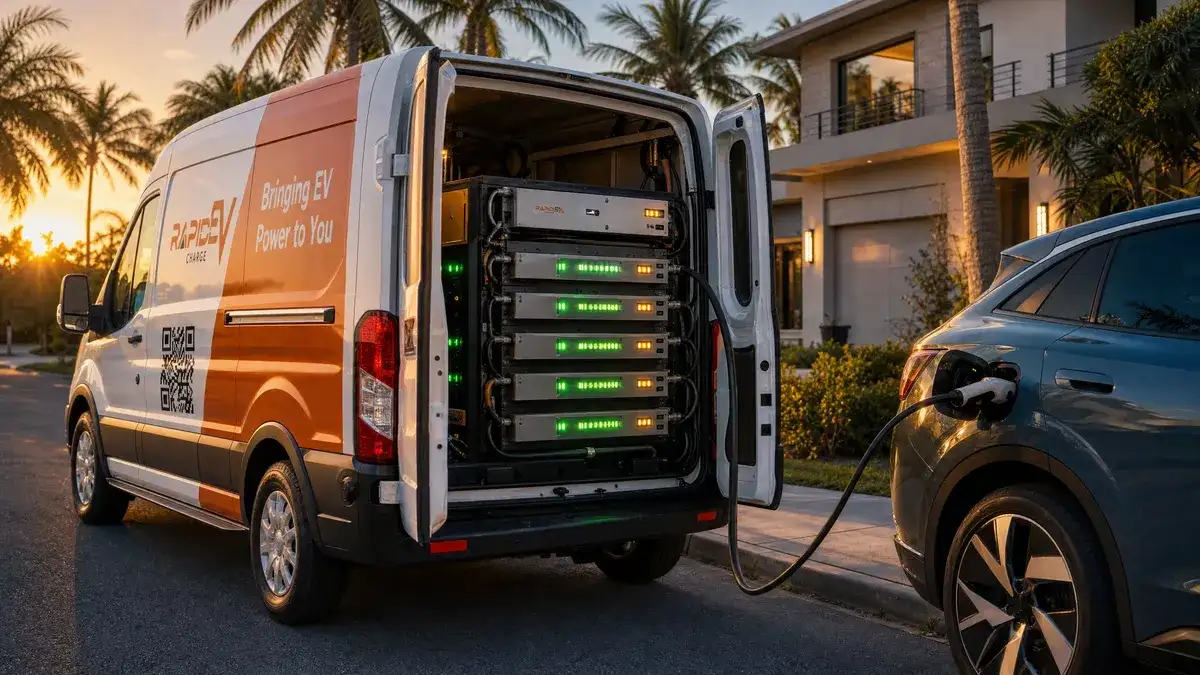
If you have landed at FLL after midnight and the EV you parked a week ago will not move, the fastest fix is to stay put, note the garage and level, and have a charging truck come to the car. Rapid Charge EV works the FLL garages at every hour, and a night call is dispatched the same way a daytime one is: a technician drives into the deck, plugs into the car where it sits, and adds enough range to get you home. The rest of this guide covers what changes from terminal to terminal, why the car drained in the first place, and how to spend the wait.
Why did the car drain while you were gone?
The battery did not fail. It kept doing its job. A modern EV parked in a Florida garage keeps its security systems awake, protects the cabin from overheating on hot afternoons, checks in with the phone app each time you open it from another state, and runs occasional battery conditioning. None of those are large draws on their own, but a week of them in September heat adds up, and a car that entered the garage at 20 percent has no room for that arithmetic. The parked-week math shows how to size the margin before you leave, and it is the prevention version of this page.
The other common cause is a charging plan that never happened. Drivers park at a Level 2 stall expecting a full pack on return, then the session finishes in hours, the car sits unplugged for days, and someone else needs the plug. The garage-by-garage FLL charging guide explains why charge-while-you-fly does not work as a strategy, so treat any charge you find on return as a bonus rather than the plan.
What changes from terminal to terminal at 2 AM?
FLL has four terminals in a line, with the Hibiscus, Palm, and Cypress garages and the surface lots sitting across from them. Overnight, the differences that matter are where you can wait, how the truck reaches your level, and how good the cell signal is where the car is parked.
Terminal 1 side: the closest decks are a short walk, and the lobby stays lit. Note whether your car is in the garage or a surface lot, because the truck routes differently for each.
Terminal 2 and Terminal 3: the central garages serve both, and the elevator lobbies are the easiest landmark to give a technician. The lower levels are where signal drops, so send your location pin from the lobby before you go down.
Terminal 4 side: the outer decks and the longer walk mean you should confirm the row marker in daylight photos on your phone if you took any on the way in. If you did not, read the nearest column sign before calling.
Economy and remote lots: the shuttle runs on a reduced overnight schedule, so tell dispatch you are in a remote lot and whether you are already at the car or still waiting for a shuttle.
The airport's parking page is the authority on which lots and garages are open at any given time, and it is worth a glance from the terminal before you walk out, especially during construction periods when a deck entrance may be closed at night.
Where should you wait, and what should you send?
Stay in the terminal or the lit elevator lobby while the truck is on the way. The arrival window is 30 to 60 minutes, and the empty deck is not a better place to spend it than a bench with lights, cameras, and staff. When dispatch calls to say the technician is close, walk to the car so the session can start the moment the truck arrives.
Send the garage name, the level, and the row or column marker. A photo of the nearest sign is better than a description.
Say what the car is and roughly what the display shows. A vehicle that reads zero and will not wake needs a slightly different start than one at 3 percent.
Say how far you are going home. That sets the target for the session, since a drive to Weston is a different ask than a drive to Dania Beach.
Keep the phone charged. A terminal outlet or a portable pack covers the wait, and the technician's arrival call is the one you cannot miss.
What does the session look like in the garage?
The truck positions beside the car, the technician connects the correct plug for your vehicle, NACS, CCS, or J-1772 as the port requires, and the car negotiates the charge the same way it would at a pedestal. Very low packs take a few minutes to wake up before the rate climbs, so do not be alarmed if the first miles arrive slowly. Most night sessions run 15 to 45 minutes and add 15 to 50 miles, which covers the drive home across Broward or gets you to a fast charger with margin to spare. Emergency mobile charging is the same service in daylight; the only thing the hour changes is how quiet the deck is.
Arrive at the airport with the round trip plus a parked-week buffer already in the pack, photograph the column sign when you park, and set the car's app to show you the state of charge a day before you fly back so you can book a session for your arrival instead of discovering the problem at the car. A charge scheduled to meet you at the garage turns a 2 AM problem into a five-minute handoff.
If you are back at FLL and the car will not make the drive home, call Rapid Charge EV at (954) 278-4454 or email support@myrapidchargeev.com. We dispatch across Broward, Miami-Dade, and Palm Beach 24/7.
Frequently Asked Questions
Can a mobile charger reach my EV inside an FLL parking garage at night?
Yes. The airport garages are open to service vehicles around the clock, and a charging truck drives to the level where the car is parked. Give the garage name, the level, and the row or column marker when you call, because the lower decks weaken cell signal and a precise location saves the technician a lap of the deck.
Why did my EV lose so much charge while parked at the airport?
Parked EVs keep running small systems: security features, cabin overheat protection in Florida heat, app connectivity, and periodic battery conditioning. A week in an open deck in August can cost several percent, and a car that went in already low has nothing to spare. The fix is to arrive with margin in the pack rather than counting on the garage to add any.
Should I wait at the car or in the terminal for a night rescue?
Wait inside the terminal or a lit area near the garage elevator lobby, then walk to the car when dispatch calls to say the truck is close. You do not need to stand beside the vehicle for the whole arrival window, and the terminals stay lit and staffed even when flights are done for the night.
How much range will a night session at FLL give me?
Typically 15 to 50 miles in 15 to 45 minutes, which is enough to reach home anywhere in Broward or to a fast charger on the way. If you live farther out, say so on the call and the technician can extend the session toward the range you actually need.
Three hundred parking spaces, four chargers, none for you: the most ordinary EV emergency in Hallandale Beach. Here is who delivers a charge to your tower garage, Gulfstream row, or US-1 shoulder. Call (954) 278-4454.
Flying out of FLL with an EV means one parking decision and two battery questions. Here is what charging actually exists in the garages, why it cannot cover your whole trip, and the plan that works. Call (954) 278-4454.
The airport run that landed late, the night shift that ran long, the dark stretch of Heckscher Drive: 2 AM strandings are Jacksonville's loneliest breakdowns. Here is who actually answers, and how the call goes. Call (954) 278-4454.