Roadside Assistance for Electric Cars: Tow, Jump, or Charge?
What is the same as a gas car, what is different, which programs a South Florida EV driver may already have, the questions to ask each one, how mobile charging fits, and how to stay safe on the shoulder.
Roadside assistance for an electric car handles the same breakdowns as a gas car (a flat tire, a lockout, a collision) plus one problem gas cars never have: a depleted high-voltage battery that cannot be jump-started. What gets you moving depends on whether the program you call can charge the car where it sits or can only tow it. Rapid Charge EV wrote this guide for drivers in Broward, Miami-Dade, and Palm Beach who want that answer before the day it happens.
Is roadside assistance for an electric car the same as for a gas car?
For most calls, yes. A flat tire is changed or plugged the same way, although many EVs ship without a spare, verify for your model year. A lockout is a lockout. A collision needs a flatbed either way. The difference is the high-voltage pack. A gas car that runs dry gets a can of fuel; an EV that runs out of charge has no equivalent, and a jump box does nothing for the pack that moves the car.
Why can't a depleted EV battery be jump-started?
A jump start pushes a burst of 12-volt power into a starter circuit. An EV's traction battery runs at several hundred volts behind contactors that close only when the car says it is safe. There is no terminal to clip onto. The pack has to be charged through the charging port.
Every EV also carries a small 12-volt battery that runs the locks, the screens, and the computer that authorizes charging. When it drains, the car looks dead: dark display, no unlock. A 12-volt jump wakes it back up but adds no driving range, so if the high-voltage pack is also empty, the car still needs a charge. Tell the dispatcher which symptom you have: a dark car points to the 12-volt, a car that wakes and reads zero percent points to the pack.
The traditional answer for an empty pack is a flatbed to the nearest working charger. As of 2026, most manufacturers state that an EV should ride on a flatbed rather than be towed with its drive wheels down, because a rolling motor can generate current; verify for your model year. When a tow is the right call is covered on the towing page.
What roadside programs might you already have?
Many South Florida EV drivers have access to more than one of these:
The manufacturer's program during the warranty period. Most EV brands include some roadside help for the first years of ownership, as of 2026. Ask it the two questions below: charge in place or tow, and to where.
A motor club membership. Ask whether it charges an EV in place or tows only, and how far it will take the car; a working fast charger that fits your connector is not always the nearest lot.
A program bundled with something else: a credit card, a new-car purchase, a lease, or a fleet vehicle. These are the ones drivers forget they have.
Before the day it happens, get a one-line answer from each: what do you do for an electric car with a depleted battery? Tow only, then where and how far? Charge in place, then with what equipment and how many miles? Ten minutes now saves an hour on the shoulder.
What should you ask when you call any roadside program?
Will you charge the car where it sits, or only tow it?
How long until someone arrives? Ask for a time, not a promise.
Flatbed or wheel-lift? For an EV the answer should be flatbed; ask them to note it on the order.
Where will the car be taken? A working charger that fits your connector, or a dealer lot closed at 11 PM?
What connector does the truck carry? NACS, CCS1, and J1772 need different hardware.
The same questions apply to mobile charging too. The mobile charging versus towing breakdown goes deeper on the decision; a mechanical fault needs the flatbed no matter how full the battery is.
How does mobile charging fit into EV roadside assistance?
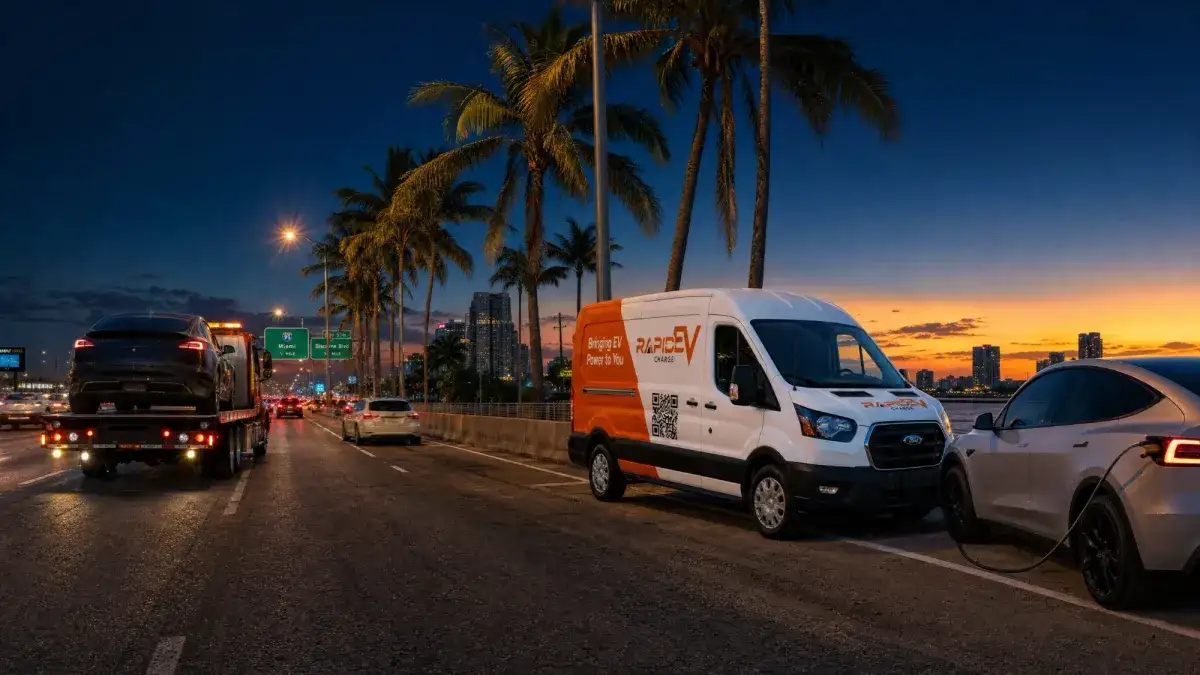
Mobile charging closes the gap a jump start cannot. A technician brings a charging unit to the car, connects through the charging port, and adds range on site. A typical emergency mobile charging session runs 15 to 45 minutes and delivers 15 to 50 miles, an average rather than a cap. Arrival is 30 to 60 minutes across Broward, Miami-Dade, and Palm Beach. Every truck carries NACS, CCS1, and J1772.
The car leaves under its own power, to a destination the driver picks. On the Miami-Dade corridors like I-95 and the Palmetto, that is often the difference between finishing the evening and losing it. The Miami-Dade County mobile charging guide shows what a call looks like across the county.
How do you stay safe on the shoulder of I-95, the Turnpike, or Alligator Alley?
When the range warning starts, leave the highway if you can reach an exit or a lit lot. If you cannot, pull as far right as the shoulder allows, turn on the hazards, and stay belted inside with the doors locked unless you are in a live lane or smell smoke; standing beside a car on I-95 at night is more dangerous than sitting in it. Note the mile marker, exit number, and direction before you call; on the Turnpike and Alligator Alley the exits are far apart, and that number turns an estimate into an arrival. What to do when your EV dies on I-95 walks through the scenario step by step.
If your electric car needs range on the shoulder or in a garage tonight, call Rapid Charge EV at (954) 278-4454 or email support@myrapidchargeev.com. We dispatch across Broward, Miami-Dade, and Palm Beach 24/7.
Frequently Asked Questions
Can roadside assistance charge an electric car on the spot?
Only if the program sends a truck with charging equipment, and not every program does. A mobile charging service is built to charge in place: the technician connects through the charging port and adds enough range in 15 to 45 minutes to reach a charger or home. Ask any program you have, before you need it, which of the two it does for a depleted battery, so the answer is not a surprise on the shoulder.
What if a wheel-lift truck is the only one available for my EV?
Ask the dispatcher to park the request rather than hook the car, and to add a note on the order that the vehicle is an EV and needs a flatbed. Waiting on the shoulder for the right truck is usually shorter than dealing with a drivetrain that was dragged on its wheels. If the wait is long, that is also the moment to ask whether a charge in place would solve the problem instead, since a car with range does not need a tow at all.
Will a jump start get my electric car moving again?
Often not by itself. An EV that sits unplugged for days keeps drawing small amounts of power for its computers, and if the high-voltage pack was already low, both batteries can end up flat together: the car will not wake, and once it does, the gauge reads near zero. Tell the dispatcher exactly what you see, a dark car with no unlock or a car that wakes and shows an empty gauge, so the truck arrives with a jump pack, charging equipment, or both.
Will a charge on the shoulder get me home, or only to the nearest charger?
Usually farther than the nearest charger. A mobile session delivers an average of 15 to 50 miles, and the driver picks the destination, so a home in western Broward or a garage in Boca Raton is often within reach from the highway. A second stop at a public fast charger makes sense when home sits at the far end of that range, when traffic is heavy, or when the car needs a full charge for the next morning anyway.
Dead EV battery on I-95 in Broward County? Learn exactly what to do, how mobile EV charging works, and how to get fast roadside rescue from Rapid Charge EV. Call (954) 278-4454.
The roadside assistance industry is being transformed by portable mobile EV chargers. Discover the innovations reshaping emergency response and how Rapid Charge EV is leading the shift in South Florida. Call (954) 278-4454.
Most Tesla drivers have never called for roadside charging, so the unknown adds to the stress. Here is the whole sequence, from the first question a dispatcher asks to the moment you pull back into traffic. Call (954) 278-4454.