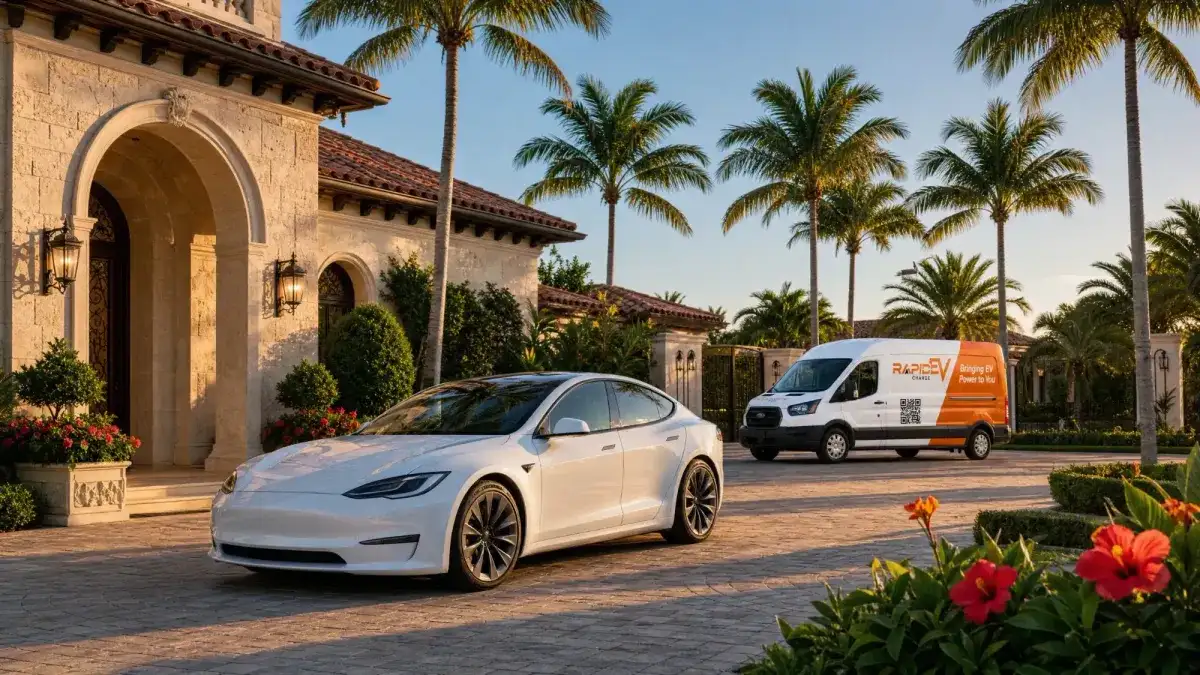
Why Miami townhomes are the hardest residential category to charge in, what a shared wall and a shared meter actually change about your options, the four routines townhome drivers land on, and how to keep a car charged while an association question stays unresolved.
If you own a Miami townhouse with no charger, your realistic options are public fast charging on a weekly rhythm, a slow household outlet where the wiring and the association both allow it, delivered charging at your own parking space, or a wall box installation that requires association approval and often a longer electrical run than you expect. Most townhome drivers end up using two of the four. Rapid Charge EV works this category a lot, because townhomes fall in the gap between the tower advice and the single family advice, and neither one fits.
Why are townhomes the awkward middle?
A single family homeowner adds a circuit and moves on. A tower resident negotiates with a board over a shared garage. A townhome owner has elements of both problems and the leverage of neither. You own your unit, but the parking pad, the walkway, and often the exterior wall your conduit would cross belong to the community. That single fact is why advice written for homeowners tends to fall apart on a townhome, and why advice written for tower residents does not quite apply either, since you may have a dedicated space with no way to power it rather than a shared garage with equipment in it.
The panel is inside and the car is outside, so the run crosses something you do not solely control.
Assigned parking may be a numbered space in a shared lot rather than a driveway attached to your unit.
Communities built before the EV era often allocated modest service capacity per unit, which limits what a new circuit can draw.
Exterior modifications usually need architectural review, which is a slower process than an electrical permit.
The pattern repeats across the Miami-Dade townhome belt: the newer communities out toward Doral and the Kendall corridor, and the older clusters closer in where the electrical predates all of this.
What does the outlet option really give you?
A standard household outlet returns roughly 3 to 5 miles of range per hour. Overnight that is 30 to 50 miles, which genuinely covers a short local commute and genuinely does not cover much else. Two cautions matter more here than in a house: the circuit needs to be properly rated and dedicated, and the cord cannot cross a walkway or a shared drive. A cord run across common area is a trip hazard, a liability question for the association, and in most communities a straightforward violation. Florida weather adds a third caution, since an outdoor connection exposed to afternoon storms and salt air needs equipment rated for it and an installer who checks rather than assumes.
What should you ask before pursuing an install?
Does the community already have an EV charging policy, and what does it require.
Where does your unit's panel sit relative to your assigned space, and what does the conduit route cross.
What service capacity does your unit actually have, confirmed by a licensed electrician rather than assumed.
Does architectural review apply, and how often does that committee meet.
Who owns the equipment when you sell, and does it convey with the unit.
The honest math often argues against installing at all. If a run is long, the panel is tight, and review takes a season, many townhome owners decide the money is better spent on a charging routine that requires no construction. The comparison between installing and using delivered charging lays out where each option wins.
How does the public charging fallback hold up?
It works, with one caveat that townhome owners feel more sharply than tower residents. Fast charging in Miami-Dade clusters around retail gravity: the big centers, the corridors, the dense employment cores. Townhome communities tend to sit past those clusters, out where the lots get larger and the stations get sparser, so the weekly refill often means driving toward charging rather than passing it.
That turns a 25 minute session into an hour of your Saturday, every week, permanently. Some drivers are fine with it. Most discover after a few months that the errand is the part of electric ownership they dislike, which is what pushes them toward a delivered routine that happens while the car is parked anyway.
What routine do townhome drivers actually settle on?
The common landing spot is a weekly fast charging stop near work or errands, plus scheduled mobile charging delivered to the assigned space on a fixed day. It needs no wiring and no approval, it happens while the car sits where it already sits, and it removes the weekly errand that most drivers quietly resent. The wider playbook for homes with no charger covers the variations, and emergency dispatch covers the week the routine slips.
Coverage runs across the whole of Miami-Dade, including the western and southern townhome communities where public charging thins out fastest.
If your townhouse has no way to charge and the association answer is still months away, call Rapid Charge EV at (954) 278-4454 or email support@myrapidchargeev.com. We dispatch across Broward, Miami-Dade, and Palm Beach 24/7.
Frequently Asked Questions
Can you charge an EV at a Miami townhouse without installing a charger?
Yes. Townhome drivers generally combine public fast charging with delivered charging at their own parking space, and some use a standard outlet at very slow speeds where the electrical setup safely allows it and the association permits it. Delivered charging is the option that needs no wiring, no permit, and no vote.
Why is a townhouse harder to wire for EV charging than a house?
Three reasons show up repeatedly in Miami: the panel often sits inside the unit while the parking is outside it, the run between them crosses common area the association controls, and older communities were built with modest service capacity per unit. Any one of those turns a routine install into a project.
Can my homeowner association stop me from charging at my townhouse?
An association can generally regulate work that touches common elements, exterior appearance, and shared electrical, which is most of what a townhome install requires. Florida law addresses electric vehicle charging in association settings, and it has been amended over time, so confirm the current requirements with your association and an attorney rather than assuming either a yes or a no.
Is a standard household outlet enough to charge an EV overnight?
It adds roughly 3 to 5 miles of range per hour, so an overnight session might return 30 to 50 miles. That covers a short commute and nothing else. It also depends on a dedicated, properly rated circuit, and running a cord across a walkway or through common area is both a hazard and usually a violation.
Fleming Island families adopted EVs faster than the infrastructure followed them down US-17. Here is who brings the charge to Eagle Harbor, Pace Island, and the CR-220 corridor. Call (954) 278-4454.
Neptune Beach is small on purpose, which is why it has no charging infrastructure. Here is who brings the charge to the Town Center, Penman Road, and every beach-access block. Call (954) 278-4454.
Pembroke Park works for a living: warehouses, commercial lots, and rideshare EVs running the county line. Here is who delivers a charge mid-shift without costing the shift. Call (954) 278-4454.