What Is a CCS1 Port? Spot It on Your Car and the Stall
The plain definition of CCS1, how to recognize the inlet and the plug, why the same port takes Level 1 and Level 2 without an adapter, which vehicles carry it as of 2026, and what a South Florida driver does when the only CCS1 cable is broken or taken.
A CCS1 port is the North American version of the Combined Charging System inlet: a round J1772 connector on top for AC charging and two large DC pins directly beneath it for fast charging. If your EV's charge port has that two-story shape, you have CCS1, and the same inlet takes a plain J1772 plug at home and the bigger combo plug at a fast-charging stall. As of 2026 it is still the port on most non-Tesla EVs in South Florida. Rapid Charge EV carries CCS1, NACS, and J1772 on every truck.
What does CCS1 stand for, and what is inside the connector?
CCS is the Combined Charging System: one inlet handles AC charging and DC fast charging instead of needing two sockets. The 1 marks the North American variant, built on the J1772 AC connector. People often say CCS with no number; CCS2 is the European version built on the Type 2 AC connector, and a CCS2 plug does not fit a CCS1 inlet. Labels here sometimes say CCS Combo 1 or SAE Combo, and as of 2026 those mean the same connector. The J1772 head holds five pins: two for AC power, one ground, and two small signal pins that let the car and the equipment agree before current flows. The two large pins underneath carry DC straight to the battery pack, bypassing the onboard charger, which is what makes fast charging fast.
How do you recognize a CCS1 inlet on your car?
Open the charge port door and look at the shape rather than the badge. A CCS1 inlet looks like a figure eight standing on end:
A round socket on top with five holes. That is the J1772 section, used for everyday charging.
Two larger round openings directly below it. Those are the DC pins, often under a small cap or flap that comes off only at a fast charger.
One door over the whole assembly; the location varies by model, so verify for your model year.
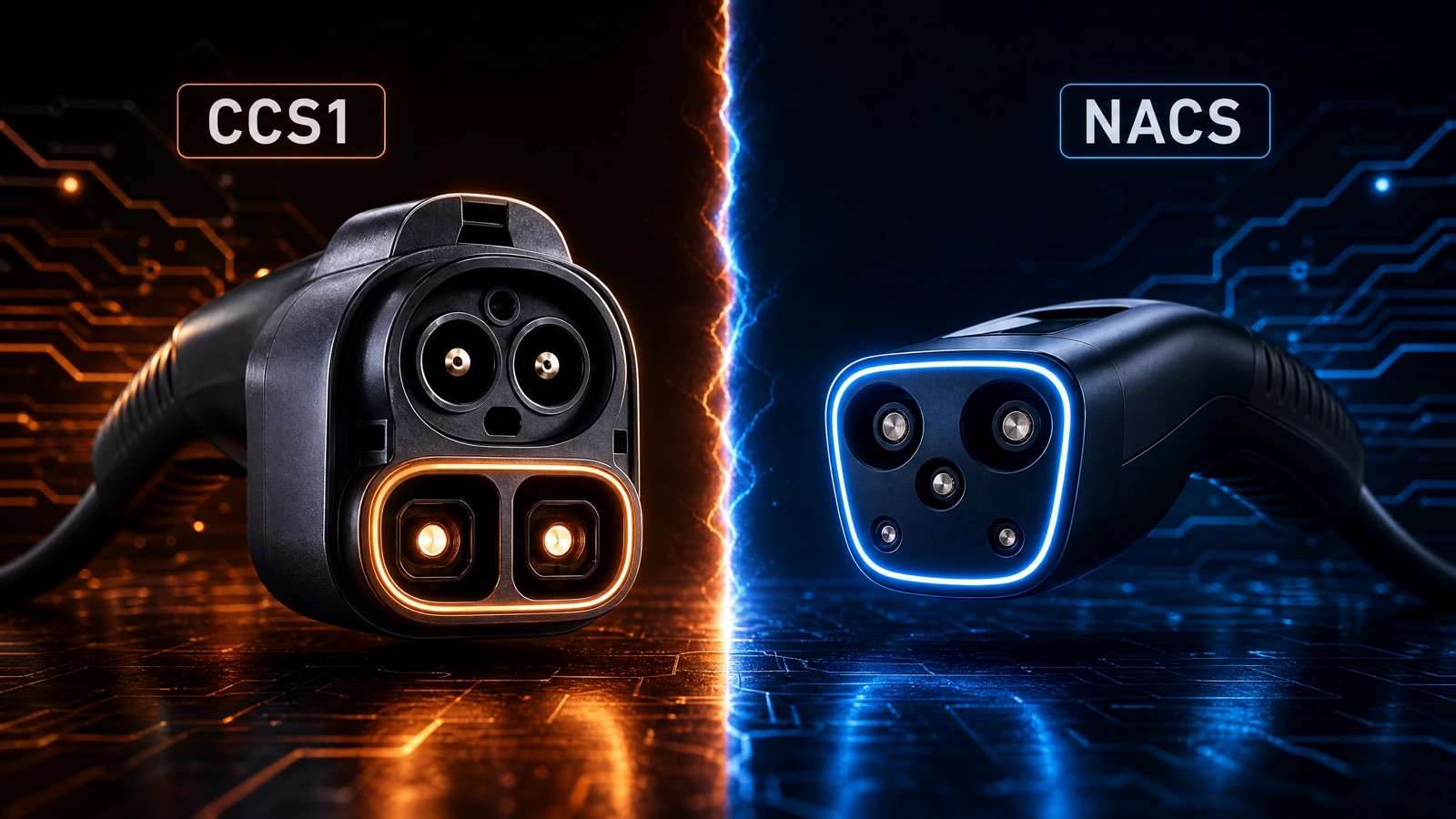
By comparison, a NACS inlet is one small oval with no lower section, and a J1772-only inlet, common on plug-in hybrids, has the round socket and nothing beneath it. The NACS versus CCS1 comparison puts the two side by side.
Why does a plain J1772 plug fit a CCS1 car?
Because the top half of a CCS1 inlet is a J1772 socket. A portable cord on a household outlet is Level 1 (some EVs still include one, many do not, so verify for your model year), a wall unit at home or work is Level 2, and both end in the same J1772 handle. Both use the upper section only while the DC pins stay covered, and the car's onboard charger converts AC to DC. At a CCS1 stall the station does that conversion and pushes DC through the lower pins. One inlet, three charging levels, no adapter for any of them: every CCS1 car is also a J1772 car.
Which vehicles use CCS1 as of 2026?
In North America, as of 2026, most non-Tesla EVs built before each automaker's switch to NACS carry a CCS1 inlet. Beginning with 2025 model years, many brands started shipping a native NACS port, and the changeover is spread across years and individual models, so the same nameplate can be CCS1 one year and NACS the next. Brand alone is not a reliable answer. Open the charge port door, or find the inlet drawing in the owner's manual, and verify for your model year before you buy an adapter.
What does a CCS1 fast-charging stall look like?
A CCS1 stall has a heavy handle with the same two-story face as your inlet, on a cable noticeably thicker and stiffer than a J1772 cord. Read the stall before you back in:
The connector label says CCS, CCS1, or Combo. Many stalls carry two cables and the second often does nothing for your car, so pick the side marked CCS.
The screen shows available, in use, or out of service; a dark screen usually means the whole unit is down.
The power rating on the label is the cable's maximum, not a promise; your car's own limit (verify for your model) and battery temperature set the pace.
Cable reach matters, because inlets sit in different places on different cars and a short cable on the wrong side makes a working stall unusable.
Do adapters change what a CCS1 car can plug into?
Yes, within limits. A NACS-to-CCS1 adapter lets a CCS1 car draw from a NACS station, and a CCS1-to-NACS adapter lets a NACS car use a CCS1 stall. For DC fast charging, use only an adapter your automaker approved for your specific model, as of 2026: the car has to recognize it before power flows, and it has to handle the current and heat of a full session, so an unapproved unit may refuse to start.
What do you do when the CCS1 stall is broken or occupied in South Florida?
Recovery is different. A driver at 4 percent in a Broward County garage whose only CCS1 cable is dead may not reach the next site. A delivered charge brings the connector to the car instead: every truck carries CCS1, NACS, and J1772, arrives in a 30 to 60 minute window, and runs a 15 to 45 minute session that adds an average of 15 to 50 miles of usable range, an average rather than a cap, enough to reach a working stall or home.
If your CCS1 car is low and the stall in front of you is dead or taken, call Rapid Charge EV at (954) 278-4454 or email support@myrapidchargeev.com. We dispatch across Broward, Miami-Dade, and Palm Beach 24/7.
Frequently Asked Questions
Is CCS the same as CCS1?
Usually, when a North American driver says it. CCS is the family name, Combined Charging System, and the number tells you which AC connector the design is built on. CCS1 sits on the J1772 head used in North America. CCS2 sits on the Type 2 head used in Europe, and its plug will not fit a CCS1 inlet. A stall label in South Florida that says CCS or Combo means CCS1, as of 2026.
Can a CCS1 car use a Level 2 station that only has a NACS cable?
Not by plugging in directly, because a NACS handle does not fit the J1772 socket at the top of a CCS1 inlet. You need either a station with a J1772 cable or a NACS-to-J1772 AC adapter approved for your car and rated for Level 2 current. AC adapters are simpler than DC fast-charging adapters, but verify for your model year before you rely on one, and never force a handle that does not seat cleanly.
Can a CCS1 car charge at a NACS station?
Often yes, with a NACS-to-CCS1 adapter that your automaker approved for your model, and only at stations that allow non-native vehicles. The car must recognize the adapter before DC power will flow, so an unapproved unit may simply refuse to start a session. Confirm both the adapter approval and the station's access rules in advance rather than at a low battery.
What if the only CCS1 stall near me is out of service?
Check the stall's screen and the site's other cables first, since many locations pair one CCS1 cable with a different connector that will not help you. If nothing on site works and the next location is beyond your remaining range, a delivered charge brings a CCS1 plug to the car within a 30 to 60 minute arrival window and adds enough range to reach a working stall or home.
The right adapter unlocks thousands of new charging stalls. The wrong one overheats in your charge port. Here is how NACS, CCS1, and J1772 adapters actually work and how to buy safely. Call (954) 278-4454.
One plug is compact and came from Tesla. The other is bulky and powered everyone else for a decade. Here is what is physically and electrically different between NACS and CCS1, and why the industry switched. Call (954) 278-4454.
The battery is fine, the station is on, and the car still refuses to charge. Most of the time the problem lives at the port. Here is how to read the blinking lights and fix the common failures. Call (954) 278-4454.