NACS vs CCS1: What Is Actually Different Between the Plugs
Every EV conversation in America eventually hits the plug question. NACS and CCS1 do the same job with very different designs, and the industry's switch from one to the other is the biggest change in EV charging since fast charging arrived.
Two plugs have fought for the front of every American EV: the compact connector Tesla built and the bulkier standard everyone else adopted. As of 2026 that fight is effectively settled, but South Florida roads will carry both ports for a decade, which makes understanding the difference practical knowledge, not trivia. And whichever plug your car wears, our emergency mobile EV charging service carries both, 24/7, at (954) 278-4454.
The Physical Difference You Can See
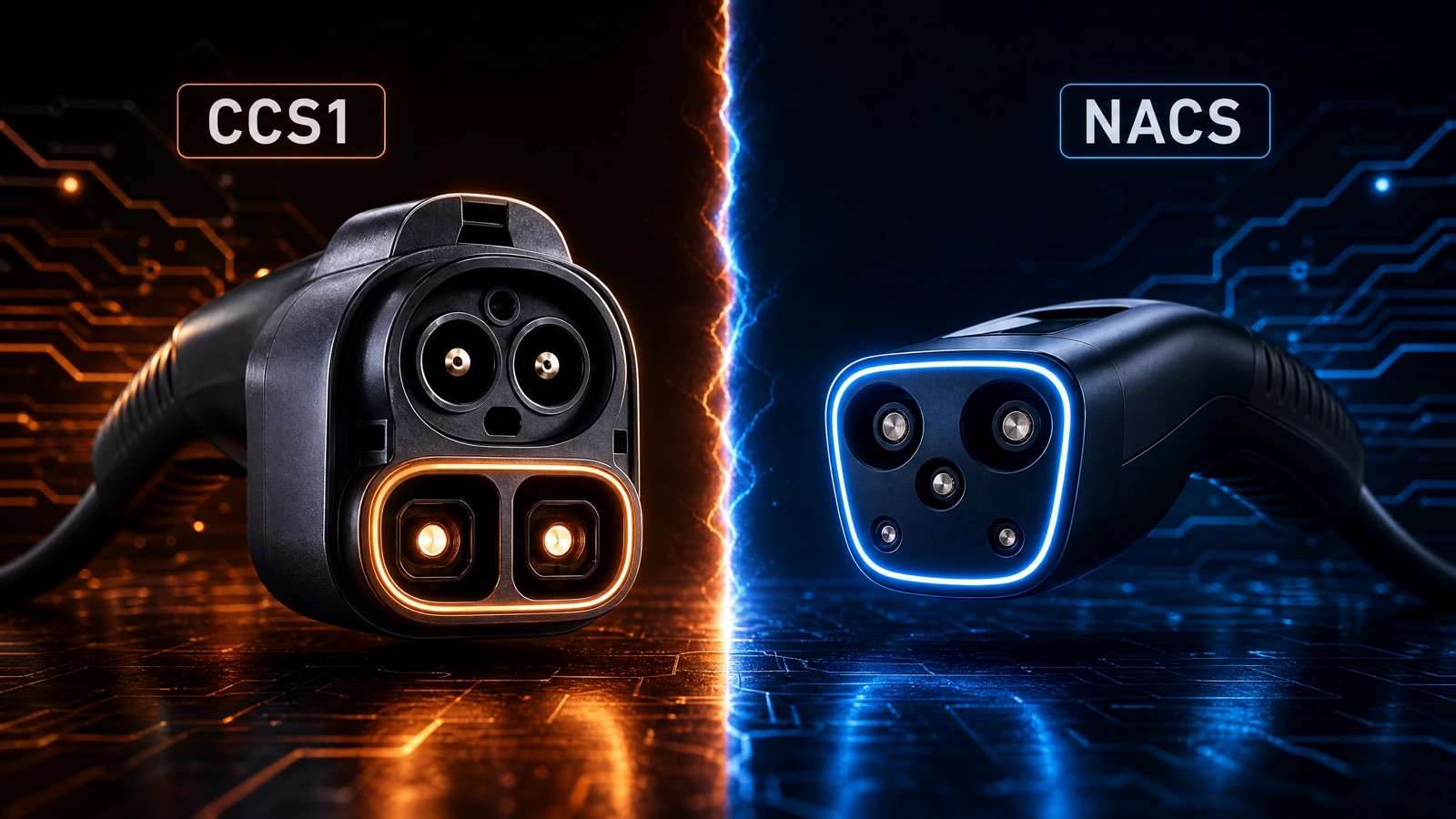
Hold the two connectors side by side and the story tells itself. NACS, the North American Charging Standard, is about the size of your palm: five pins in a small oval, light enough to handle with two fingers. CCS1, the Combined Charging System, is a two-story connector: a round J1772 AC head on top and two thick DC pins bolted underneath, roughly twice the size and noticeably heavier with its cable.
The size gap comes from a design decision. CCS1 dedicates separate pins to AC and DC charging, which is why the DC section hangs below the AC head. NACS routes both AC and DC through the same pins and lets the car and station negotiate which is flowing. Same job, one connector does it with less metal.
The Electrical Difference You Cannot See
Both standards support the full range of charging: Level 1 and Level 2 AC at home, and DC fast charging in public.
Both support high-voltage packs; real-world speed limits come from the vehicle's battery and the station hardware, not the plug shape. Our battery guides cover those per-brand limits.
NACS is now formalized as SAE J3400, meaning it is an open industry standard maintained by the same body that governs J1772, not a Tesla proprietary design.
Communication protocols were aligned during standardization, which is what makes cross-brand Supercharger access and adapters workable.
How the Industry Flipped
Tesla ran its connector as a walled garden from 2012 until late 2022, when it opened the design and named it NACS. Ford broke the dam in mid 2023 by announcing Supercharger access, GM followed within weeks, and by 2024 essentially every automaker selling EVs in America had committed. Native NACS ports began shipping on non-Tesla EVs through 2025 and 2026, with Rivian, Ford, and GM among the first movers while BMW and others bridge with adapters.
No, and this is the most common misconception about the whole transition. Neither connector is inherently faster. The speed of any session is set by three things: what your vehicle's battery will accept at its current state of charge and temperature, what the station can deliver, and how the two negotiate. The plug is the doorway, not the engine.
Which is why a CCS1 car on a modern station and a NACS car on the same site can charge at similar rates, and why the same car can be fast one afternoon and slow the next. If a session feels unexpectedly slow, the plug is almost never the reason. Heat, a nearly full pack, or a shared dispenser splitting power between two cars usually is.
What about charging at home?
Home charging is where the difference nearly disappears. Level 2 home equipment in North America overwhelmingly uses the J1772 connector, which plugs straight into the AC section of a CCS1 car and into a NACS car through a small adapter that most NACS vehicles ship with. In practice, a home charger installed for one car will serve the other with an inexpensive adapter, so the connector transition is not a reason to replace home equipment.
For drivers with no home plug at all, the connector question is beside the point, and the practical options are covered in the no-charger apartment playbook.
What It Means at the Charging Station
In practice, a South Florida driver now sees three situations. Tesla Superchargers from Fort Lauderdale to Miami increasingly serve non-Tesla EVs through NACS adapters or native ports. CCS1 stations from Electrify America, EVgo, and others continue serving CCS1 cars directly and NACS cars through adapters. And new station buildouts increasingly hang both connectors on the same dispenser. Which adapter does what is its own subject, covered in our adapters guide.
The Bottom Line
NACS won the future, CCS1 still owns a huge share of the present, and for the rest of this decade both plugs live on every major South Florida corridor. Knowing which one your car takes, and which adapter bridges the gap, is now as basic as knowing which side the fuel door was on. If you are not certain which your car wears, the brand-by-brand port guide settles it in about a minute.
Should the plug affect what you buy in 2026?
Less than the marketing suggests. A native NACS port is genuinely more convenient, because it removes an adapter from your routine and from your trunk. But a CCS1 car bought today is not stranded: the stations serving it are widespread, new builds increasingly carry both connectors, and adapters bridge the rest. Rapid Charge EV carries NACS, CCS1, and CHAdeMO on the truck for exactly this reason, and expects to for years.
The honest advice is to weigh the connector last. Range, charging curve, service network, and price will affect your ownership far more than which plug is on the front, and any of those is a better reason to choose one car over another as of 2026.
When the battery runs out before the plug question even matters, call Rapid Charge EV at (954) 278-4454 or email support@myrapidchargeev.com. We dispatch across Broward, Miami-Dade, and Palm Beach 24/7.
Frequently Asked Questions
What is the difference between NACS and CCS1?
NACS is the compact connector Tesla designed, using one small set of pins for both AC and DC charging. CCS1 is the larger two-part connector most other brands used, combining a J1772 AC head with two big DC pins below it. Both deliver the same charging levels; the difference is size, weight, and design philosophy.
Is NACS better than CCS1?
For drivers, NACS is smaller, lighter, and easier to handle, and it won the standards war: nearly every automaker committed to NACS ports on new EVs. CCS1 is not worse at charging, and millions of CCS1 vehicles will charge happily for years using stations and adapters.
Will CCS1 cars stop being able to charge?
No. CCS1 stations remain widespread, new stations continue to carry both connectors, and NACS-to-CCS1 adapters let CCS1 cars use Tesla Superchargers. The transition is being managed with adapters on both sides, not by stranding anyone.
Can a mobile charging service handle both connectors?
Yes. Rapid Charge EV's mobile units carry NACS, CCS1, and CHAdeMO connectors, so any EV in Broward, Miami-Dade, or Palm Beach County gets a roadside DC charge regardless of which port it has.
The right adapter unlocks thousands of new charging stalls. The wrong one overheats in your charge port. Here is how NACS, CCS1, and J1772 adapters actually work and how to buy safely. Call (954) 278-4454.
A small city where a hospital, a university's spillover, a rail line, and a retail district all share a few overworked plugs. Here is who answers at the junction. Call (954) 278-4454.
CCS1 is the two-story charging inlet on most non-Tesla EVs: a J1772 head on top and two big DC pins below. Here is how to spot it on your car and at the stall, and what to do when the stall is dead. Call (954) 278-4454.