What Is a Rapid EV Charger? Levels, Speed, and Plan B
The US translation of "rapid charger," the three charging levels in plain terms, why the station's kW rating is only a ceiling, where rapid chargers cluster across South Florida, and the delivered-charge option when none is within reach.
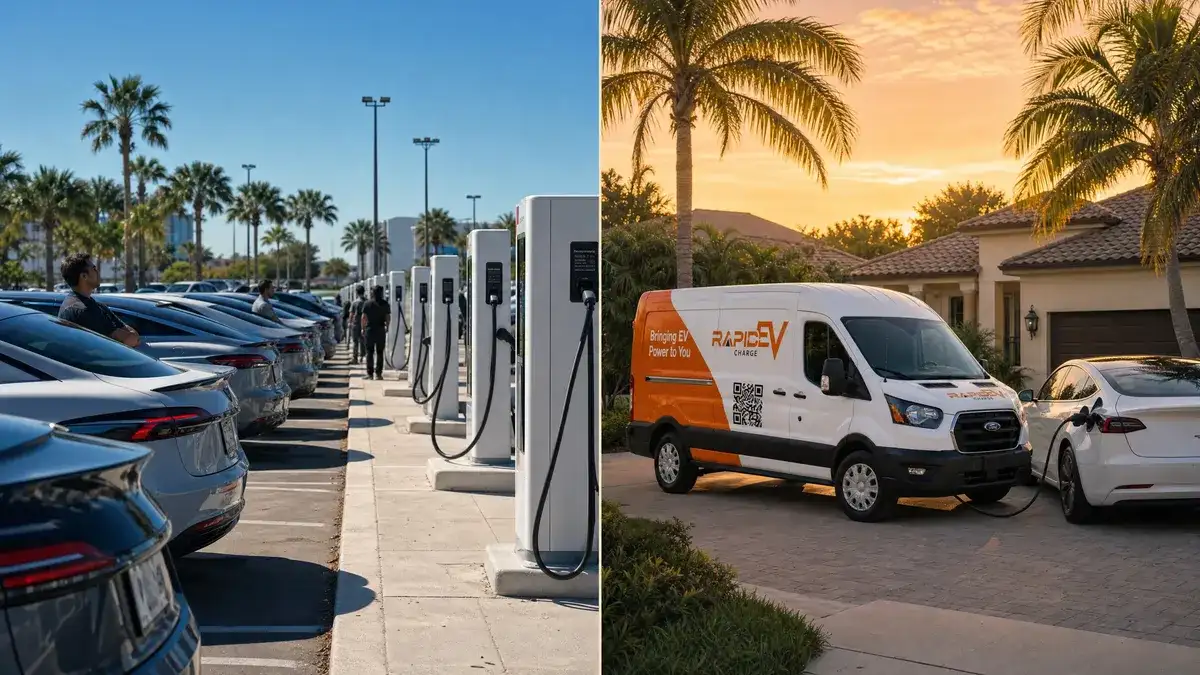
A rapid EV charger is the UK and European name for what US drivers call a DC fast charger or Level 3: a station that sends direct current straight into the battery and adds real range in minutes, not hours. South Florida maps and signs use the US wording. Rapid Charge EV is a mobile charging service that brings a DC charge to the car where it sits across Broward, Miami-Dade, and Palm Beach, not a network of stations.
Why does a search for rapid chargers near me come up thin in Florida?
Because the word is not on the map. Rapid is UK and European signage; Florida station apps label the same stall DC fast or DCFC, or use the network's own name. Pick the DC fast filter in a station app, or search a web map for DC fast charger plus the city. Level 3 is driver shorthand for the same thing, so those results count too.
What are the three charging levels in plain terms?
Level 1: a standard household outlet and the car's own cord. A few miles of range per hour, enough to recover a short commute overnight.
Level 2: a 240 volt circuit feeding a wall unit at home, work, or a mall. Most cars fill overnight, and most charging happens here.
DC fast, the rapid charger: direct current into the pack, from tens of kilowatts at older sites to several hundred at new highway stalls, as of 2026.
The first two run through the car's built-in charger, which caps alternating current. DC fast skips that bottleneck, so it is the only level that makes sense mid-trip.
What actually sets the speed at a rapid charger?
The stall's number is a ceiling, not a promise. Four things set the real speed.
Acceptance limit. Every EV has a ceiling set by its battery and software, and many mainstream models top out well below the biggest stations; verify yours by model year.
State of charge. A pack between roughly 10 and 50 percent accepts the most power.
Temperature. A cold battery accepts less, and one heat soaked after a July afternoon on the Turnpike pulls back while the cooling system catches up.
A shared cabinet. Paired stalls often split one power supply, so a second car beside you cuts your speed.
Why does rapid charging slow down after about 80 percent?
As lithium-ion cells approach full, the battery management system tapers the current to protect them. On most cars the taper begins between 70 and 85 percent and gets steep past 80, as of 2026 (the exact point varies by model), so the final 20 percent can take as long as the first 70. That is why drivers at a busy stall unplug at 80: the useful rapid-charging window is roughly 10 to 80 percent, and the last 20 belongs on Level 2 overnight.
How do you read a station's kW rating and connector?
A 50 kW unit is a legitimate rapid charger but slow by today's standards; 150 kW and up is typical of new highway sites as of 2026. The connector decides whether you can plug in: CCS1 is the large combined plug most non-Tesla EVs used through the mid-2020s, and NACS is the smaller Tesla-style plug the industry has been adopting as of 2026. A CCS1 car can use a NACS stall with the manufacturer's approved adapter only where that network has opened to non-Tesla cars, so check the app first; a NACS car at a CCS1 stall needs the reverse adapter, which not every brand supports yet.
Where do rapid chargers cluster in South Florida?
On a map a cluster is several stalls at one pin that says DC fast, not Level 2. The big pins sit on the regional malls and highway corridors as of 2026: Sawgrass Mills in Sunrise, Aventura Mall, Dadeland, Town Center Mall in Boca Raton, and the Turnpike's Pompano Beach service plaza. The thin zones are Kendall west of the Palmetto, the I-595 and Turnpike run between Pembroke Pines and the airport, the Palm Beach villages west of the Turnpike (Royal Palm Beach has almost none), and the Everglades edge. Where CCS fast charging sits in South Florida maps the clusters county by county.
When is a rapid charger the wrong tool?
Overnight at home or a hotel. Level 2 fills the pack by morning, and rapid speed buys nothing while you sleep.
A car that already has tomorrow's range. Topping off from 60 to 100 percent sits in the slowest part of the curve and holds a stall a driver at 5 percent needs.
Daily commuting. A 30 mile round trip comes back overnight on a workplace or home Level 2, and a short commute even on a household outlet.
What do you do when the nearest rapid charger is far, full, or broken?
A driver at 4 percent in a Pembroke Pines parking lot at 11 PM, with the nearest highway site showing a line, can wait, crawl toward a station and risk the shoulder, or have the charge delivered. Emergency mobile EV charging is the third: a truck carrying NACS, CCS1, and J1772 typically arrives in 30 to 60 minutes, the on-site session runs 15 to 45 minutes, and the car leaves with 15 to 50 miles of usable range on average, enough to reach a working rapid charger or home Level 2. When you call, give dispatch four things: the exact location; the make, model, and model year; the port type (CCS1, NACS, or J1772); and how far you need to go next. The Broward County mobile charging guide runs from Weston to the beach, and the Broward County hub covers all 31 cities.
If the nearest rapid charger is too far, full, or out of order and your EV cannot make it there, call Rapid Charge EV at (954) 278-4454 or email support@myrapidchargeev.com. We dispatch across Broward, Miami-Dade, and Palm Beach 24/7.
Frequently Asked Questions
Is a rapid charger the same thing as a fast charger?
Yes, with one wrinkle. UK signage and apps often split rapid, roughly the 50 kW class, from ultra-rapid, roughly 100 kW and up, as of 2026. Most US maps and apps lump everything above Level 2 under DC fast, whether the stall is 50 kW or 350 kW, though some networks add their own labels for the highest-power stalls. So a visitor used to the UK labels should ignore the word and read the kW number printed on the stall, because that number, not the name, tells you which class you are standing at.
Can every electric car use a rapid charger?
Not every one. Most EVs sold in recent years accept DC fast charging, but a few small or older models were built for Level 2 only, and plug-in hybrids almost never have a DC port. Check the charge port door: a CCS1 inlet with the two large lower DC pins can fast charge, while a J1772-only inlet cannot. A NACS port looks the same whether or not the car accepts DC, so confirm it in the owner's manual or the manufacturer's spec sheet for your model year, and note the maximum DC charging power while you are there, because that figure, not the station, sets your speed.
How long does a rapid charger take to charge an EV?
For a car built for fast charging, going from a low battery to about 80 percent usually takes between 20 and 45 minutes at a healthy high-power station as of 2026; verify the figure for your model year. Arriving at 10 percent charges faster than arriving at 50, a shared or older stall takes longer, and the car's own ceiling matters more than the station's.
Does rapid charging wear out the battery faster?
Occasional rapid charging is what the pack was built for, and the car's battery management system limits current and temperature on every session. What adds wear is a habit: fast charging to 100 percent daily, or fast charging a heat-soaked pack in July over and over. Use rapid charging on the road and for the low day, stop near 80 percent, and let a Level 2 unit do the routine overnight fill. Verify the manufacturer's guidance for your model year.
In Miami-Dade, the speed of mobile charging is less about the cable and more about the city: towers, causeways, and traffic decide how fast help arrives. The honest breakdown. Call (954) 278-4454.
Customers ask us this all the time: what's actually in the truck? Here's the walkthrough, equipment, capability, what a service call actually looks like from start to finish. Call (954) 278-4454.
The most EV-dense blocks in Florida park vertically, behind valets and key fobs, above chargers that are always taken. Here is who delivers power to the deck where your car actually lives. Call (954) 278-4454.