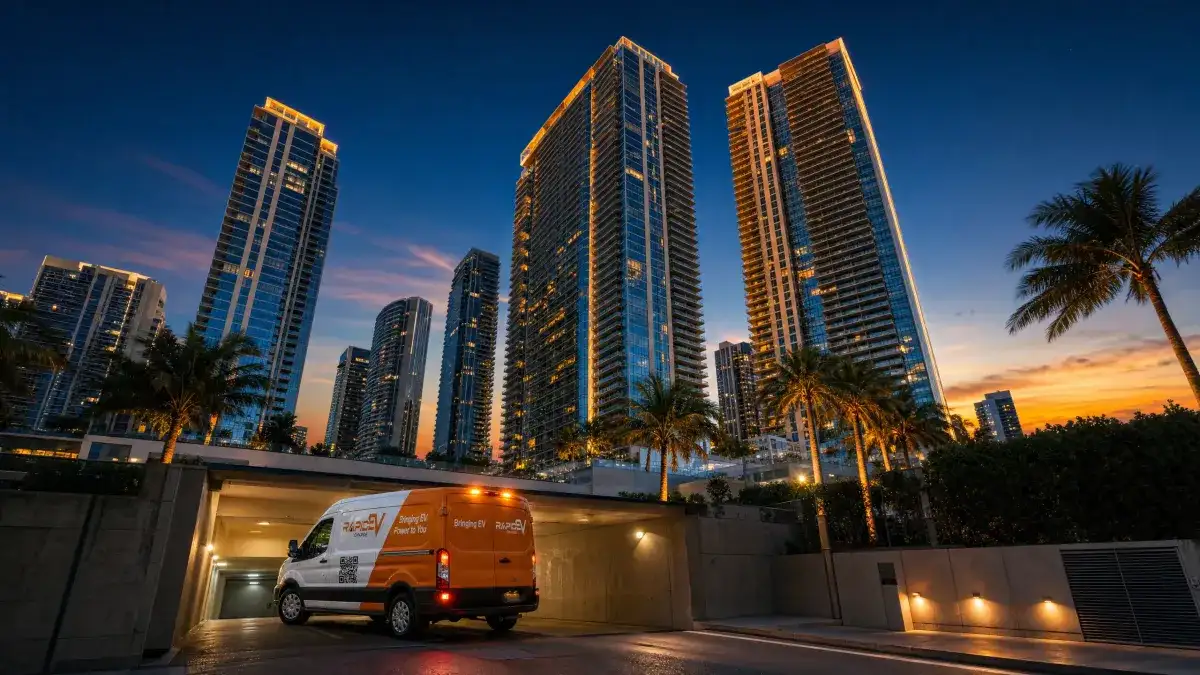
What a Florida condominium or homeowner association board is really weighing when an owner asks to install a charger, the submission packet that answers those concerns before they become objections, the three refusals that show up most often, and the interim plan that keeps your car charged while the process grinds forward.
The fastest way to get a Florida condo board to approve an EV charger is to hand them a request that already answers every question they were going to ask: who pays, who insures it, who maintains it, what the electrical load does to the building, and what happens when you sell the unit. Boards rarely reject charging because they dislike electric cars. They reject vague requests that create work and risk for volunteers. Rapid Charge EV serves a lot of owners stuck mid process, so this guide covers both halves of the problem: the approval packet, and the charging plan that carries you until the vote lands.
What is the board actually worried about?
Sit in on a meeting and the objections sort into a short list. Understanding them is most of the work, because every item on the list has a documentable answer.
Electrical capacity. Older South Florida buildings were wired for a very different load profile, and the board does not know whether ten more chargers would strain the service.
Cost allocation. If common electricity feeds the charger, other owners are paying for one owner's miles.
Liability and insurance. Who is responsible if equipment in a shared garage causes damage.
Precedent. Approving one request means fielding the next twenty, so boards want a policy rather than an exception.
Aesthetics and access. Conduit routing, wall boxes, and whether a reserved charging space changes parking rights.
What should the submission packet contain?
Treat this as a proposal rather than a request. The goal is a document a volunteer board can approve without doing research of its own.
A licensed electrician's assessment of the panel, the available capacity, and the proposed circuit route, with a diagram.
The specific equipment you intend to install, with its amperage draw and its listing information.
A metering plan that bills the electricity to you, which removes the cost sharing objection entirely.
Proof of insurance naming the association where your policy allows it, plus your written acceptance of maintenance responsibility.
A transfer clause covering what happens when the unit sells: the equipment stays, is removed, or transfers with the space.
A short note on scope, making clear you are asking to serve one assigned space rather than to rewire the garage.
Ask the manager whether the association already has an EV charging policy. Many South Florida buildings quietly adopted one after the first owner asked, and complying with an existing policy is far easier than persuading a board to write a new one. If a policy exists, read it before you spend money on an electrician, because it may already specify the equipment, the metering approach, and the insurance language your packet needs to match.
How do you work the meeting cycle?
Boards are volunteers with agendas set weeks in advance, so timing decides how many months this takes. The owners who move fastest treat the process as a campaign with three stages rather than a single submission.
Talk to the property manager first, before anything is written. They know what the board has already rejected, what the governing documents require, and which meeting has room on the agenda.
Circulate the packet to board members ahead of the meeting so nobody is reading it for the first time while deciding. Surprises at a meeting produce deferrals.
Attend the meeting yourself and answer questions in person, briefly. A five minute answer from the owner beats a written response that waits another month.
Ask for a written decision with conditions rather than a yes or no, since conditional approval is what most boards are comfortable granting.
One more piece of leverage: find out whether other owners in the building drive electric. A request from four owners asking for a policy carries more weight than one owner asking for a favor, and it changes the board conversation from an accommodation into planning for something already happening in the garage.
How do you handle the three common refusals?
The panel cannot support it. This is sometimes true and often assumed. A load calculation from a licensed electrician either resolves it or gives you a real number to work with, and load managed equipment that throttles during peak demand answers many capacity objections outright.
We do not want to set a precedent. Reframe it: you are proposing the policy, not an exception. Boards that adopt a standard set of conditions stop having this argument every quarter, which is a benefit you are handing them.
The garage is common element and nobody has assigned spaces. This is the hardest one, because the answer usually involves a shared installation the association has to own. If your building is here, the realistic path is a longer conversation about a shared charging bank, and the interim plan below matters more than usual. Miami high rise and condo charging covers how residents in exactly this position keep driving.
How do you charge while the process runs?
Approval takes months, and your car does not pause. Most owners assemble a routine from three sources: public fast charging for the weekly refill, workplace charging where it exists, and scheduled mobile charging at the building on a fixed day. The third one is the piece people underestimate. It runs in your own assigned space with no electrical work, no permits, and no board vote, which is why it also survives as a backup after the wall box is finally installed.
If your board vote is still months away and you need a reliable charge at your building, call Rapid Charge EV at (954) 278-4454 or email support@myrapidchargeev.com. We dispatch across Broward, Miami-Dade, and Palm Beach 24/7.
Frequently Asked Questions
Can a Florida condo board refuse to allow an EV charger?
Florida law addresses electric vehicle charging in condominium and homeowner association settings, and boards generally may set reasonable requirements around installation, insurance, and cost responsibility rather than issuing a flat refusal. The specifics have been amended over time, so confirm the current text with your association manager and an attorney before you rely on any summary, including this one.
Who pays for an EV charger installed at a condo parking space?
In the typical arrangement the requesting owner carries the cost of the equipment, the installation, the electricity, and the ongoing maintenance, and the association sets the conditions. That is also the framing most likely to win a vote, because it removes the objection that other residents are subsidizing one owner's car.
How long does condo board approval for EV charging take?
Plan on a few months rather than a few weeks. Most boards meet monthly, many require the request to be circulated before a vote, and an incomplete packet usually costs a full cycle. Owners who submit a complete packet the first time tend to be the ones who get approved in one or two meetings.
How do I charge while I wait for approval?
Use a combination of public fast charging and scheduled mobile charging at your building. Delivered charging works in an assigned space with no electrical work, no permits, and no board vote, which is why many South Florida owners use it as the bridge and then keep it after installation as a backup.
Apartment hunting with an EV changes the checklist. Here is where charging-equipped buildings actually cluster in South Florida, the exact questions to ask a leasing office, and the fix when your building offers nothing. Call (954) 278-4454.
People who search for EV charger service want one of three things: a broken charger fixed, a new charger installed, or power brought to the car right now. Here is how to tell which one you need today, what to check first, and when a delivered charge is the fastest fix. Call (954) 278-4454.
Southbank towers, Brooklyn mid-rises, San Marco condos: thousands of Jacksonville EVs live in buildings that were never wired for them. Here is how delivered charging solves it without an HOA construction fight. Call (954) 278-4454.