Which Charging Port Does My EV Have? 2026 Brand Guide
The port on your EV decides which stations you can use and which adapter belongs in your trunk. As of 2026 the answer is different for almost every brand, so here is the whole map in one place.
The single most useful thing an EV owner can know in 2026 is which port their car actually has, because the industry is halfway through swapping connectors and no two brands are at the same point. Here is the brand-by-brand map, current as of the 2026 model year. Whichever port you find, our emergency mobile EV charging service carries every connector, 24/7, at (954) 278-4454.
The Three-Second Rule
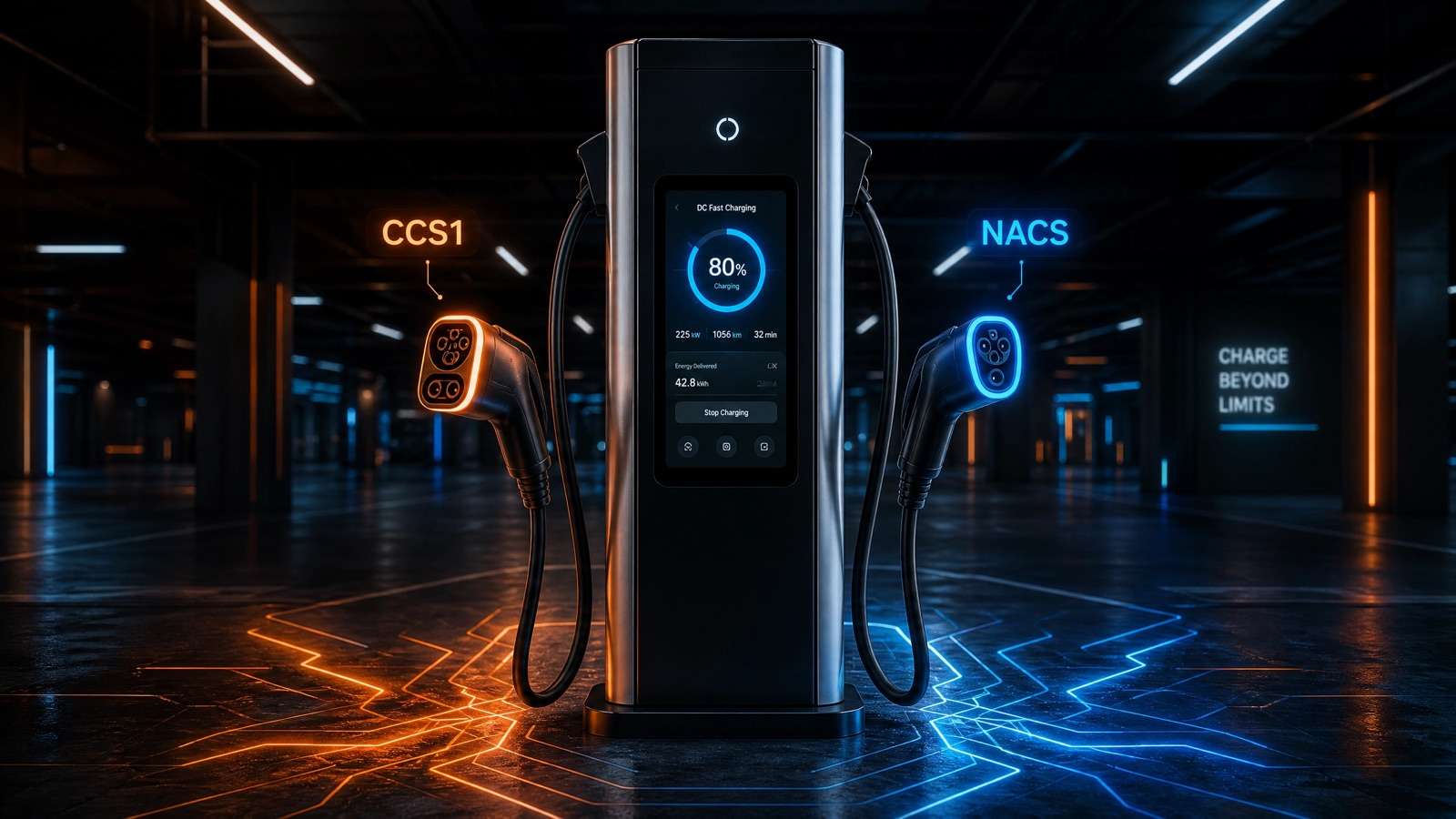
If the port is small and oval with five pins, it is NACS. If it is a big two-part socket with a round head and two large holes below, it is CCS1. If it has a huge round connector with fat pins beside a J1772 socket, that is CHAdeMO, and you are probably driving a Nissan Leaf.
Brand by Brand, as of 2026
Tesla: native NACS on everything, always has been. Full detail in our Tesla battery guide.
Ford: CCS1 on Mach-E and Lightning built through 2024, with free or cheap NACS adapters for Supercharger access; newer models shifting to native NACS. See the Ford battery guide.
Chevy and GM: CCS1 on early Ultium models with adapter access to Superchargers; native NACS arriving across the lineup. See the Chevy battery guide.
Rivian: CCS1 on first generation R1T and R1S, native NACS on second generation trucks. See the Rivian battery guide.
BMW: CCS1 across i4, i5, i7, and iX with NACS adapter access rolling out; native NACS lands with the Neue Klasse generation. See the BMW battery guide.
Lucid: CCS1 on the Air, native NACS on the Gravity SUV. See the Lucid battery guide.
Rolls-Royce: CCS1 on the Series I Spectre; the 2026 Series II lists a NACS port. See the Spectre battery guide.
Nissan: CHAdeMO on the Leaf, CCS1 on the Ariya, NACS on newer models.
Hyundai and Kia: CCS1 through 2024, native NACS on new models since.
Three ways, in order of reliability. The owner's manual states the connector explicitly and is the only source that cannot be out of date for your specific car. The vehicle's own app or centre screen usually names the charging standard in its charging settings. And the window sticker or original build sheet, if you still have it, lists it among the specifications. Rapid Charge EV dispatch only needs your make, model, and year, so if you are calling for help you do not need to resolve this at all.
Avoid guessing from a photograph of a similar car online. Within a single model, the connector changed partway through the transition, so a picture of someone else's identical-looking vehicle proves nothing about yours.
Why model year is a trap when buying used
This is where buyers get caught. Manufacturers switched connectors on production timelines, not neatly at model-year boundaries, so two cars badged the same year can carry different ports depending on when they were actually built. A used listing that says the model year is telling you less than it appears to.
Check the actual car, not the listing. Look at the port, or read the VIN-specific build information.
Ask what adapters come with it. An adapter that shipped with the car is worth real money and is easy for a seller to lose.
If it is a CCS1 car, confirm whether it has been enabled for Supercharger access, because that varies by brand and sometimes by software version.
For an older CHAdeMO vehicle, check what fast charging actually exists on your regular routes before you buy, since that network is shrinking.
The AC Side Everyone Forgets
Every non-Tesla EV with a CCS1 port uses the round J1772 top section alone for Level 1 and Level 2 charging, which is why any public Level 2 station fits any CCS1 car. NACS cars use the same small port for AC and DC alike, with a simple J1772 adapter bridging older home equipment. The full story of that round connector lives in our J1772 and CHAdeMO guide.
What to Keep in Your Trunk
The right answer depends on your port. CCS1 drivers want an approved NACS adapter for Supercharger access. NACS drivers want a J1772 adapter for Level 2 stations, and possibly a CCS1 adapter for maximum fast-charging coverage. Which specific adapters are safe, and which cheap ones to avoid, is exactly what our adapters guide covers.
When does the port actually matter?
Day to day, almost never. If you charge at home or at one reliable station, you learn your plug once and stop thinking about it. The port starts mattering the moment your routine breaks: a road trip through a stretch you do not know, an unfamiliar station at low battery, or a rental or borrowed EV that is not the car you are used to.
That is the argument for keeping the right adapter in the car permanently rather than in a drawer at home. The trip where you need it is by definition the trip where you are nowhere near the drawer, and adapters are small enough that there is no good reason to leave one behind. Verify every few model years too, since a replacement vehicle may not carry the same connector as the one it replaced.
What if the connector does not fit when you arrive?
It happens, usually because a station was mapped wrong or the only compatible dispenser is occupied. Do not force anything: connectors are keyed, and a plug that does not seat is telling you something true. Check whether the site has a second dispenser type, whether your adapter is in the car rather than at home, and whether the station app lists a compatible unit nearby before you spend range driving to one. If the port itself looks damaged or the car refuses the handshake, the charge port troubleshooting guide walks the checks worth doing on the spot. Coverage across Miami-Dade, Broward, and Palm Beach means a truck can meet you with the right connector wherever this happens.
If the port question just became academic because the battery is empty, call Rapid Charge EV at (954) 278-4454 or email support@myrapidchargeev.com. We dispatch across Broward, Miami-Dade, and Palm Beach 24/7.
Frequently Asked Questions
Which EVs have NACS ports in 2026?
Every Tesla, plus a growing wave of native NACS models from Rivian, Ford, GM, Hyundai, Kia, Lucid's Gravity, and others introduced through 2025 and 2026. Older non-Tesla EVs keep their CCS1 ports and reach Superchargers through approved adapters.
Which EVs still use CCS1?
Most non-Tesla EVs built before roughly 2025: Mustang Mach-E and Lightning, Chevy Ultium models, BMW i4 through iX, Lucid Air, Rolls-Royce Spectre, and many more. They charge normally at CCS1 stations and most gained Supercharger access with a NACS adapter.
What port does a Nissan Leaf have?
The Leaf is the outlier: it fast-charges on CHAdeMO, a legacy connector with a shrinking station network, while its J1772 port handles Level 1 and Level 2. Newer Nissan EVs moved to CCS1 and then NACS.
Does the port change how mobile charging works?
No. Rapid Charge EV's mobile units carry NACS, CCS1, and CHAdeMO, so the technician arrives with the right connector for any EV in Broward, Miami-Dade, or Palm Beach County. You just tell dispatch your make and model.
The battery is fine, the station is on, and the car still refuses to charge. Most of the time the problem lives at the port. Here is how to read the blinking lights and fix the common failures. Call (954) 278-4454.
CCS1 is the two-story charging inlet on most non-Tesla EVs: a J1772 head on top and two big DC pins below. Here is how to spot it on your car and at the stall, and what to do when the stall is dead. Call (954) 278-4454.
Drivers ask whether a portable charger in the trunk makes the charging truck unnecessary. The honest answer depends on what you mean by portable, how much range you need, and where you are stopped. Call (954) 278-4454.