Portable Charger vs Charging Truck: Which Rescues Faster?
What a portable EV charger really is as of 2026, how much range each option adds per hour, the situations where a trunk unit genuinely helps, and the scenarios where only a delivered DC charge gets you moving before dark.
A mobile charging truck rescues a stranded EV faster than a portable charger in almost every real roadside situation, because the truck brings its own power and delivers it as DC, while a portable charger is a cord that needs an outlet and adds only a few miles per hour when it finds one. Rapid Charge EV hears the comparison often, usually from a driver who bought a trunk unit and wants to know whether it made the truck unnecessary. It did not, but it is not useless either. This page sorts out what each option does, how fast, and when.
What does portable EV charger actually mean?
The phrase covers two very different products, and the confusion between them is where most bad roadside decisions start. The first kind is a portable cord: a Level 1 or Level 2 charging cable with a household or dryer-style plug on one end and a J-1772 or NACS connector on the other. Most EVs ship with one. It converts an outlet into a charging point and it carries no energy of its own. The second kind is a battery-pack unit, a wheeled or carried box holding a few kilowatt-hours that can push a small charge into a car with no outlet nearby.
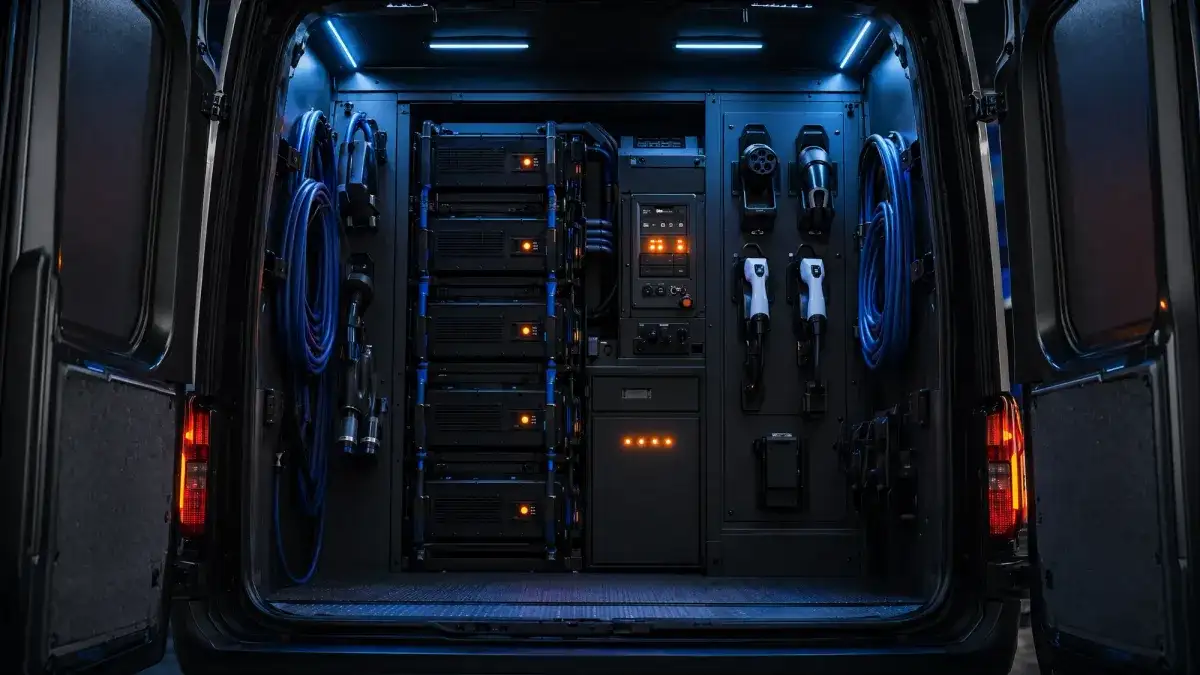
Both are real products and both have a place. Neither is a mobile charging truck, which is a vehicle carrying commercial-grade equipment that delivers DC power directly to the battery at rates far above anything a portable unit manages. The truck walkthrough shows what that equipment looks like and how a session runs.
How much range does each option add, and how fast?
Portable Level 1 cord on a standard household outlet: roughly 2 to 5 miles of range per hour, as of 2026. An hour at a friend's house buys a trip across town, not a trip across the county.
Portable Level 2 cord on a dryer-style outlet: meaningfully faster, often 20 to 30 miles per hour depending on the circuit and the car's onboard charger, but the outlet is the hard part, and roadside shoulders do not have one.
Battery-pack portable unit: a few kilowatt-hours delivered over a long session, which works out to a handful of miles. Enough to move a car from a parking spot to a nearby charger, not enough to finish a commute.
Mobile charging truck: DC power the car accepts at fast-charger rates, typically 15 to 50 miles in 15 to 45 minutes, with the correct connector for the vehicle already on board.
The gap is not a matter of degree. A portable cord on a household outlet needs most of a day to add what the truck adds in half an hour, and the day only starts once you find the outlet.
When does a portable charger genuinely help?
Keep the cord in the trunk. It earns its place at a friend's driveway, a hotel with an outdoor outlet, a job site with power, a vacation rental with no charger, or an overnight stop where slow is fine because you are asleep. It also helps a car that made it into a parking lot with a few percent left and a visible outlet nearby: an hour on the cord can be the difference between reaching a fast charger and calling for help. Those are planned stops, or at least stationary ones, and a portable cord is built for exactly that.
The industry view on portable roadside charging explains where the technology is heading, and it is worth reading if you are deciding whether to buy a battery-pack unit. The honest summary is that the packs are improving but are not yet a roadside solution for most drivers.
When does only the truck work?
A highway shoulder on I-95 or the Turnpike. A causeway with no exit. A garage level with no outlet in reach. A driveway in the western suburbs of Broward or Palm Beach County where the nearest fast charger is 12 miles away and the car has 4 percent. A parking lot at closing time when the store's outlet is inside a locked building. In each of those, the portable cord has nothing to plug into, and the battery-pack unit adds too little to matter. The truck arrives in 30 to 60 minutes, connects NACS, CCS, or J-1772 as the port requires, and the session adds enough range to reach a charger or get home. Emergency mobile charging is the service built for that list, and the towing comparison covers why a delivered charge usually beats a flatbed for the same stranding.
What is the right combination for a South Florida driver?
Carry the cord for planned stops, skip the heavy battery pack unless your routine involves regular parking far from any plug, and save the dispatch number for the unplanned stops. The Broward County mobile charging guide walks through how the delivered option fits into a normal week of driving, and the same logic applies in Miami-Dade. The drivers who end up on a shoulder are rarely the ones without a portable charger. They are the ones who trusted a portable charger to do a truck's job.
If your EV is stopped where a cord cannot help, call Rapid Charge EV at (954) 278-4454 or email support@myrapidchargeev.com. We dispatch across Broward, Miami-Dade, and Palm Beach 24/7.
Frequently Asked Questions
Can a portable EV charger rescue a stranded EV on the roadside?
Only if there is a power outlet within reach of the cord, and even then slowly. A portable Level 1 or Level 2 cord is a plug for someone else's electricity, not a power source. On a standard household outlet it adds roughly 2 to 5 miles of range per hour, so a roadside shoulder with no outlet gets nothing from it.
What about battery-pack portable chargers that need no outlet?
As of 2026 the consumer versions carry only a few kilowatt-hours and are heavy, so they add a handful of miles after a long session and take up trunk space year round. They can help a car parked a short distance from a plug. They are not a substitute for a delivered DC charge when the car is on a highway shoulder and needs real range.
How much range does a mobile charging truck add?
Typically 15 to 50 miles in 15 to 45 minutes, delivered as DC power the car accepts the same way it would at a fast-charging station. The truck arrives in 30 to 60 minutes and carries NACS, CCS, and J-1772 connectors, so the session does not depend on the brand of the car.
Is it worth keeping a portable charger in the trunk anyway?
Yes, for the situations it fits: a friend's driveway, a hotel with an outdoor outlet, a job site, or a slow overnight top-up when no charger is nearby. Think of it as a convenience for planned stops, and keep the number for a delivered charge for the unplanned ones.
The roadside assistance industry is being transformed by portable mobile EV chargers. Discover the innovations reshaping emergency response and how Rapid Charge EV is leading the shift in South Florida. Call (954) 278-4454.
Tesla, Ford, Chevy, Rivian, BMW, Lucid, Nissan: every brand is somewhere different in the switch from CCS1 to NACS. Here is the 2026 map of who has which port and what adapter they need. Call (954) 278-4454.
Customers ask us this all the time: what's actually in the truck? Here's the walkthrough, equipment, capability, what a service call actually looks like from start to finish. Call (954) 278-4454.