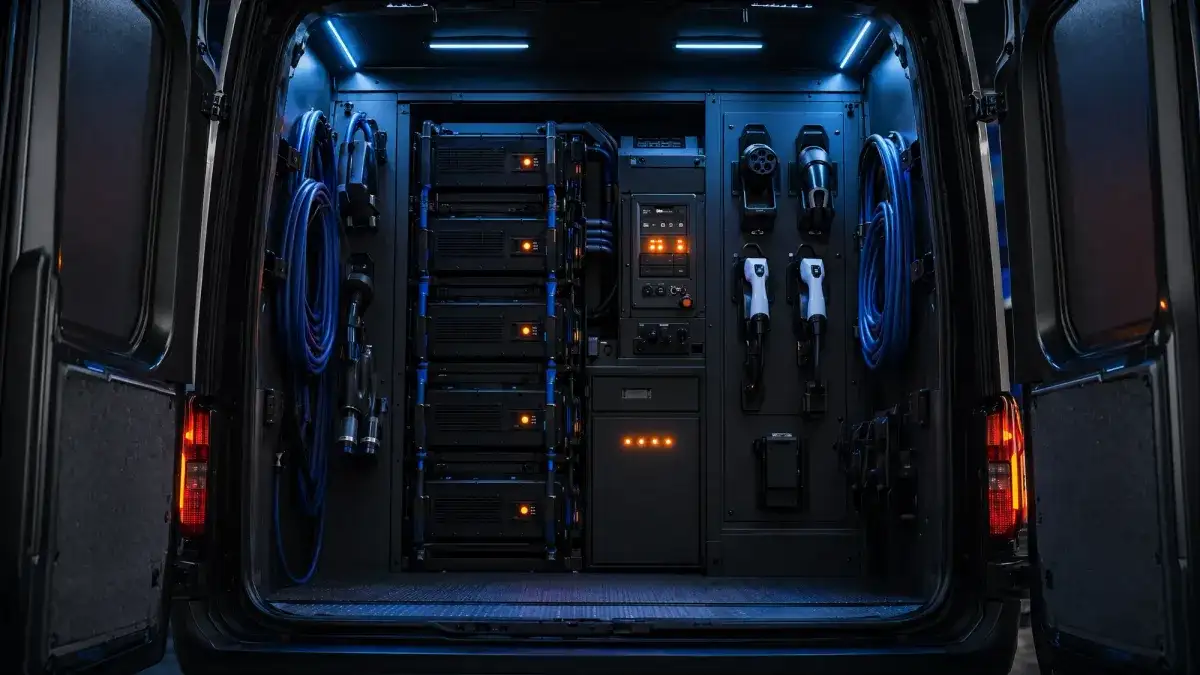
Emergency EV Charging for Tow Yards, Lots, and Fleets
What portable units can and cannot do per session, what a charging truck of your own demands in capital and staff, how an on-call dispatch account works day to day, and the checklist to run on any provider.
A business has three ways to cover a dead EV: buy portable charging units and run them yourself, build a charging truck of your own, or contract an on-call mobile charging provider. For most tow operators, dealership service centers, rental branches, and parking managers, the on-call account is the one that absorbs an unpredictable call count without tying up capital or a technician. Rapid Charge EV is that provider across South Florida and the Jacksonville metro. Here is what each path really takes.
When does owning charging equipment make sense?
Count the calls before buying anything. A dealership lot or a tow yard that sees a dead EV most weeks, trade-ins at zero, impounds that sat for days, loaners returned empty, keeps a portable unit busy and one employee trained on it. Random roadside calls do not: two one week, none the next, and the unit sits on a shelf losing charge while the trained person changes shifts. That pattern favors an on-call account.
What can a portable charging unit really do for your operation?
Portable units come in two families as of 2026. Level 2 units run from a 240-volt outlet or a generator and add range slowly, which suits a lot where vehicles sit for hours. Battery-backed DC units add range faster but hold a limited amount per charge, so one unit covers roughly one rescue before it goes back on a plug. Read the rated stored energy and output on the spec sheet; what matters is how many miles one full unit puts into the vehicles you actually see.
The unit has to be recharged after every use, stored out of the heat, inspected, and loaded onto the truck.
Staff need training on connector types, pack voltages, and what to do when a vehicle at zero will not wake up.
A trunk-size unit will not get a large truck or SUV pack far enough to matter on a highway shoulder.
Portable charger vs charging truck has the range math. For a business, portable units are a fair supplement at a lot or yard and a weak primary plan for roadside calls.
What does building your own charging truck take?
A purpose-built charging truck solves the range problem and creates four new ones: capital, a technician, maintenance, and utilization. The vehicle, onboard storage, and DC equipment are a major purchase, and the operator has to know high-voltage systems and every connector standard on the road. The equipment needs service, the storage degrades, and a truck that sits idle five days a week has to pay for itself on the two it works. Fleet charging without the depot covers when depot charging beats contracting for a Broward fleet; a truck of your own passes the same test only on daily, predictable volume.
How does an on-call mobile charging account work day to day?
The account is set up once, with a named dispatch contact on both sides and billing details on file. When a tow operator, service writer, or branch manager has a dead EV, they call emergency mobile charging dispatch with the location, vehicle, and state of charge. A technician typically arrives in 30 to 60 minutes across Broward, Miami-Dade, Palm Beach, or the Jacksonville metro, depending on traffic and distance from the nearest truck, with NACS, CCS1, and J1772 aboard. The on-site session runs 15 to 45 minutes and adds 15 to 50 miles on average, enough to reach a fast charger, the lot, or the yard. Under a business service agreement, calls are billed to the account instead of paid at the roadside; confirm the terms at setup. The Broward County mobile charging guide shows the same call from the stranded driver's side.
Which questions should you ask any emergency EV charging provider?
Coverage map: which counties and highways, and what happens at the edge.
Hours: a person answering 24/7, or a daytime line with an after-hours voicemail.
Arrival window: promised and typical, and whether dispatch calls with an estimate once the truck is rolling.
Connectors and pack voltages: NACS, CCS1, and J1772 on every truck, and whether it can charge the higher-voltage packs on newer trucks and SUVs, as of 2026.
Session length and delivered range: an average, not a sales number, and how the session is sized to the destination.
How calls are placed: a dedicated line, a named account, and whether drivers call directly or through your office.
Account billing: whether calls under a service agreement are billed to the business instead of paid at the roadside, and on what terms.
A certificate of insurance on request, with your business as certificate holder, so your vendor file is complete before the first call.
Hurricane and outage readiness: whether trucks keep running when public chargers lose power, and how accounts are prioritized around a storm.
How do tow operators, dealerships, and fleets use the account?
A tow operator calls when a dead EV sits on a shoulder and a flatbed ride to the nearest charger would take longer than a charge in place. The driver leaves under their own power and the flatbed stays free for a wreck. A vehicle already at the yard is charged there before release. When the technician finds a fault rather than an empty pack, so a flatbed is needed after all, dispatch says so while your driver is still on scene, and your truck keeps the transport. For a stranded driver with no tow company, towing dispatch across South Florida is coordinated through licensed operators.
A dealership service center or rental branch calls for loaners, trade-ins, and returns that arrive at zero, and a property or parking manager calls for a guest's car blocking a space. A fleet books scheduled top-ups for vehicles that end the day low and keeps the emergency line for the van that strands on a route.
If your operation needs a dependable way to cover a dead EV without buying or building anything, call Rapid Charge EV at (954) 278-4454 or email support@myrapidchargeev.com. We dispatch across Broward, Miami-Dade, Palm Beach, and the Jacksonville metro 24/7.
Frequently Asked Questions
Can a towing company use a portable EV charger instead of calling a mobile charging service?
It can, with three checks first. As of 2026, battery-backed portable units can throttle or shut down on thermal protection in cab heat and age faster when stored hot, so check the unit's rated operating temperature and keep it in a shaded, ventilated spot on the truck, not on the dash or in a closed toolbox. It must be at full charge at the start of every shift, which means a plug at the yard and a name on that task. And the driver should hear up front that the top-up reaches the nearest charger, not home.
What happens if the vehicle will not wake up when the technician arrives?
Tell dispatch on the call if the screen is dark or the doors will not unlock. On many EVs as of 2026 a drained 12-volt auxiliary battery, not the main pack, is what keeps the car from waking, because it powers the computer that authorizes a charge, so the technician checks that first and can often bring the car up before the DC session starts. If the car still shows a fault or refuses a charge, it needs a flatbed and a service bay, and dispatch tells your driver on the spot so the vehicle is not waited on twice.
What information does dispatch need when a service writer or tow operator calls?
The exact location, including a garage level, a lot name, or an exit number, the vehicle make and model, the state of charge on the display, and where the vehicle needs to go next. That last item sizes the session. Under a business service agreement, calls are billed to the account instead of paid at the roadside; confirm the billing terms when the account is set up.
Does an on-call provider still operate during a hurricane or a power outage?
A charging truck carries its own stored energy, so it does not depend on grid power at the scene, which matters when public chargers go dark after a storm. Ask any provider how it handles a named storm: whether trucks stand down only while roads are closed, how soon dispatch resumes once they reopen, and how business accounts are prioritized in the days before and after landfall. Get the answer in writing.
Miami-Dade runs the densest delivery and rideshare economy in Florida. Mobile fleet charging keeps its commercial EVs working without depot construction. The local B2B picture. Call (954) 278-4454.
Palm Beach County is long, spread out, and seasonal. A dead EV in Jupiter is a different event from one in Wellington. Here's who to call and how the county's geography shapes the answer. Call (954) 278-4454.
A flat tire or a lockout is handled the same way on an EV as on a gas car. A depleted battery is not, because it cannot be jump-started. Here is what the programs you already have do about that, and what to ask them before the day it happens. Call (954) 278-4454.