EV Emergency Mobile Charger: What It Is & How It Works
An emergency mobile charger is any system that brings charge to a stranded EV instead of the other way around. That covers everything from a trunk-carried cord to a truck-mounted DC fast charging system, and the difference between those two things is the difference between an hour of walking-speed charging and 15 to 50 miles in the time it takes to drink a coffee.
The search phrase 'EV emergency mobile charger' hides two very different questions: 'what gadget should I keep in my trunk' and 'who brings a charger to my dead car right now'. Both deserve straight answers, because the gap between a consumer portable unit and a professional mobile charging system is enormous, and buying the wrong expectation is how drivers end up stranded twice.
The Three Things People Mean by 'Mobile Charger'
Portable EVSE cords: the Level 1/2 unit many EVs ship with. Plugs into a wall or dryer outlet. Essential at home, nearly useless on a road shoulder, because shoulders do not have outlets.
Generator-based rigs: a gas generator feeding a portable EVSE. It works, slowly, with fuel, noise, weight in your trunk permanently, and enough caveats that most owners abandon the idea after the math.
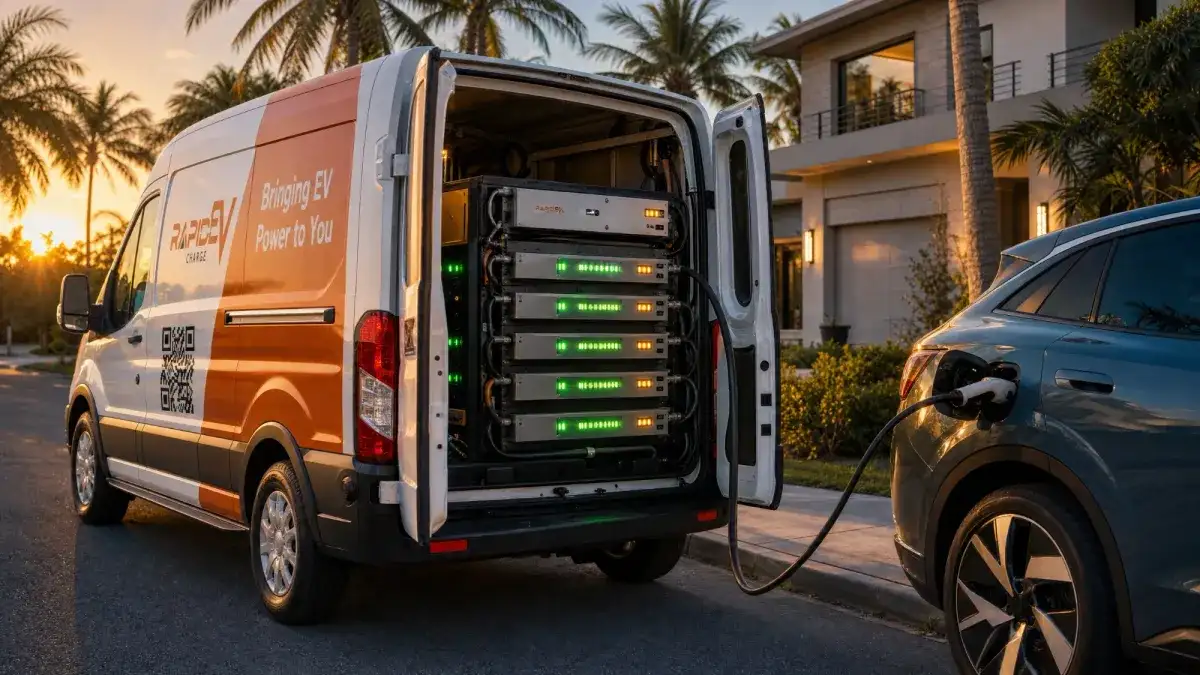
Professional truck-mounted systems: commercial Level 2 and Level 3 equipment that carries its own energy to the car and charges at real speed. This is what an emergency mobile charging service dispatches, and what this company runs across South Florida and Jacksonville.
Why can you not just carry a battery pack?
This is the question behind most searches for a trunk-sized emergency charger, and the answer is physics rather than product availability. A phone power bank holds a tiny fraction of a kilowatt hour. Moving an electric car a meaningful distance takes tens of kilowatt hours, which is thousands of times more energy. Scaling a battery up to that capacity does not produce a gadget you toss in the boot; it produces something that weighs hundreds of pounds and costs a serious fraction of the car.
Small portable jump-style packs marketed for EVs exist, and they are worth understanding for what they are. Most are sized to wake a dead 12-volt battery, which is a genuinely common failure and a completely different problem from an empty traction pack. They will not add driving range. If the car is dead because the little battery quit rather than the big one, that is a distinct diagnosis worth knowing before you buy anything.
The Buy-Versus-Call Math
A quality portable EVSE runs a few hundred dollars and earns its keep as a travel backup wherever outlets exist. A generator rig capable of meaningful charging speed costs high hundreds to over a thousand dollars, plus fuel and storage, to deliver charging far slower than a professional visit. Against that, calling a 24/7 emergency dispatch when the rare stranding actually happens costs a quoted, surge-free fee explained in our Florida pricing breakdown, and delivers 15 to 50 miles while you wait with the car. Most owners are best served by the cord for home, the phone number for emergencies, and skipping the generator entirely.
How the Professional Version Works
You call 954-278-4454 with your location, vehicle, and battery percentage. The truck arrives with NACS, CCS, and J-1772 connectors aboard, stages safely (full protocol on highway shoulders), and the session negotiates with your car's battery management system exactly as a fixed fast charger would. The full walkthrough covers the equipment and process step by step, and the industry-trend piece explains where this technology is heading.
Which situations actually count as an emergency?
Not all of them are the roadside stranding people picture, and Rapid Charge EV runs the whole range. Knowing which one you are in decides how urgent the call is.
Hard zero on a shoulder or in a lane. The genuine emergency, and the one where staying with the vehicle matters most.
Low but still driving, with no reachable working station. The most common call, and the easiest to resolve, because you can choose where to stop.
Blocked in. The car sits in a garage or assigned space with enough charge to be useless and no way to reach a station without risking the trip.
A failed home or building charger. Nothing wrong with the car, but the routine broke and the pack is drifting down each day.
A dead 12-volt battery, where the traction pack is fine and the car simply will not wake. A different fix entirely, covered in the technician walkthrough.
How is this different from calling a tow?
A tow moves the car to energy. Mobile charging moves energy to the car. The practical difference is what happens to your evening: a tow means waiting outside while the vehicle is loaded, riding to a station that may itself be occupied, and then still needing to charge. A delivered session means you stay with the car, it charges where it sits, and you drive away under your own power. There are cases where a tow is genuinely the right call, a mechanical fault or damage among them, and the comparison guide is honest about which is which.
When the Trunk Unit Is the Right Answer
Honesty cuts both ways: if you park nightly next to an outlet, travel to rural rentals, or want insurance against a failed home charger, a portable EVSE is genuinely worth carrying, and we say so even though we sell the alternative. What it will not do is rescue you on I-95, at the far end of a beach lot, or anywhere else the nearest outlet is a building away. For that scenario, the answer rides on a truck.
Stranded or running low anywhere we serve? Call Rapid Charge EV at (954) 278-4454 or email support@myrapidchargeev.com. We dispatch across Broward, Miami-Dade, and Palm Beach 24/7.
Frequently Asked Questions
What is an EV emergency mobile charger?
Any charging system that delivers power to a stranded electric vehicle where it sits. The category spans consumer portable units (a Level 1 or 2 cord system that still needs an outlet or generator to feed it) and professional truck-mounted systems that carry their own energy and deliver DC fast charging roadside. When a service advertises emergency mobile charging, it means the second kind.
Can I buy a mobile charger to keep in my trunk?
You can, but understand what it is: a portable EVSE cord still needs somewhere to plug in, so it rescues you only if you are stranded near an accessible outlet, and at Level 1 speeds that means roughly 3 to 5 miles of range per hour. Generator-based setups exist but add cost, fuel, weight, and real safety and warranty considerations. A trunk unit is a fine home-and-travel backup; it is not a roadside rescue.
How much range does a professional mobile charging visit deliver?
A typical emergency session delivers 15 to 50 miles of range in about 15 to 45 minutes, negotiated with the car's own battery management system, using the correct connector for the vehicle: NACS for Tesla, CCS for most other modern EVs, J-1772 for Level 2.
Does emergency mobile charging work for Tesla?
Yes. Professional trucks carry NACS alongside CCS and J-1772, so Tesla, Rivian, Ford, Hyundai, BMW, and the rest of the fleet get the same roadside answer. Call 954-278-4454 anywhere in South Florida or the Jacksonville metro, any hour.
Ever wondered what actually happens when you call for emergency EV charging? Rapid Charge EV walks you through the exact process and commercial-grade equipment used to rescue stranded EVs anywhere in South Florida. Call (954) 278-4454.
Miami-Dade's EVs live in towers, cross water daily, and park with valets. The county's mobile charging patterns are unlike anywhere else in Florida. The local operating guide. Call (954) 278-4454.
Most Tesla drivers have never called for roadside charging, so the unknown adds to the stress. Here is the whole sequence, from the first question a dispatcher asks to the moment you pull back into traffic. Call (954) 278-4454.